Number Analogy | Examples | Part-02 | Reasoning | Bharath Kumar
TL;DR
This session analyzes number analogies to help with competitive exam preparations.
Transcript
hi everyone welcome back in this session i am going to explaining about the number analogy topic uh in this session i am going to explaining about number energy number analogy is one of the type in uh analogy topic in the last session i already explained about the analogy and various types of analogies number analysis letter analogy and also word a... Read More
Key Insights
- 🏆 Number analogies require logical reasoning and mathematical proficiency, making them a critical skill for many competitive tests.
- #️⃣ Recognizing patterns within numbers, such as squares or specific arithmetic operations, is key to solving analogies effectively.
- #️⃣ Confidence in number series aids in mastering number analogies, suggesting practice and familiarity are essential.
- 😒 The use of consecutive odd numbers forms a foundational logic that can be applied across different analogy problems.
- #️⃣ Understanding the structure of number relationships helps uncover the methods to find missing values in analogies.
- 😒 Analogies often use a blend of perfect squares and minor adjustments, such as adding or subtracting one.
- 🍳 Systematic approaches to break down the problem can simplify complex number relationships and reveal the correct answers.
Install to Summarize YouTube Videos and Get Transcripts
Explore YouTube Video Summarizer or Get YouTube Transcript Extractor
Questions & Answers
Q: What is the significance of number analogy in competitive examinations?
Number analogy plays a vital role in various competitive examinations. It assesses logical reasoning and mathematical skills, which are essential for success in banking, railway, UPSC, and CSAT exams. Understanding these analogies can help candidates quickly identify relationships between numbers, thus improving their problem-solving techniques.
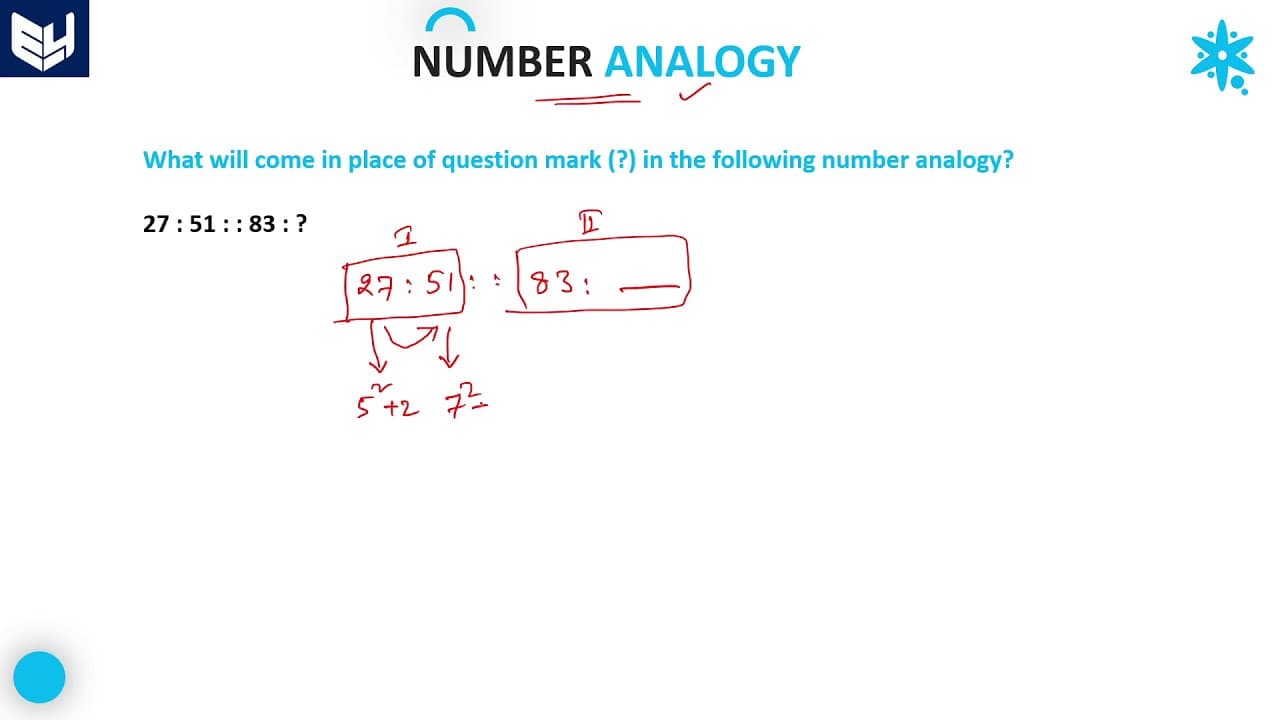
Q: Can you explain the logic behind the first number analogy example using 27 and 51?
In the first example, 27 is equivalent to 5 squared plus 2, and 51 is 7 squared plus 2. This pattern indicates that the underlying logic involves consecutive odd numbers. By applying this logic further, you find that for 83, it would be 9 squared plus 2. Following the same sequence, the next number should be 11 squared plus 2, resulting in 123.
Q: How does the analogy involving the numbers 25, 37, and 49 work?
The numbers 25 and 49 are perfect squares, specifically 5 squared and 7 squared. For 37, it is identified as being close to 6 squared plus 1. By continuing the pattern with squares, it leads to 8 squared plus 1. When calculated, this gives you 65, which is the missing number in the analogy.
Q: What is the logic applied to the third group of numbers: 9, 80, and 100?
In this example, the first number (9) aligns with the logic of n and n squared minus 1, where 9 is n and 80 is 9 squared minus 1. For the missing number, substituting 100 into n produces 100 squared minus 1, which calculates to 9999. This demonstrates the consistent logic of operating within the n squared framework.
Summary & Key Takeaways
-
The session focuses on the concept of number analogy, emphasizing its importance in competitive exams like banking and UPSC.
-
Several examples illustrate how to derive missing numbers in analogies by recognizing underlying mathematical patterns and using logic.
-
The speaker encourages viewers to build confidence with number series to easily solve number analogy problems.
Read in Other Languages (beta)
Share This Summary 📚
Summarize YouTube Videos and Get Video Transcripts with 1-Click
Try YouTube Summary with ChatGPT & Claude or YouTube Transcript Generator