Nanotechnology Targeting for Cancer | Goeun Kim, Jeongyun Lim & Jiho Yu | TEDxYouth@IJSHS
TL;DR
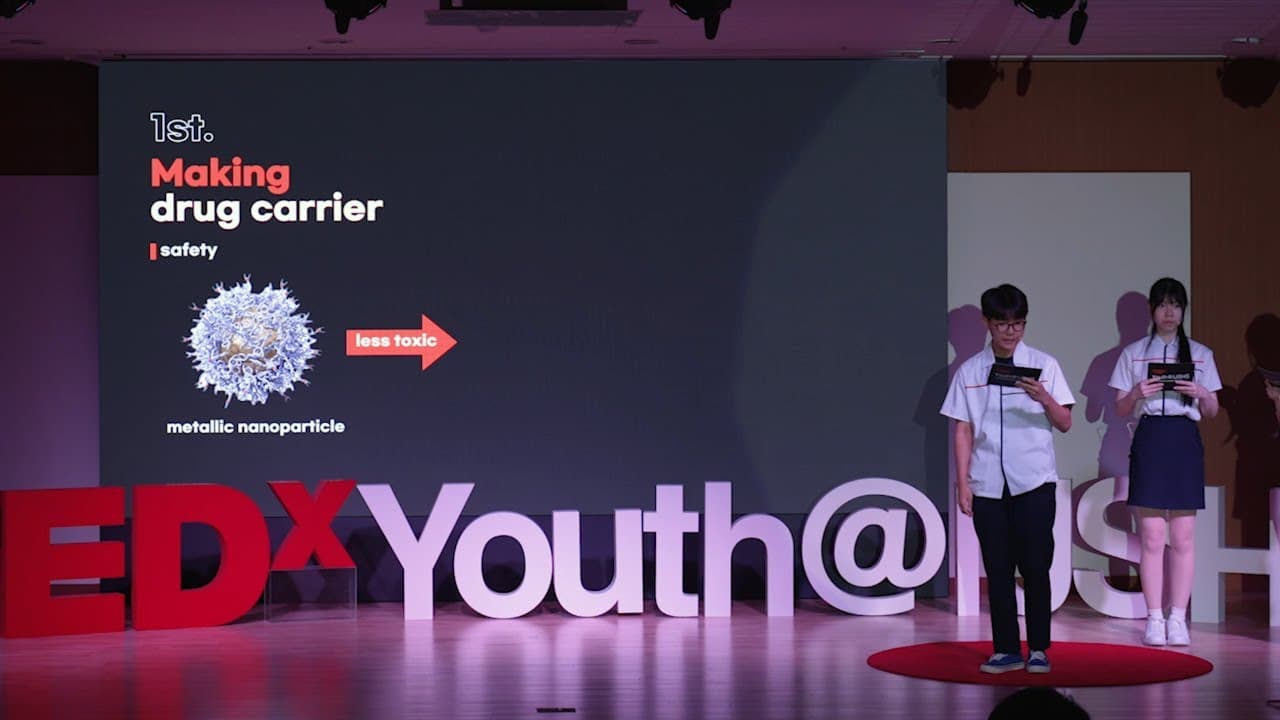
Nanotechnology offers a potential solution for improving cancer treatments by delivering anti-cancer agents directly to cancer cells, minimizing side effects and maximizing efficacy.
Transcript
good evening everyone today we are going to talk about nanotechnologies in cancer treatments there are many diseases that greater modern people but what is the illness that comes up to me number one among them cancer accounts for 30 percent of deaths in the current generation and the number of a number of patients is steadily increasing year by yea... Read More
Key Insights
- 🧑⚕️ Cancer is a major global health concern, accounting for a significant number of deaths.
- ♋ Anti-cancer chemotherapy often leads to side effects due to its limited targeting of cancer cells.
- ♋ Nanoparticles can serve as drug carriers to precisely deliver anti-cancer agents to cancer cells, minimizing side effects.
- 😥 pH-sensitive nanoparticles can prevent drug leakage from cancer cells, enhancing the efficacy of treatment.
- ♋ Nanotechnology in cancer treatment has the potential to revolutionize diagnosis, treatment, and improve overall patient outcomes.
- 👨🔬 Future research goals include reducing toxicity, preventing drug leakage, and exploring alternative substances for drug release.
Install to Summarize YouTube Videos and Get Transcripts
Explore YouTube Video Summarizer or Get YouTube Transcript Extractor
Questions & Answers
Q: What are the three main topics for treating cancer?
The three main topics for treating cancer are surgery, anti-cancer chemotherapy, and radiotherapy. Nanotechnology in cancer treatment is an emerging field that shows promise in improving treatment outcomes.
Q: How does cancer nanotherapy work?
Cancer nanotherapy utilizes nanoscale drug delivery systems to inhibit or kill cancer cells. These systems target cancer cells by exploiting their rapid growth and division, while minimizing side effects on normal cells.
Q: Why are metal nanoparticles preferred for drug delivery in cancer treatment?
Metal nanoparticles, such as gold nanoparticles, offer distinct advantages in anti-cancer therapy. They exhibit excellent activity capabilities and can be used as drug carriers due to their biocompatibility and ability to maintain their original state within cancer cells.
Q: How can drug leakage from cancer cells be prevented?
pH-sensitive nanoparticles can be used to prevent drug leakage from cancer cells. These nanoparticles maintain their original state inside the cells, ensuring that the drug is released only when it reaches its target.
Summary & Key Takeaways
-
Cancer is the leading cause of death, accounting for 30% of deaths in the current generation, with the number of patients steadily increasing.
-
Current cancer treatments include surgery, chemotherapy, radiotherapy, and the emerging field of cancer nanotechnology.
-
Nanoparticles are being developed as drug carriers that can precisely deliver anti-cancer agents to cancer cells, mitigating the issues associated with conventional chemotherapy.
Read in Other Languages (beta)
Share This Summary 📚
Summarize YouTube Videos and Get Video Transcripts with 1-Click
Try YouTube Summary with ChatGPT & Claude or YouTube Transcript Generator
Explore More Summaries from TEDx Talks 📚




Summarize YouTube Videos and Get Video Transcripts with 1-Click
Try YouTube Summary with ChatGPT & Claude or YouTube Transcript Generator