Differential equation in the form of G(ax+by), intro and example
TL;DR
Learn how to solve a special form differential equation by using substitution, with step-by-step examples.
Transcript
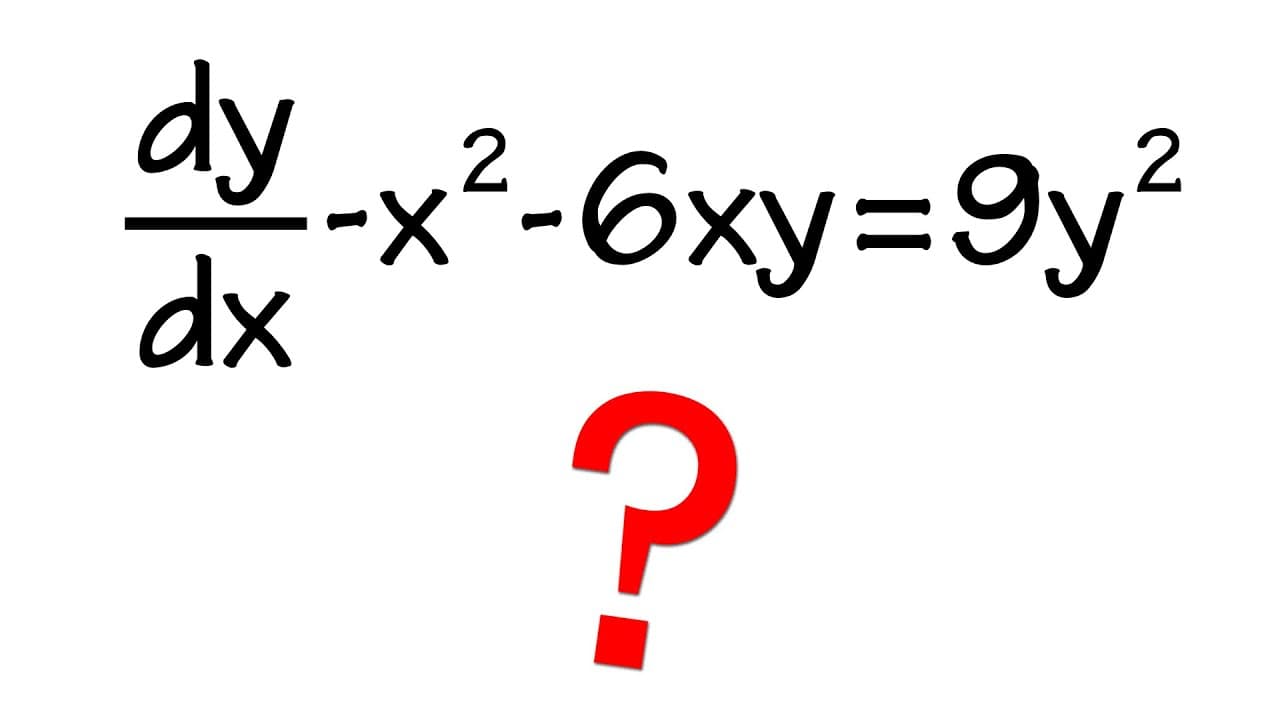
I'm going to talk about another special form differential equation and we're still going to use the substitution to solve if the equation in the form dy/dx is equal to G as a function of ax plus B Y if this is a situation that we have we are going to let C as our new variable to be a XS dy that's being put right here and here are the examples to de... Read More
Key Insights
- 🇳🇨 The process of solving a special form differential equation involves isolating dy/dx, substituting a new variable (usually denoted as C), differentiating both sides, and integrating the equation.
- 💦 Substitution makes the equation easier to work with by transforming it into a simpler form.
- ❓ Integration is used to find the solution, often involving integration techniques for functions like the tangent function.
- 😀 The final solution includes a constant (C) that can be determined by the initial conditions of the problem.
Install to Summarize YouTube Videos and Get Transcripts
Explore YouTube Video Summarizer or Get YouTube Transcript Extractor
Questions & Answers
Q: How do you solve a differential equation in the form dy/dx = G(ax + By)?
To solve this type of differential equation, you first isolate dy/dx and then substitute a new variable. By differentiating and integrating, you can find the solution.
Q: What is the purpose of the substitution in solving the differential equation?
The substitution allows us to transform the equation into a different form that is easier to work with. It simplifies the process of finding the solution.
Q: How do you integrate the equation after substituting the new variable?
After substituting the new variable, you integrate both sides of the equation. This involves using integration techniques for functions like the tangent function.
Q: What is the final solution to the differential equation?
The final solution is given as Y = 1/(3√3) * tan(√3x + C) - x/3, where C is a constant determined by the initial conditions.
Summary & Key Takeaways
-
This content explains how to solve a differential equation in the form dy/dx = G(ax + By) using substitution.
-
The process involves isolating dy/dx, substituting a new variable, differentiating both sides, and integrating to find the solution.
-
The final solution is given as Y = 1/(3√3) * tan(√3x + C) - x/3.
Read in Other Languages (beta)
Share This Summary 📚
Summarize YouTube Videos and Get Video Transcripts with 1-Click
Try YouTube Summary with ChatGPT & Claude or YouTube Transcript Generator
Explore More Summaries from blackpenredpen 📚
Summarize YouTube Videos and Get Video Transcripts with 1-Click
Try YouTube Summary with ChatGPT & Claude or YouTube Transcript Generator