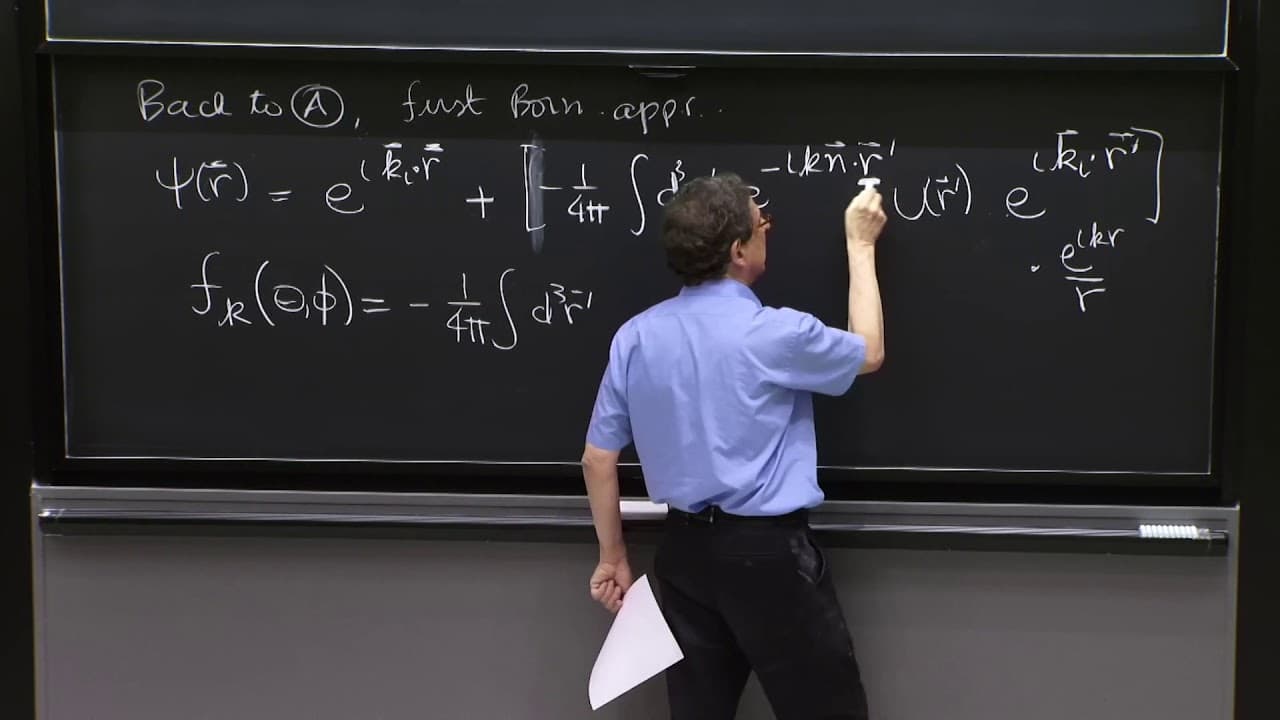
L22.2 First Born Approximation. Calculation of the scattering amplitude
TL;DR
The first Born approximation is a high-energy approximation used to simplify calculations in quantum scattering, and the scattering amplitude can be calculated using a Fourier transform of the potential.
Transcript
PROFESSOR: What are we going to do? We're going to explore only the first Born approximation. And the first Born approximation corresponds to just taking this part. So this would be the first Born approximation. It corresponds to what we were doing here. What did we do here? Well, we're simplifying the second term, the integral term, by using what ... Read More
Key Insights
- 👋 The first Born approximation simplifies quantum scattering calculations by replacing the wave function inside the integral.
- 🥶 The Born approximation is valid when the free part of the wave function dominates over the perturbation.
- ❓ The scattering amplitude can be calculated using a Fourier transform of the potential evaluated at the transfer momentum.
- ✋ The Born approximation is a high-energy approximation and is better in high-energy scenarios.
- ❓ The formula for the scattering amplitude demonstrates the importance of the transfer momentum and its relationship with the incident and scattered momenta.
- 🐬 The formula also highlights the dependence of the scattering amplitude on the angles theta and phi.
- 👻 Although an approximation, the Born approximation allows for calculations in cases where the potential is not spherically symmetric.
Install to Summarize YouTube Videos and Get Transcripts
Explore YouTube Video Summarizer or Get YouTube Transcript Extractor
Questions & Answers
Q: What is the first Born approximation in quantum scattering calculations?
The first Born approximation simplifies calculations by replacing the wave function inside the integral term with the incident wave. It is valid when the free part of the wave function dominates over the perturbation.
Q: When can the Born approximation be considered a good approximation?
The Born approximation is a good approximation when the scattering center has a finite-energy bump and high-energy particles are being sent. In this case, the plane-incident wave dominates over the scattering process.
Q: How can the scattering amplitude be calculated using the Fourier transform?
The scattering amplitude can be calculated as a Fourier transform of the potential evaluated at the transfer momentum. The transfer momentum is the vector that takes you from the initial momentum to the scattered momentum.
Q: What are the advantages of using the first Born approximation?
The first Born approximation provides a physical interpretation in terms of a Fourier transform of the potential and allows for calculations even when the potential is not spherically symmetric.
Summary & Key Takeaways
-
The first Born approximation simplifies the integral term in quantum scattering calculations by replacing the wave function inside the integral with the incident wave.
-
The Born approximation is valid when the free part of the wave function dominates over the perturbation.
-
The scattering amplitude can be calculated using a Fourier transform of the potential evaluated at the transfer momentum.
Read in Other Languages (beta)
Share This Summary 📚
Summarize YouTube Videos and Get Video Transcripts with 1-Click
Try YouTube Summary with ChatGPT & Claude or YouTube Transcript Generator
Explore More Summaries from MIT OpenCourseWare 📚


Summarize YouTube Videos and Get Video Transcripts with 1-Click
Try YouTube Summary with ChatGPT & Claude or YouTube Transcript Generator