Can Computers Ever Achieve Consciousness?
TL;DR
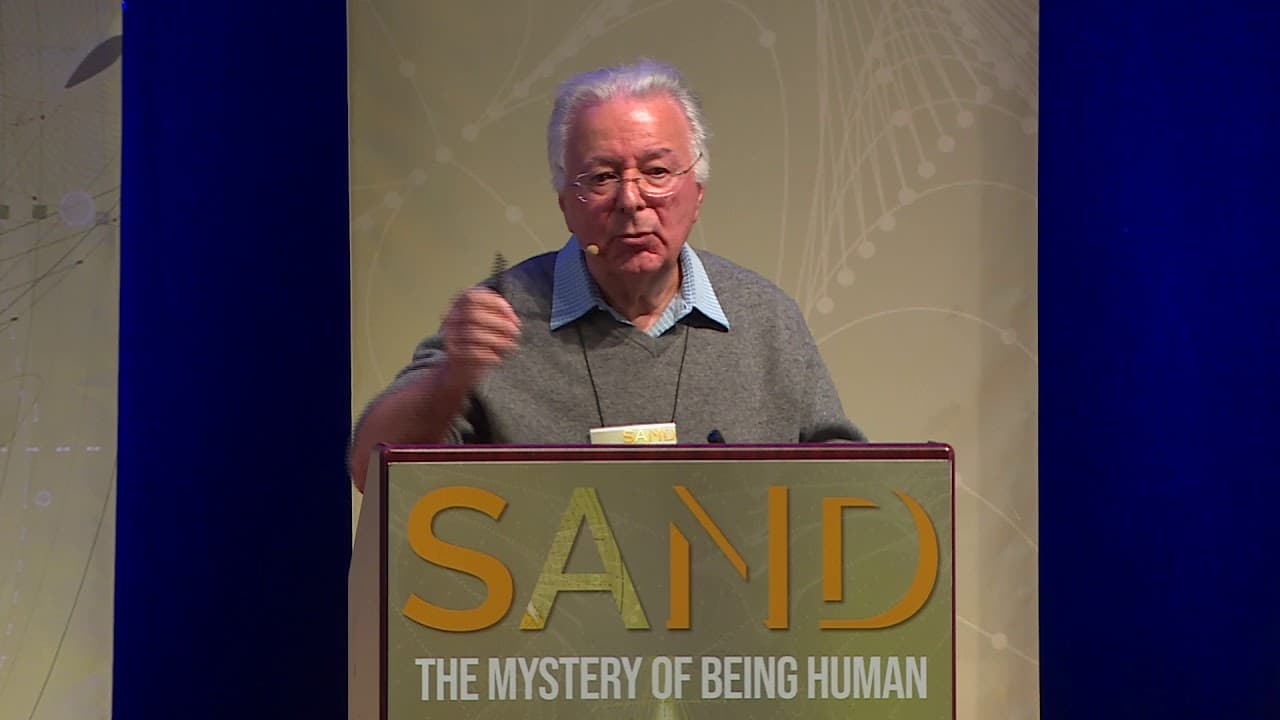
Computers cannot become conscious, as they operate on abstract symbols devoid of meaning, unlike human consciousness. Federico Faggin posits that consciousness is essential for true understanding, which AI fundamentally lacks, highlighting the need for a new conceptual framework that integrates consciousness with the nature of reality.
Transcript
I want to talk about the fundamental differences between human and artificial intelligence is a topic that is playing a lot today and of course is a such a vast topic that I can only cover one key in fundamental difference what I consider the crucial difference see I was told it is the clicker but I don't see where the clicker is so then th... Read More
Key Insights
- Federico Faggin argues that consciousness is essential for true understanding, which AI lacks, making AI fundamentally different from human intelligence.
- AI's impressive achievements in games like chess and Go do not equate to consciousness, which remains a uniquely human trait.
- Consciousness provides meaning to existence, a quality that abstract information, like that used in AI, cannot possess.
- Faggin suggests a model where quantum fields possess both inner and outer realities, reflecting the dual nature of consciousness and symbolic information.
- In this model, conscious fields have unique identities, free will, and the capacity for action, distinguishing them from AI's abstract symbols.
- The framework posits that living symbols, unlike abstract symbols, are indivisible from their meaning, emphasizing the integration of consciousness and physical reality.
- AI and computers, though made of conscious matter, cannot achieve consciousness due to their reliance on abstract symbols defined by human conventions.
- The current scientific worldview, focusing on material rather than spiritual growth, limits understanding of consciousness and the mysteries of existence.
Install to Summarize YouTube Videos and Get Transcripts
Explore YouTube Video Summarizer or Get YouTube Transcript Extractor
Questions & Answers
Q: What is the main difference between human and artificial intelligence according to Federico Faggin?
Federico Faggin highlights consciousness as the main difference between human and artificial intelligence. While AI can perform impressive tasks and mimic intelligent behavior, it lacks the conscious understanding that humans possess. Consciousness provides meaning and context to information, which AI's abstract symbols cannot achieve, making AI fundamentally different from human intelligence.
Q: Why does Faggin believe AI cannot achieve consciousness?
Faggin believes AI cannot achieve consciousness because it relies on abstract symbols defined by human conventions, which lack inherent meaning. Consciousness, according to Faggin, is an irreducible property of physical reality, intertwined with meaning and understanding. AI's current framework, based on abstract information, cannot replicate the complex, integrated nature of conscious experience.
Q: How does Faggin's model describe the nature of consciousness?
Faggin's model describes consciousness as arising from quantum fields that possess both inner and outer realities. These conscious fields have unique identities, free will, and the capacity for action, reflecting the dual nature of consciousness and symbolic information. This model suggests that consciousness is an integral part of physical reality, challenging the current scientific view that overlooks its significance.
Q: What role does meaning play in Faggin's argument about consciousness?
Meaning plays a crucial role in Faggin's argument as he asserts that consciousness is necessary for true understanding and meaning. Abstract information, like that used in AI, lacks inherent meaning and cannot provide the context and understanding that consciousness offers. Faggin emphasizes that consciousness imbues existence with meaning, which is absent in the abstract symbols used by AI.
Q: What critique does Faggin offer about the current scientific worldview?
Faggin critiques the current scientific worldview for reducing reality to abstract information and overlooking the role of consciousness. He argues that this perspective limits understanding by focusing on material rather than spiritual growth, neglecting the mysteries of consciousness and existence. Faggin calls for a new framework that integrates consciousness as a fundamental aspect of reality.
Q: How does Faggin's model challenge traditional views of quantum fields?
Faggin's model challenges traditional views by suggesting that quantum fields are conscious entities with both inner and outer realities. This contrasts with the conventional view of quantum fields as abstract information. Faggin proposes that these fields are integral to consciousness, possessing unique identities and free will, which are absent in the traditional understanding of quantum mechanics.
Q: What is the significance of 'living symbols' in Faggin's framework?
In Faggin's framework, 'living symbols' are significant because they are indivisible from their meaning, unlike abstract symbols used in AI. These symbols represent the integration of consciousness and physical reality, emphasizing the dynamic, open nature of conscious experience. Faggin argues that recognizing this integration is essential for understanding the true nature of consciousness and existence.
Q: How does Faggin propose to bridge the gap between science and spirituality?
Faggin proposes bridging the gap between science and spirituality by recognizing consciousness as an integral part of reality. He suggests that current scientific perspectives, which focus on abstract information, overlook the role of consciousness. By integrating consciousness into scientific understanding, Faggin believes we can forge a new framework that acknowledges the mysteries of life and the interconnectedness of existence.
Summary & Key Takeaways
-
Federico Faggin explores the fundamental differences between human and artificial intelligence, focusing on consciousness as a key aspect. He argues that AI, despite its capabilities, lacks consciousness, which is essential for true understanding and meaning. This distinction challenges current scientific perspectives on life, consciousness, and reality.
-
Faggin introduces a model where quantum fields possess both inner and outer realities, reflecting the dual nature of consciousness and symbolic information. He suggests that conscious fields have unique identities, free will, and the capacity for action, which distinguishes them from AI's abstract symbols, emphasizing the need for a new framework to understand reality.
-
The presentation critiques the physicalist worldview that reduces reality to abstract information, arguing that this perspective overlooks the essential role of consciousness. Faggin proposes that a shift towards recognizing consciousness as an integral part of reality could bridge the gap between science and spirituality, offering a deeper understanding of existence.
Read in Other Languages (beta)
Share This Summary 📚
Summarize YouTube Videos and Get Video Transcripts with 1-Click
Try YouTube Summary with ChatGPT & Claude or YouTube Transcript Generator
Explore More Summaries from Science and Nonduality 📚
Summarize YouTube Videos and Get Video Transcripts with 1-Click
Try YouTube Summary with ChatGPT & Claude or YouTube Transcript Generator