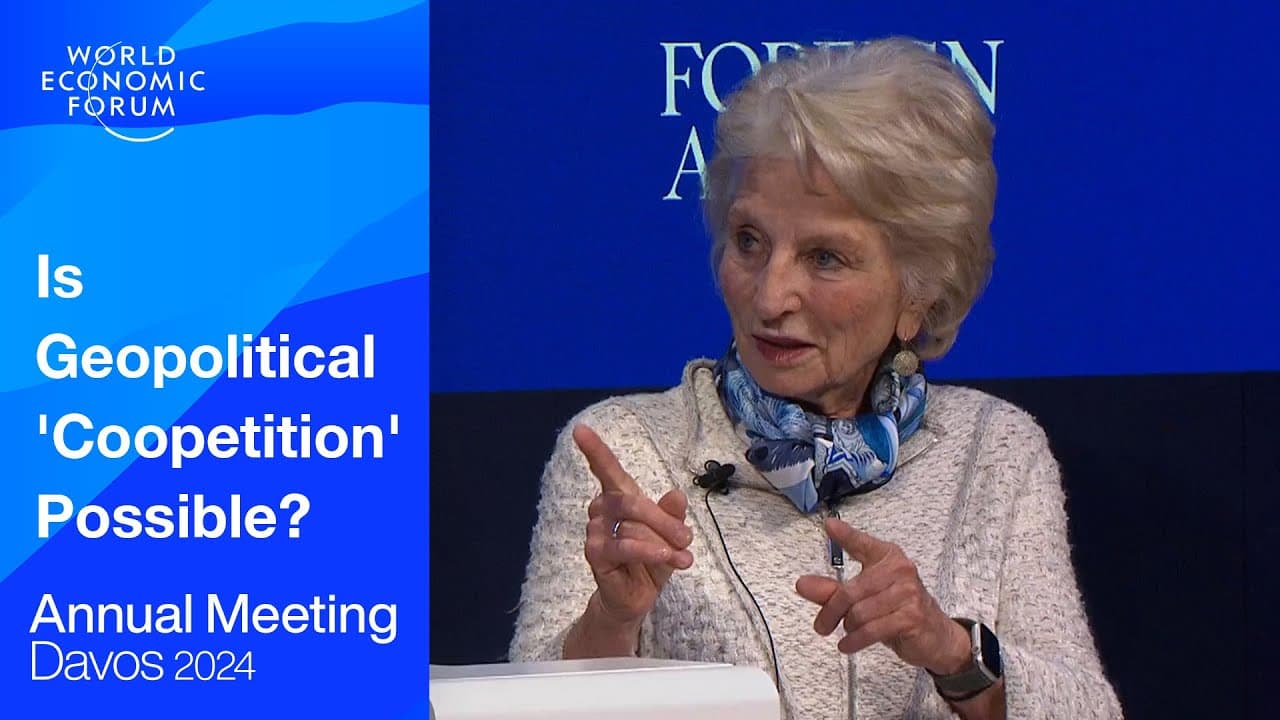
Is Geopolitical 'Coopetition' Possible? | Davos 2024 | World Economic Forum
TL;DR
Coopetition refers to the combination of cooperation and competition in geopolitics, presenting challenges and opportunities in maintaining trust and addressing shared challenges in a competitive world.
Transcript
all right good morning everyone nice to um see everyone still going strong on this final morning uh I'm Dan criten I'm the editor of Foreign Affairs magazine it is my immense pleasure to be on stage with these four speakers um I confess that the term Coop petition was new to me before I got this assignment and I spent probably too much time going d... Read More
Key Insights
- 🇨🇫 Coopetition, the combination of cooperation and competition, is a central tension in geopolitics and foreign policy.
- 👨💼 Ensuring predictability in rules and regulations is crucial for businesses to navigate complex international markets.
- 🥺 Cooperation in the clean tech industry can drive sustainability and innovation, while competition can lead to fragmentation and limited returns on investment.
- 😋 Balancing cooperation and competition is essential for addressing shared challenges, such as climate change, food security, and geopolitical conflicts.
- 🌍 Trust and transparency between governments and private sector leaders are vital for effective cooperation in a competitive world.
- 🌐 Geopolitical shifts, such as elections and changes in government policies, can affect global cooperation and competition dynamics.
Install to Summarize YouTube Videos and Get Transcripts
Explore YouTube Video Summarizer or Get YouTube Transcript Extractor
Questions & Answers
Q: How can countries like Japan and South Korea prepare for contingencies in the face of growing tensions with China and potential conflicts with North Korea?
Taku Yama Nami urges countries to prioritize predictability through clear rules, intelligence upgrades to keep track of changing dynamics, and scenario preparation in case of emergencies. Cooperation with governments and peers is crucial for preparedness.
Q: How can cooperation in the clean tech industry be enhanced to address global challenges and reduce competition?
Matthias Mitter highlights the need for global standards and regulations that reward collaboration between companies in the clean tech industry. A focus on reducing CO2 emissions and promoting local supply chains can also contribute to environmental sustainability.
Q: What lessons have been learned from the European approach to Russia, and how can countries prevent overreliance on certain markets or suppliers?
Maros Sefcovic acknowledges the need to be cautious about dependencies and stresses the importance of diversification in supply chains and strategic autonomy. Europe aims to prioritize sustainability and reduce reliance on Russian fossil fuel supplies.
Q: How can the US and Europe balance competition and cooperation when it comes to the China challenge?
Jane Harman highlights the need for a broader lens in US policy, focusing on not just China but also North Korea, Iran, and Russia. She emphasizes the importance of close alliances with countries like Japan and South Korea and promoting transatlantic cooperation to address shared challenges.
Summary & Key Takeaways
-
Coopetition is a concept that highlights the need for cooperation and competition in geopolitics, which poses significant challenges in maintaining trust and addressing shared challenges.
-
Japan's CEO of Centaur Holdings, Taku Yama Nami, emphasizes the importance of predictability, intelligence upgrades, and scenario preparation when dealing with countries like China and Taiwan.
-
Jane Harman, former U.S. Congress member, discusses the changing dynamics of trade politics, the decline of pro-trade majorities, and the need for transatlantic cooperation to set global trade standards.
-
Maros Sefcovic, European Commission Vice President, emphasizes the importance of building bridges and synergizing efforts to achieve common goals in the green transition, emphasizing predictability in regulations and policies.
-
Matthias Mitter, CEO of Yor, explains how the fragmentation and competition in the clean energy industry can have both positive and negative impacts, such as reducing competition and driving innovation, but also decreasing return on capital and limiting global cooperation.
Read in Other Languages (beta)
Share This Summary 📚
Summarize YouTube Videos and Get Video Transcripts with 1-Click
Try YouTube Summary with ChatGPT & Claude or YouTube Transcript Generator
Explore More Summaries from World Economic Forum 📚

Summarize YouTube Videos and Get Video Transcripts with 1-Click
Try YouTube Summary with ChatGPT & Claude or YouTube Transcript Generator