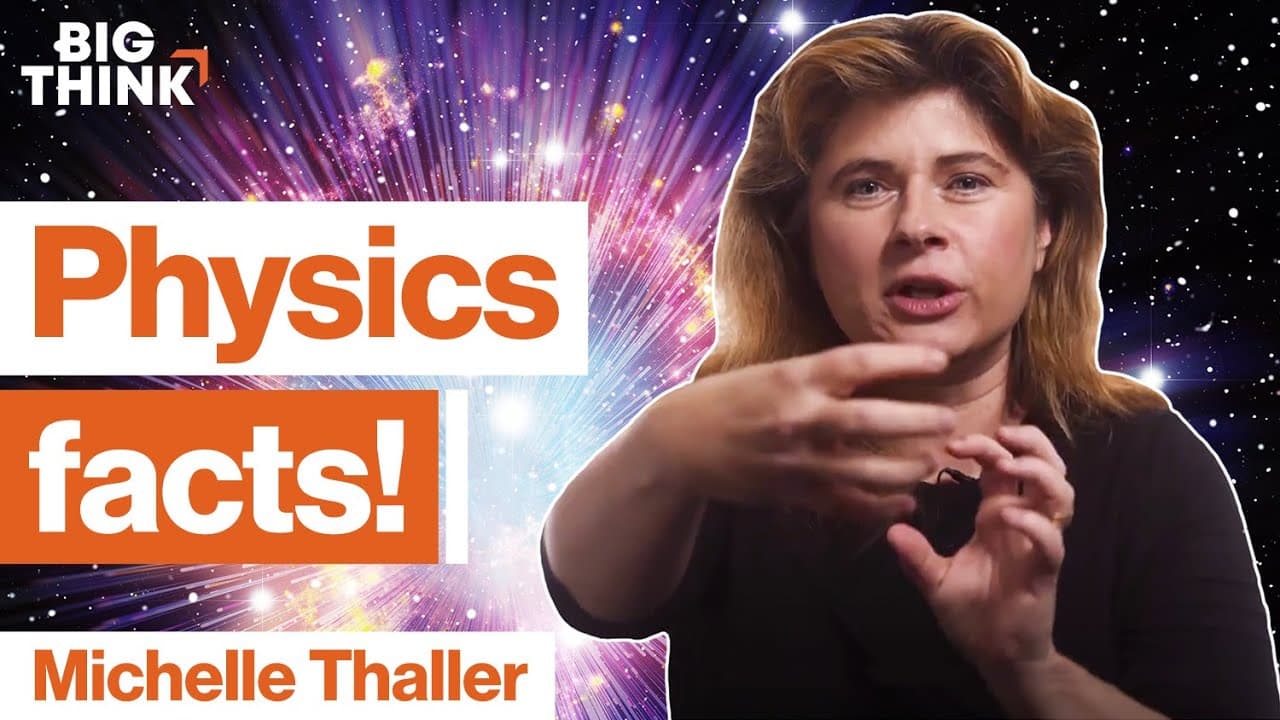
3 wonders of the universe, explained | Michelle Thaller | Big Think
TL;DR
Atoms are not composed of electrons moving in orbits, but rather exist as waves in volumes around the nucleus. The Big Bang was an expansion of space itself, not an explosion of matter. The speed of light is special because time and space slow down as an object approaches it.
Transcript
TEXT: This is NOT what an atom really looks like. MICHELLE THALLER: Calling what an electron is and where it is around an atom an ""orbit"" is actually very misleading. In truth electrons don't move around a nucleus the same way that planets move around a star at all. It's very, very different and part of that has to do with what an electron really... Read More
Key Insights
- 👋 Electrons do not orbit atoms but exist as waves in volumes around the nucleus.
- 😥 The Big Bang was an expansion of space itself, not an explosion of matter from a central point.
- 🙂 The speed of light is special because time and space slow down as an object approaches it.
- 💆 Mass is a measurement of energy, and as an object gets closer to the speed of light, its mass appears to increase due to the inclusion of kinetic energy.
- ❓ There is no empty center to the universe, and galaxies are spread throughout the observable universe.
- 🫀 Atoms are far more complex and mysterious than artistic depictions suggest.
- 🦾 The behavior of electrons in atom orbitals is a subject of study in quantum mechanics.
Install to Summarize YouTube Videos and Get Transcripts
Explore YouTube Video Summarizer or Get YouTube Transcript Extractor
Questions & Answers
Q: How do electrons behave around an atom?
Electrons do not move in orbits around the nucleus like planets. Instead, they exist as waves and fill volumes called orbitals. These orbitals have different shapes and can even extend through the nucleus.
Q: What did the Big Bang actually involve?
The Big Bang was not an explosion of matter from a central point. It was an expansion of space itself, happening at every point simultaneously. There is no empty center to the universe, and galaxies are spread throughout the observable universe.
Q: Why can't anything with mass reach the speed of light?
As an object gets closer to the speed of light, its mass increases due to the inclusion of kinetic energy. This increase in mass is observed by outside observers but not by the object itself. Time slows down and space contracts as an object approaches the speed of light.
Q: Does mass really equal energy?
According to Einstein's equation, E = mc^2, energy and mass are equivalent. Mass is a measurement of the energy an object contains, including the energy of its motion. As objects approach the speed of light, their mass appears to increase due to the addition of kinetic energy.
Summary & Key Takeaways
-
Electrons do not orbit atoms like planets around a star. Instead, they exist as waves in volumes around the nucleus, filling in different shapes such as spheres or dumbbells.
-
The Big Bang was not an explosion of matter; it was an expansion of space itself. There is no empty center to the universe, and galaxies are not flying away from a common center.
-
The speed of light is unique because as an object approaches it, time slows down and space contracts. Mass increases as an object gets closer to the speed of light due to the inclusion of kinetic energy.
Read in Other Languages (beta)
Share This Summary 📚
Summarize YouTube Videos and Get Video Transcripts with 1-Click
Try YouTube Summary with ChatGPT & Claude or YouTube Transcript Generator
Explore More Summaries from Big Think 📚




Summarize YouTube Videos and Get Video Transcripts with 1-Click
Try YouTube Summary with ChatGPT & Claude or YouTube Transcript Generator