Ep. 11: Summary
TL;DR
This content explores the process of how chemical elements are formed in the universe and their contribution to the chemical evolution of the cosmos.
Transcript
Have you ever wondered how all the chemical elements are made? Then join me as we are lifting all the star dust secrets to understand the cosmic origin of the chemical elements. We have come to the end of our little journey where we wanted to explore the origin of the chemical elements. I hope you enjoyed it and I hope I could help you to understan... Read More
Key Insights
- 🤩 Chemical elements are formed through fusion and neutron-capture processes in stars, supernovae, and neutron star mergers.
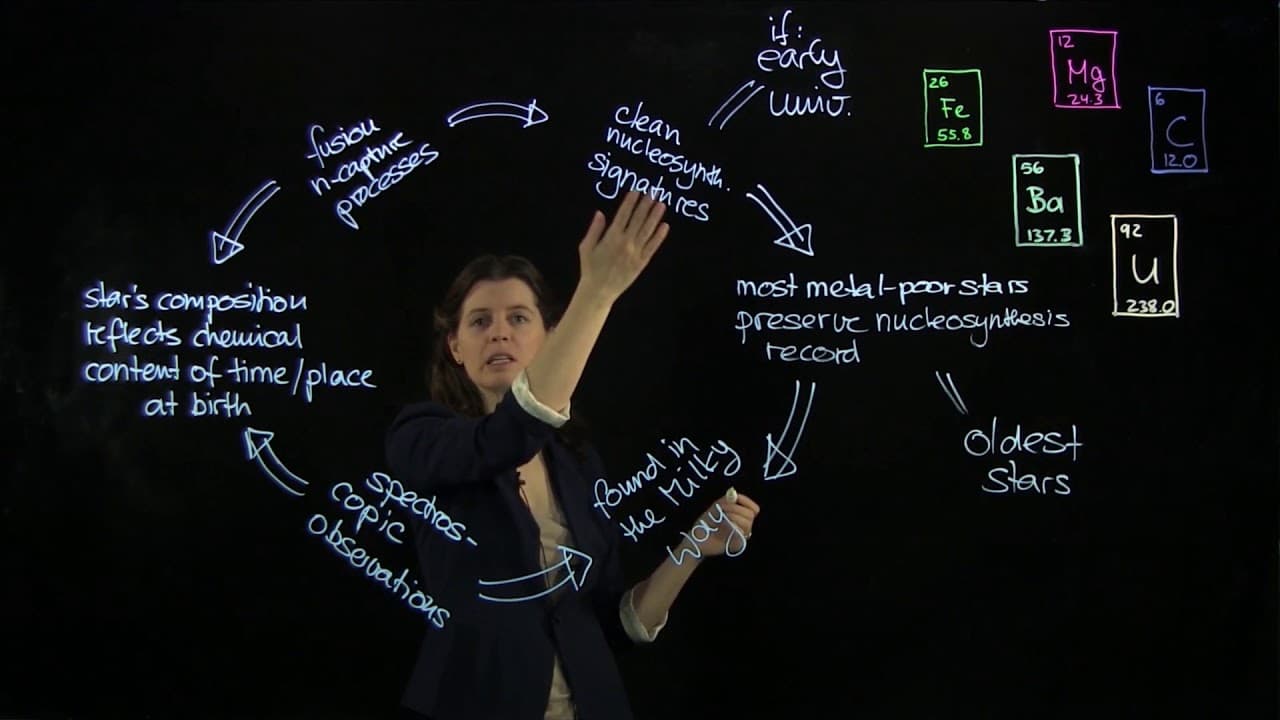
- 🤩 Observing the oldest stars provides insights into the chemical composition of the early universe.
- 🌥️ Spectroscopic observations using large telescopes help analyze the composition of elements across the periodic table.
- 💱 The universe's chemical composition continuously changes through ongoing stellar processes.
Install to Summarize YouTube Videos and Get Transcripts
Explore YouTube Video Summarizer or Get YouTube Transcript Extractor
Questions & Answers
Q: How are chemical elements created in the universe?
Chemical elements are created through fusion and neutron-capture processes that occur in the cores of stars, as well as in supernovae and neutron star mergers. These processes involve the fusion or capturing of atomic nuclei to form heavier elements.
Q: Where can we observe the clean signatures of the oldest stars?
The oldest stars, which contain elements produced in the early universe, can be observed in the Milky Way. These stars offer clean signatures of the chemical composition of the early universe.
Q: How do scientists determine the composition of stars and elements?
Scientists use spectroscopic observations with the help of large telescopes to analyze the composition of different elements across the periodic table. By measuring tiny absorption lines, they can determine the chemical composition of stars and elements.
Q: Why is carbon considered the most important element in the universe?
Carbon is crucial for the formation of stars, galaxies, planets, and life. It played a fundamental role in the early universe by aiding in the formation of gas and enabling the formation of structures necessary for the creation of stars and ultimately life.
Summary & Key Takeaways
-
Chemical elements are created through fusion and neutron-capture processes in the cores of stars, supernovae, and neutron star mergers.
-
These elements can be observed in the oldest stars, offering clean signatures of their origin.
-
Spectroscopic observations using large telescopes help determine the composition of different elements across the periodic table and understand how their abundance has changed over time.
Read in Other Languages (beta)
Share This Summary 📚
Summarize YouTube Videos and Get Video Transcripts with 1-Click
Try YouTube Summary with ChatGPT & Claude or YouTube Transcript Generator
Explore More Summaries from MIT OpenCourseWare 📚



Summarize YouTube Videos and Get Video Transcripts with 1-Click
Try YouTube Summary with ChatGPT & Claude or YouTube Transcript Generator