PROM | Logic Diagram | Example problem | STLD | Lec-110
TL;DR
This video explains the fundamental concepts of Programmable Read-Only Memory (PROM) and its functionalities.
Transcript
hi everyone in this video I'm going to explain about programmable readon memory pom so prom stands for programmable read only memory programable read only memory so programable readon memory it's a type of programable logic device okay there are three types of programable logic devices programable array logic programable logic array and the third o... Read More
Key Insights
- ⛔ PROM is a fixed logic structure that limits reconfiguration, unlike other types of programmable logic devices.
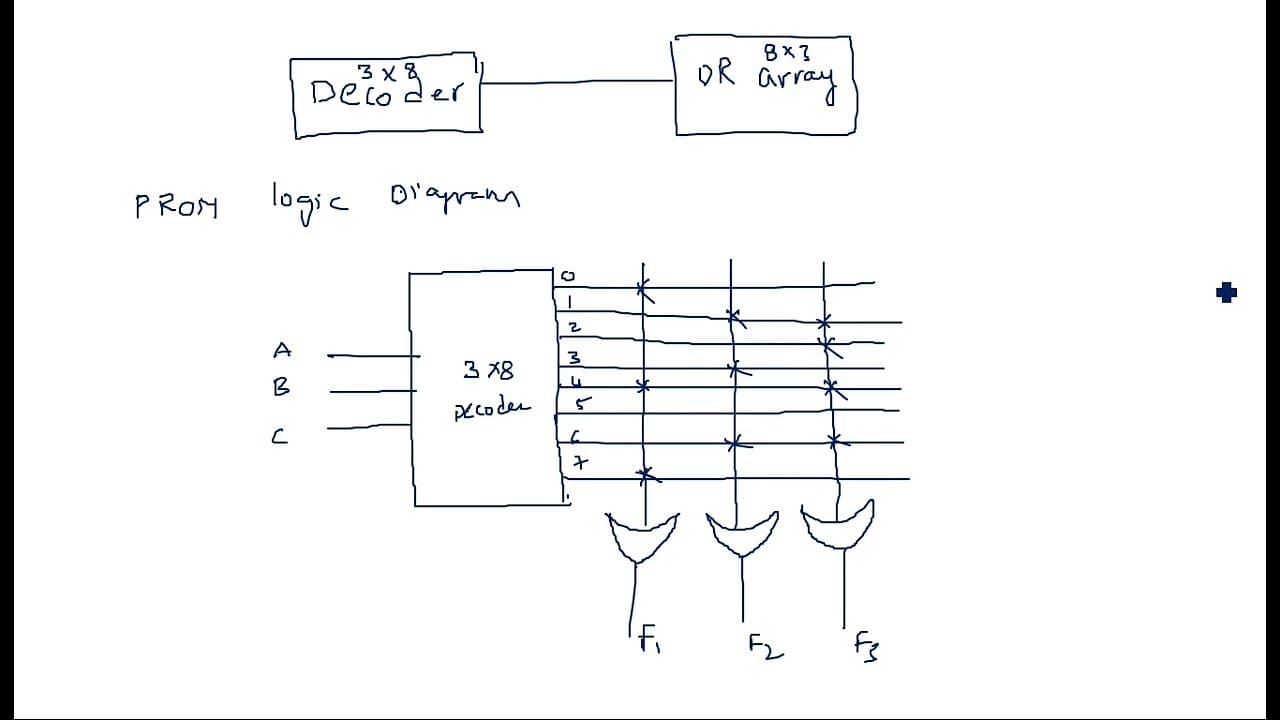
- ❓ The architecture of PROM consists of a decoder followed by a programmable OR array for conducting logical operations.
- 🔠 The size notation (e.g., 8x3) is crucial for understanding the relationship between input and output configurations in PROM.
- 🪡 The output of the decoder directly impacts how many OR gates are needed for function realization.
- 🔢 A systematic approach to identifying max numbers in function definitions helps discern input sizes that align with the PROM's capabilities.
- 🎨 The design process for PROM is simpler than for PLAs or PALs, due to fewer variables involved once the decoder size is established.
- 🔬 Understanding the functionality of AND and OR gates within PROM can significantly enhance the efficacy of implementing complex logic operations.
Install to Summarize YouTube Videos and Get Transcripts
Explore YouTube Video Summarizer or Get YouTube Transcript Extractor
Questions & Answers
Q: What is PROM and how does it differ from other programmable logic devices?
PROM stands for Programmable Read-Only Memory and is a type of programmable logic device that consists of fixed logic elements, unlike PLAs or PALs, which allow reconfiguration. PROM has a permanent AND array and a programmable OR array for logic function realization, making it less flexible than other programmable logic devices but simpler in design.
Q: How are the input and output sizes of a PROM determined?
The input and output sizes of a PROM can be determined by the notation such as 8x3, where "8" represents the number of outputs from the decoder, and "3" indicates the number of inputs. This follows the relationship that if there are 8 outputs, then 3 inputs (as 2^3 = 8) are necessary to generate them.
Q: Can you explain the role of the decoder in a PROM's structure?
The decoder in a PROM serves as the first stage that produces specific output lines based on the given input combinations. It effectively translates binary input signals into unique outputs, which are then utilized by subsequent stages in the logic function realization process. The decoder's output directly influences the operation of the programmable OR gate stage.
Q: How does one realize functions using a PROM?
Functions are realized in a PROM by first identifying the decoder’s size based on the specified outputs, then determining the necessary product terms corresponding to the input combinations. These product terms guide the configuration of the programmable OR gates, allowing specific logical functions to be constructed as per the required specifications.
Summary & Key Takeaways
-
Programmable Read-Only Memory (PROM) is a type of programmable logic device that consists of a fixed AND array and a programmable OR array.
-
The video outlines the structure of PROM, including its decoder, which generates corresponding output based on given inputs and how the output size indicates the number of input lines.
-
Various examples illustrate how to realize functions using PROM, emphasizing the importance of identifying the size of the decoder and its corresponding output configuration.
Read in Other Languages (beta)
Share This Summary 📚
Summarize YouTube Videos and Get Video Transcripts with 1-Click
Try YouTube Summary with ChatGPT & Claude or YouTube Transcript Generator