Radar System Losses | Antenna | Part-1/2 | Radar Systems | Lec-14
TL;DR
This video details various losses affecting radar system measurements.
Transcript
hi everyone in this video I am going to explain about various losses encountered in the measurement of radar range or any type of parameter so known as system losses system classes system losses you are nothing but radar system losses so the losses in the radar system are known as system losses I is indicated by LS system law or SL they have severa... Read More
Key Insights
- 🧑🏭 Radar system losses can derive from both internal and external factors affecting measurement accuracy and reliability.
- 📶 Microwave plumbing losses can significantly impact signal strength during the transmission process, emphasizing the need for precise component design.
- 🌸 Antenna losses, including beam shape and scanning losses, can lead to missed detections or misclassification of targets in radar systems.
- 🧑🏭 Operator fatigue can have a tangible impact on radar performance, demonstrating the importance of human factors in technical operations.
- 🌸 The radom serves a dual purpose, providing protection for radar equipment while also introducing losses that must be accounted for in system designs.
- 📡 Phased array antennas enhance flexibility in radar applications, allowing for rapid reorientation of signal focus without mechanical movements.
- 🧑💼 Challenges with phased array systems highlight the trade-offs between complexity and radar performance, underlining the importance of efficient system architecture.
Install to Summarize YouTube Videos and Get Transcripts
Explore YouTube Video Summarizer or Get YouTube Transcript Extractor
Questions & Answers
Q: What are system losses in radar systems?
System losses refer to various inefficiencies encountered in radar measurements due to multiple factors like signal transmission, atmospheric conditions, and operator performance. These losses are critical as they can severely affect the accuracy and reliability of radar data, leading to challenges in target detection and tracking.
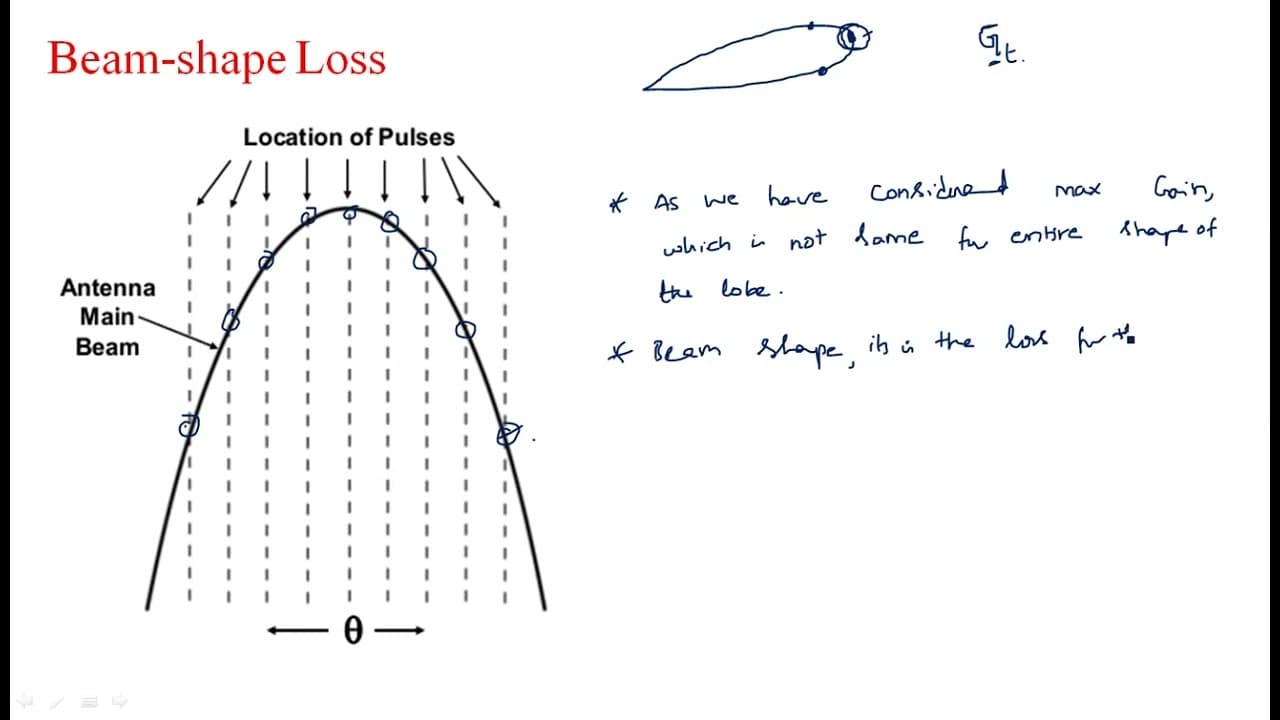
Q: How does beam shape loss affect radar performance?
Beam shape loss occurs due to variations in the radar signal's gain as it transmits across different points within its lobe shape. This means that even when a target is present, the radar may not detect its maximum echo strength consistently, leading to potential target misidentification or missed detections.
Q: What causes scanning loss in radar systems?
Scanning loss arises when a radar system continuously searches for targets while they may not be in the radar's immediate vicinity. Antenna rotation and target movement can lead to a drop in signal gain during critical moments, which can affect the radar's ability to capture strong echoes from distant targets.
Q: How does the radom influence radar signal transmission?
A radom is a protective cover for radar antennas that shields them from environmental elements. However, as signals pass through the radom, some portion of the signal can be lost due to attenuation, reducing the overall effective gain and performance of the radar system in real-time communications.
Q: What are phased array antennas, and what benefits do they offer?
Phased array antennas consist of multiple antennas working together to transmit and receive signals. They allow for electronic steering of the radar beam without physical movement. This capability improves tracking of fast-moving targets and enhances the system's response time, making it far more efficient for various applications.
Q: Can you elaborate on the types of plumbing losses mentioned?
Plumbing losses in radar systems arise during signal transmission through waveguides and connections in the system. Losses include transmission line losses, duplexer losses, and losses at connections between components, all of which can significantly degrade the radar signal strength and quality.
Q: What is operator loss in a radar context?
Operator loss refers to the degradation in performance and accuracy of radar systems due to human factors. An operator working long hours might experience fatigue, leading to errors in signal interpretation, missed targets, or incorrect responses to radar data, ultimately affecting the effectiveness of the radar operation.
Q: What are the challenges associated with phased array antennas?
While phased array antennas provide enhanced tracking and reception capabilities, they introduce additional transmission losses due to the complexity of connecting multiple antennas. The distributed nature of these systems can reduce overall antenna gain, complicating signal integrity and requiring careful design to mitigate these losses.
Summary & Key Takeaways
-
The video introduces system losses in radar systems, defining them as microwave plumbing losses, signal processing losses, and operator losses among others, highlighting their sources and impacts on radar measurement accuracy.
-
It explains specific types of losses, including beam shape loss, scanning loss, and radom loss, detailing how each affects signal transmission and reception while emphasizing their inevitability in radar operations.
-
The video discusses the concept of phased array antennas and their benefits, while also noting the additional transmission losses due to the complexity of using multiple antenna elements.
Read in Other Languages (beta)
Share This Summary 📚
Summarize YouTube Videos and Get Video Transcripts with 1-Click
Try YouTube Summary with ChatGPT & Claude or YouTube Transcript Generator