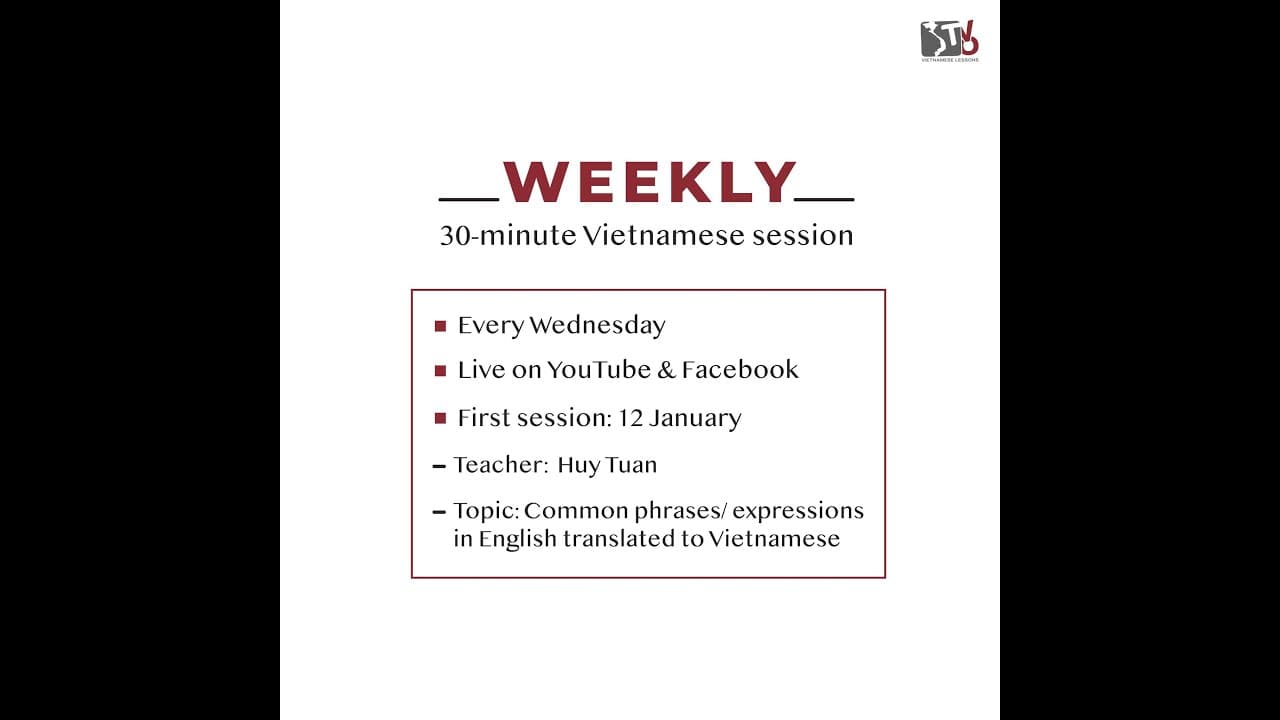
30-minute Vietnamese session | Common English phrases/Expressions translated to Vietnamese
TL;DR
Learn common English phrases translated into Vietnamese in 30 minutes.
Transcript
uh i'm gonna have uh we're gonna have 30 minutes to talk about the common phrase in english that can be translated into vietnamese so uh i'm the teacher in tvo and uh i've been teaching interviews for a couple of years now hello john hello xy ciao ciao one more question it's pretty cold here i don't really like cold weather could you uh let me know... Read More
Key Insights
- The session focuses on translating common English phrases into Vietnamese, providing practical language tips.
- The instructor teaches phrases applicable in both Northern and Southern Vietnamese dialects.
- Common greetings in Vietnamese include 'xin chao' and informal variations like using pronouns.
- Vietnamese often uses questions to greet, similar to 'how are you' in English, without expecting detailed responses.
- The lesson covers the cultural context of using 'see' versus 'meet' in Vietnamese, emphasizing correct usage.
- Expressions like 'long time no see' and 'how have you been' have specific Vietnamese translations.
- The session explains nuances in Vietnamese expressions, such as the difference between 'vui' and 'hanh phuc'.
- The lesson includes an interactive exercise for participants to apply their learning in a practical conversation.
Install to Summarize YouTube Videos and Get Transcripts
Explore YouTube Video Summarizer or Get YouTube Transcript Extractor
Questions & Answers
Q: What is the focus of the Vietnamese lesson?
The focus of the lesson is to teach common English phrases translated into Vietnamese, providing practical language tips and insights. The session aims to enhance learners' conversational skills by offering phrases applicable in both Northern and Southern Vietnamese dialects.
Q: How are greetings typically expressed in Vietnamese?
Greetings in Vietnamese often involve saying 'xin chao' or using informal variations with pronouns. Additionally, Vietnamese people frequently use questions as greetings, similar to 'how are you' in English, without expecting detailed responses. This reflects cultural nuances in Vietnamese communication.
Q: What is the difference between 'see' and 'meet' in Vietnamese?
In Vietnamese, 'see' and 'meet' have distinct usages. 'See' is used for watching or observing, while 'meet' is used for encountering people intentionally. The lesson emphasizes using 'meet' in contexts like visiting friends or family, highlighting the importance of correct verb usage in Vietnamese.
Q: How are expressions like 'long time no see' translated into Vietnamese?
Expressions like 'long time no see' are translated into Vietnamese as 'lâu rồi không gặp'. The lesson provides specific translations for such phrases, helping learners understand their proper usage in Vietnamese conversations.
Q: What is the significance of tone in Vietnamese expressions?
Tone plays a crucial role in Vietnamese expressions, affecting the meaning and formality of phrases. For instance, the difference between 'vui' (happy) and 'hanh phuc' (very happy) indicates varying levels of emotion. Understanding tone is essential for effective communication in Vietnamese.
Q: What interactive exercise is included in the lesson?
The lesson includes an interactive exercise where participants fill in blanks in a conversation with appropriate Vietnamese phrases. This exercise helps reinforce learning by allowing learners to apply their knowledge in a practical scenario, enhancing their understanding of conversational Vietnamese.
Q: How does the lesson address both Northern and Southern Vietnamese dialects?
The instructor, based in Hanoi, teaches phrases that are applicable in both Northern and Southern Vietnamese dialects. The lesson highlights differences and similarities in pronunciation and usage, ensuring learners can communicate effectively across different regions of Vietnam.
Q: What resources are available for further learning?
For further learning, participants can access the lesson recording on TVO's YouTube channel or Facebook page. TVO also offers additional resources, including quiz questions, glossary, and special materials, available to patrons. Learners are encouraged to contact TVO for more information on lessons and materials.
Summary & Key Takeaways
-
The session provides a 30-minute lesson on translating common English phrases into Vietnamese, focusing on practical conversational skills. The instructor, based in Hanoi, shares insights applicable to both Northern and Southern dialects, emphasizing cultural nuances in language use.
-
Participants learn various greetings, expressions, and conversational phrases in Vietnamese, such as 'xin chao', 'long time no see', and 'how have you been'. The session highlights the importance of context and tone in Vietnamese communication.
-
An interactive exercise allows learners to practice translating and using phrases in a simulated conversation, reinforcing the lesson's key points. The instructor encourages questions and provides detailed explanations to enhance understanding.
Read in Other Languages (beta)
Share This Summary 📚
Summarize YouTube Videos and Get Video Transcripts with 1-Click
Try YouTube Summary with ChatGPT & Claude or YouTube Transcript Generator
Explore More Summaries from Tieng Viet Oi - Vietnamese Lessons 📚

Summarize YouTube Videos and Get Video Transcripts with 1-Click
Try YouTube Summary with ChatGPT & Claude or YouTube Transcript Generator