Number System | Divisibility rules - 2 | Aptitude | Part- 04 | Bharath Kumar
TL;DR
This session covers divisibility rules from 11 to 19, crucial for competitive exams.
Transcript
hi everyone welcome to the session in this session i am going to explaining about divisibility rules in the last session we have discussed up to 10 divisibility rules now we'll continue the divisibility rules from 11 onwards first divisibility rule of 11 guys in any competitive examination or else any campus placement drives divisibility rule of 11... Read More
Key Insights
- 🎭 Understanding divisibility rules is crucial for performing quick calculations in competitive examinations.
- 📏 The rule of 11 highlights the significance of positional digits rather than just the digits themselves.
- 📏 Divisibility by 12 requires knowledge of the separate rules of both 3 and 4, emphasizing the importance of understanding combinations.
- 🙊 Knowing the specific last digits to check for divisibility speaks to the efficiency of number analysis in mathematics.
- 🛀 Different divisibility rules can be interrelated, showing how mathematic principles can connect various concepts.
- 🧑🎓 The session provides a structured approach to learning these rules, ideal for students preparing for technical assessments.
- 🛝 Practical examples reinforce the application of abstract principles, grounding the theoretical aspects of divisibility.
Install to Summarize YouTube Videos and Get Transcripts
Explore YouTube Video Summarizer or Get YouTube Transcript Extractor
Questions & Answers
Q: What is the divisibility rule for 11?
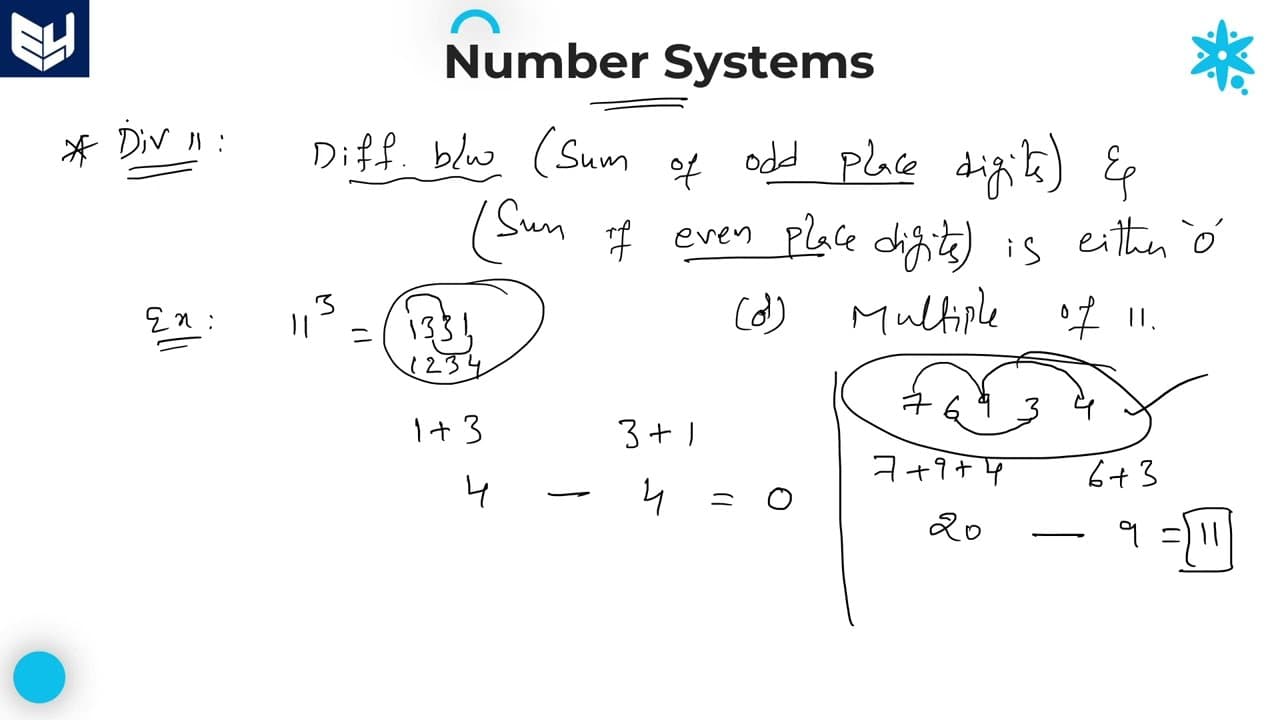
To determine if a number is divisible by 11, calculate the difference between the sum of the digits in odd positions and the sum of the digits in even positions. If this difference is either 0 or a multiple of 11, then the number is divisible by 11.
Q: How can we check if a number is divisible by 12?
A number is divisible by 12 if it meets the rules for both 3 and 4. Specifically, it must be divisible by 3 (the sum of its digits is divisible by 3) and by 4 (the last two digits form a number divisible by 4).
Q: Can you explain how to apply the divisibility rule of 16?
To check for divisibility by 16, only the last four digits of the number need to be considered. If these four digits form a number that is divisible by 16, then the entire number is also divisible by 16.
Q: What is the combination rule for divisibility by 15?
A number is divisible by 15 if it meets the criteria for both 3 and 5. This means the sum of its digits must be divisible by 3, and the last digit must be either 0 or 5 for the number to be divisible by 15.
Q: How does one determine if a number is divisible by 19?
For a number to be divisible by 19, you sum the tens place and twice the unit's place digit. If this sum is divisible by 19, then the entire number is considered divisible by 19.
Q: Explain the divisibility rule of 17.
To determine if a number is divisible by 17, find the difference between the tens place and five times the units place. If this difference is divisible by 17, then the entire number is also divisible by 17.
Summary & Key Takeaways
-
The session elaborates on the divisibility rule of 11, explaining that a number is divisible if the difference between the sum of its odd and even place digits is 0 or a multiple of 11.
-
The rules for divisibility by 12, 14, 15, 16, 18, 19, 13, and 17 are discussed, highlighting that some are combinations of other rules and emphasizing the importance of knowing separate rules for accurate evaluations.
-
Examples are used to illustrate each rule, reinforcing the concepts and showing how to apply the rules to various numbers effectively for examinations.
Read in Other Languages (beta)
Share This Summary 📚
Summarize YouTube Videos and Get Video Transcripts with 1-Click
Try YouTube Summary with ChatGPT & Claude or YouTube Transcript Generator