How to Find the Area Between Two Parabolas Using Integration
TL;DR
To find the area bounded by two parabolas, set up an integral by determining the right and left curves in relation to the y-axis. Use integration with respect to y from the intersection points to calculate the area, subtracting the left curve's integral from the right curve's integral. The final area is found by evaluating the definite integral with the correct limits.
Transcript
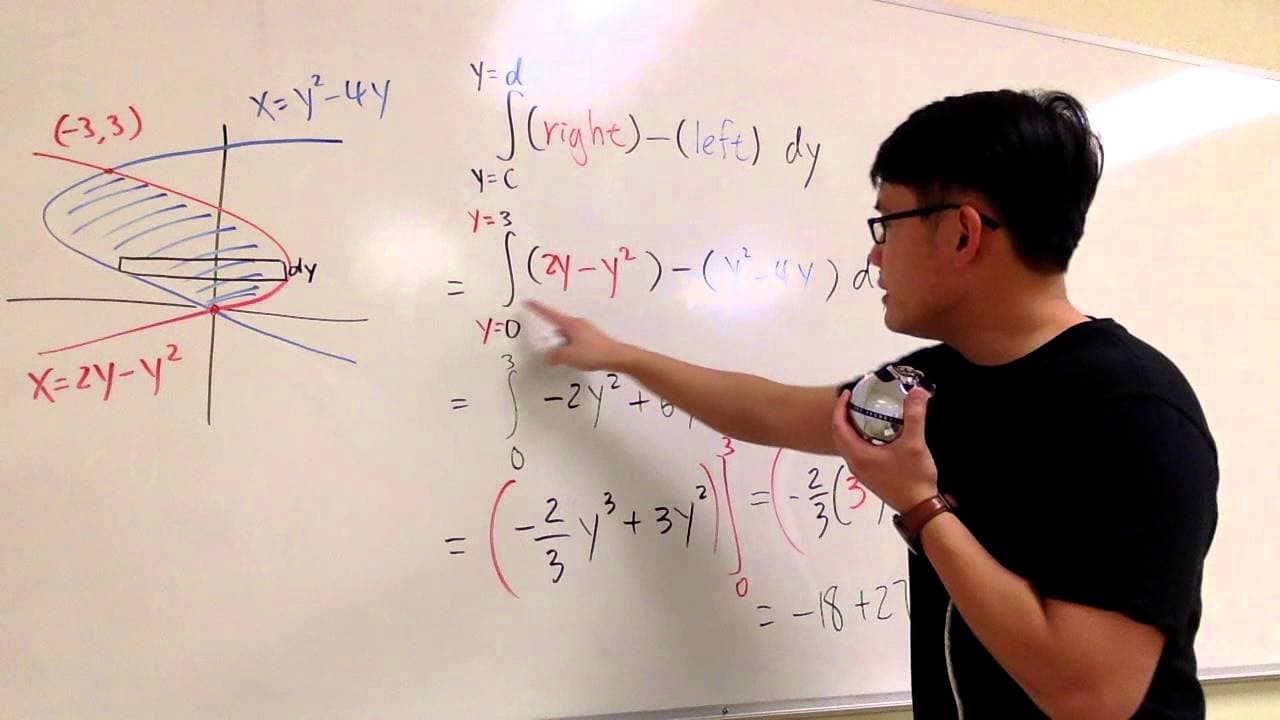
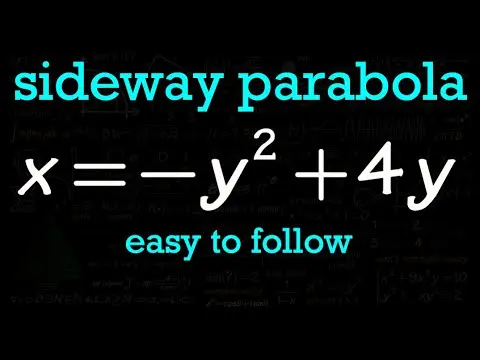
let's take a look on how we can find the area of this shaded region and this region is bounded by two parabolas and these two parabolas above open sideways notice that the X is being isolated and we have X's in terms of y so X is a function of Y in such a situation whenever you have a function that's open X sideways we should do a break then go hor... Read More
Key Insights
- 🫡 The area between two parabolas can be found by setting up a rectangle and evaluating integrals with respect to the Y variable.
- 🇾🇪 Isolating X as a function of Y is necessary to express the parabolas in terms of Y and perform the integration.
- ✊ The reverse power rule is employed to integrate the functions representing the parabolas.
- 🧡 The Y values of the intersections of the parabolas determine the range within which the integrals are evaluated.
- ↔️ The area calculation involves subtracting the integral of the parabola on the left from the integral of the parabola on the right.
- 😫 The importance of correctly identifying the region and setting up the integrals is highlighted.
- 🥺 Plugging in the Y values of the intersections and performing the necessary calculations leads to the final area value.
Install to Summarize YouTube Videos and Get Transcripts
Explore YouTube Video Summarizer or Get YouTube Transcript Extractor
Questions & Answers
Q: How is the area of the shaded region between two parabolas calculated?
The area is calculated by setting up a rectangle with the base representing a small change in the Y axis. The integrals of the functions representing the parabolas on the right and left sides are evaluated within the Y value range of the region.
Q: What rule is used to integrate the functions representing the parabolas?
The reverse power rule is used to integrate the functions. It involves adding one to the exponent and dividing the result by the new exponent.
Q: What is the importance of isolating X as a function of Y?
Isolating X as a function of Y allows us to express the parabolas in terms of Y and, therefore, integrate the functions with respect to Y to find the area between them.
Q: Why is a rectangle with a base representing dy used in the calculation?
The rectangle with a dy base is used because the integral is calculated with respect to Y and represents the small change in Y axis for finding the area of the region between the parabolas.
Summary & Key Takeaways
-
The content focuses on finding the area of a shaded region between two parabolas by isolating the variable X as a function of Y and using integration.
-
A rectangle is set up with the base representing a small change in the Y axis (dy) to calculate the integral.
-
The integrals are then evaluated using the reverse power rule and the Y values of the intersections.
Read in Other Languages (beta)
Share This Summary 📚
Summarize YouTube Videos and Get Video Transcripts with 1-Click
Try YouTube Summary with ChatGPT & Claude or YouTube Transcript Generator
Explore More Summaries from blackpenredpen 📚
Summarize YouTube Videos and Get Video Transcripts with 1-Click
Try YouTube Summary with ChatGPT & Claude or YouTube Transcript Generator