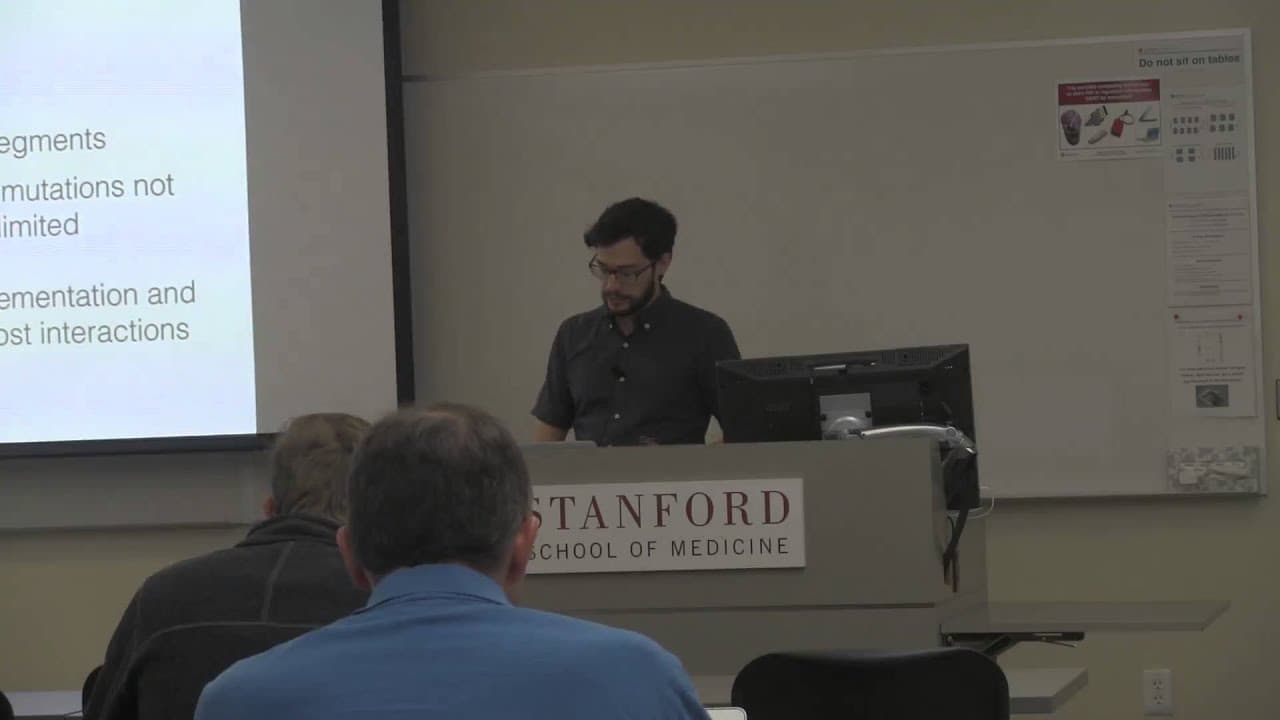
Michael Pearce, Evolutionary Speedups from Rare Reassortment
TL;DR
Mathematical models show that rare reassortment can significantly increase the speed of evolution, leading to new insights in evolutionary biology and public health.
Transcript
get started now so I Michael McLaren on the grad student indoor Feldman's left and I'm not here today introduce Michael Pierce progressed and Indian officials lab and so a basic question in evolutionary biology is is what determines a speed of adaptation of a species so how quickly can species of actor changing environment and this is important als... Read More
Key Insights
- 🐎 Rare reassortment can significantly increase the speed of evolution in a species.
- 🐎 The speed of evolution depends on the frequency of reassortment events and the size of the population.
- ❓ Mathematical models can be used to study the effects of rare reassortment on the dynamics of molecular evolution.
Install to Summarize YouTube Videos and Get Transcripts
Explore YouTube Video Summarizer or Get YouTube Transcript Extractor
Questions & Answers
Q: What is rare reassortment and why is it important in evolutionary biology and public health?
Rare reassortment refers to the shuffling of chromosomes, which can significantly increase the rate of adaptation in a species. This process is important to understand how pathogens can adapt to changing immune systems and how genetic data from rapidly evolving viruses and bacteria can be incorporated into research.
Q: How does rare reassortment impact the speed of evolution?
The frequency of reassortment events affects the speed of evolution. Higher reassortment rates can lead to a significant increase in evolution speed, while lower rates result in a more gradual evolution process.
Q: What factors determine the speed of evolution with rare reassortment?
The speed of evolution is influenced by the frequency of reassortment events, the size of the population, and the fitness of individuals within the population. These factors interact to shape the dynamics of molecular evolution.
Q: How can rare reassortment be studied experimentally?
Experimental systems, such as studying viruses with segmented genomes, can be used to investigate the effects of rare reassortment on evolution. By manipulating reassortment rates and analyzing genetic data, researchers can gain insights into the dynamics of molecular evolution.
Summary & Key Takeaways
-
Rare reassortment, or the process of shuffling chromosomes, can accelerate evolution in a species.
-
By using mathematical models, researchers have found that rare reassortment can increase the rate of adaptation and change the dynamics of molecular evolution.
-
The speed of evolution depends on the frequency of reassortment events and the size of the population.
Read in Other Languages (beta)
Share This Summary 📚
Summarize YouTube Videos and Get Video Transcripts with 1-Click
Try YouTube Summary with ChatGPT & Claude or YouTube Transcript Generator
Explore More Summaries from Stanford 📚





Summarize YouTube Videos and Get Video Transcripts with 1-Click
Try YouTube Summary with ChatGPT & Claude or YouTube Transcript Generator