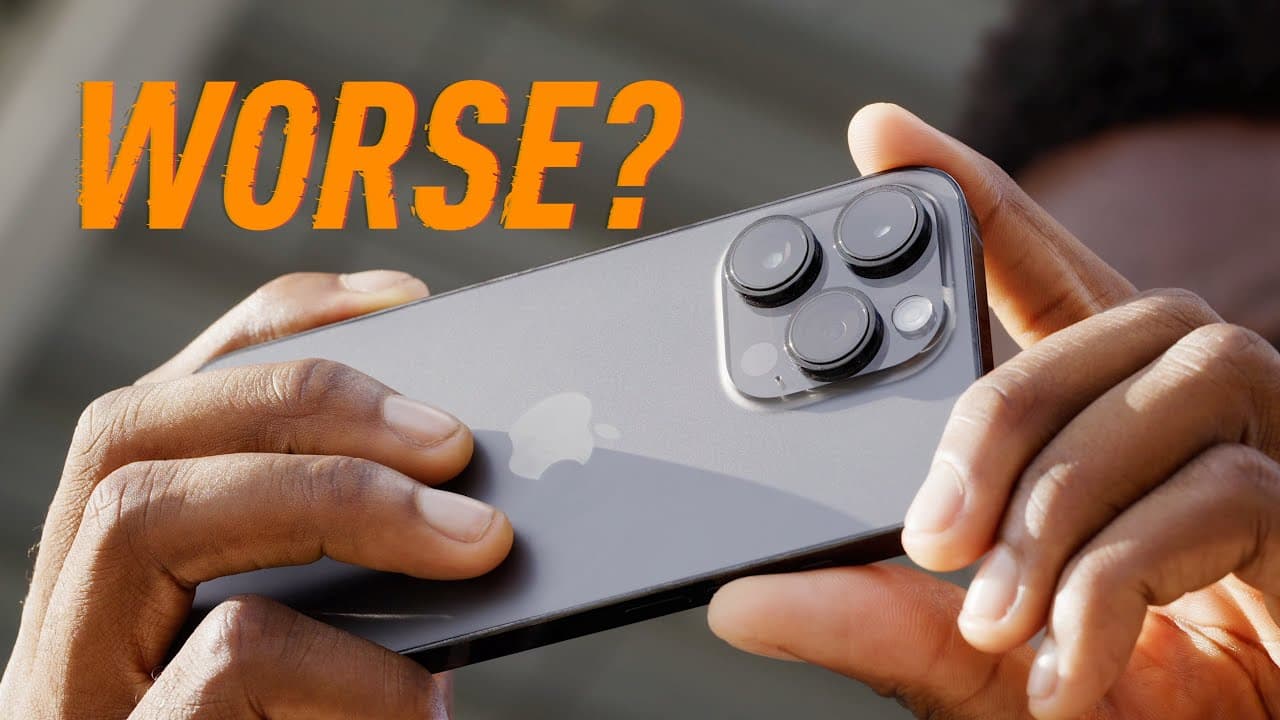
What is Happening with iPhone Camera?
TL;DR
Smartphone cameras have evolved from simple sensors that capture light to complex computational systems that heavily rely on software to process images, resulting in different interpretations and optimization choices by different manufacturers.
Transcript
(Intro SFX) - Okay, what exactly is happening with the iPhone's camera? Like we've done years of blind smartphone camera tests in bracket format and the iPhone, supposedly one of the premium cameras in the entire smartphone industry, consistently loses in the first round. Then we do a scientific version with 20 million+ votes and it finishes in the... Read More
Key Insights
- 📷 Cameras on smartphones have evolved from simple sensors to complex computational systems that merge exposures, apply tone mapping, and use software to create the final image. Software now plays a bigger role than the sensor's quality.
- 📲 Google's success with the Pixel series can be attributed to its consistent use of the IMX363 sensor and fine-tuned software. This combo has proven to produce impressive images, even against newer phones with larger sensors.
- 📷 The transition to larger sensors, like the 50-megapixel sensor on the Pixel 6, can pose challenges for software optimization. Initial results may appear overprocessed, but updates and adjustments can improve the overall image quality.
- 📲 The iPhone follows a similar pattern, with the iPhone 14 Pro being the first to feature a dramatically larger 48-megapixel sensor. Some iPhone photos may appear overprocessed due to software choices, but future updates are expected to address these issues.
- 🤔 The choice of test subjects can reveal how smartphones handle different scenarios. Testing on human faces highlighted how software interpretations can vary, with iPhones often applying even lighting to faces, sometimes resulting in an unnatural look.
- ♂️ Google's Real Tone software optimization helps accurately represent a variety of skin tones in photos. Apple's camera software, on the other hand, aims to evenly light faces but may not account for different white balances and exposures required for accurate representation.
- 📷 Comparing photos between smartphones is challenging due to the wide variation in software choices. Different phones may excel in different scenarios, such as landscapes, skin tones, or pet photos, making it difficult to pick a clear winner.
- 🏆 The blind scientific camera test focused on exposure and colors but didn't consider factors like sharpness, autofocus speed, video quality, and more. The trophy for best overall camera system went to the iPhone based on factors that were not part of the scientific test.
Install to Summarize YouTube Videos and Get Transcripts
Explore YouTube Video Summarizer or Get YouTube Transcript Extractor
Questions & Answers
Q: Why do smartphone cameras rely heavily on software processing rather than just having the best sensor?
Smartphone cameras have shifted their focus to software processing because it allows for more control and optimization of the final image. While a good sensor is still important, software can compensate for limitations and enhance the overall image quality by merging exposures, reducing noise, and improving dynamic range.
Q: Why did Google's Pixel 6 receive criticism for over sharpening and HDR-like effects?
The Pixel 6's transition to a larger sensor resulted in the camera's software processing still treating images as if they were taken with a smaller sensor. This led to excessive processing, over-sharpening, and HDR-like effects, which some users found unnatural. Google had to make adjustments and updates to the software to optimize it for the new sensor.
Q: How does software processing affect the interpretation of human faces in photos?
Smartphone cameras, like the iPhone, tend to evenly light faces in photos, which can sometimes result in removing natural shadows and giving a subtle "bounce fill" effect. This can make the lighting look artificial and impact the overall realism of the image. Different manufacturers make different choices and optimizations to represent skin tones, with Google's Real Tone being a notable example.
Q: Why do different smartphones produce different-looking photos even when capturing the same scene?
Each smartphone manufacturer applies their own software processing algorithms, resulting in different interpretations of the scene. Companies prioritize different factors, such as landscape rendering, skin tone accuracy, and pet photography, leading to variations in the final image. Comparing photos side by side can be difficult because personal preferences and priorities differ.
Q: What were the limitations of the blind scientific camera test mentioned in the video?
The blind scientific camera test focused on exposure, colors, and general image quality but did not evaluate sharpness, detail, autofocus speed and reliability, camera app performance, video quality, or microphone quality. These factors contribute significantly to the overall camera system but were not tested in the specific experiment mentioned.
Q: How do manufacturers like Apple work on improving their camera systems over time?
Manufacturers, including Apple, constantly work on refining their camera systems through software updates. They analyze feedback, address issues, and make adjustments to optimize the image processing for new sensors. Future iterations of smartphone cameras, such as the iPhone 15 Pro, are likely to feature software improvements and advancements explained during launch events.
Summary & Key Takeaways
-
Cameras have evolved from simple sensors to computational systems that merge exposures, perform tone mapping, noise reduction, and HDR processing to create the final image.
-
Software plays a crucial role in determining the image quality, and companies like Google have perfected the combination of the IMX363 sensor and software tuning for their Pixel smartphones.
-
The transition to larger sensors, such as the 50-megapixel sensor in the Pixel 6a and the 48-megapixel sensor in the iPhone 14 Pro, has posed challenges for manufacturers, leading to overprocessing and inconsistent image quality.
Read in Other Languages (beta)
Share This Summary 📚
Summarize YouTube Videos and Get Video Transcripts with 1-Click
Try YouTube Summary with ChatGPT & Claude or YouTube Transcript Generator
Explore More Summaries from Marques Brownlee 📚


Summarize YouTube Videos and Get Video Transcripts with 1-Click
Try YouTube Summary with ChatGPT & Claude or YouTube Transcript Generator