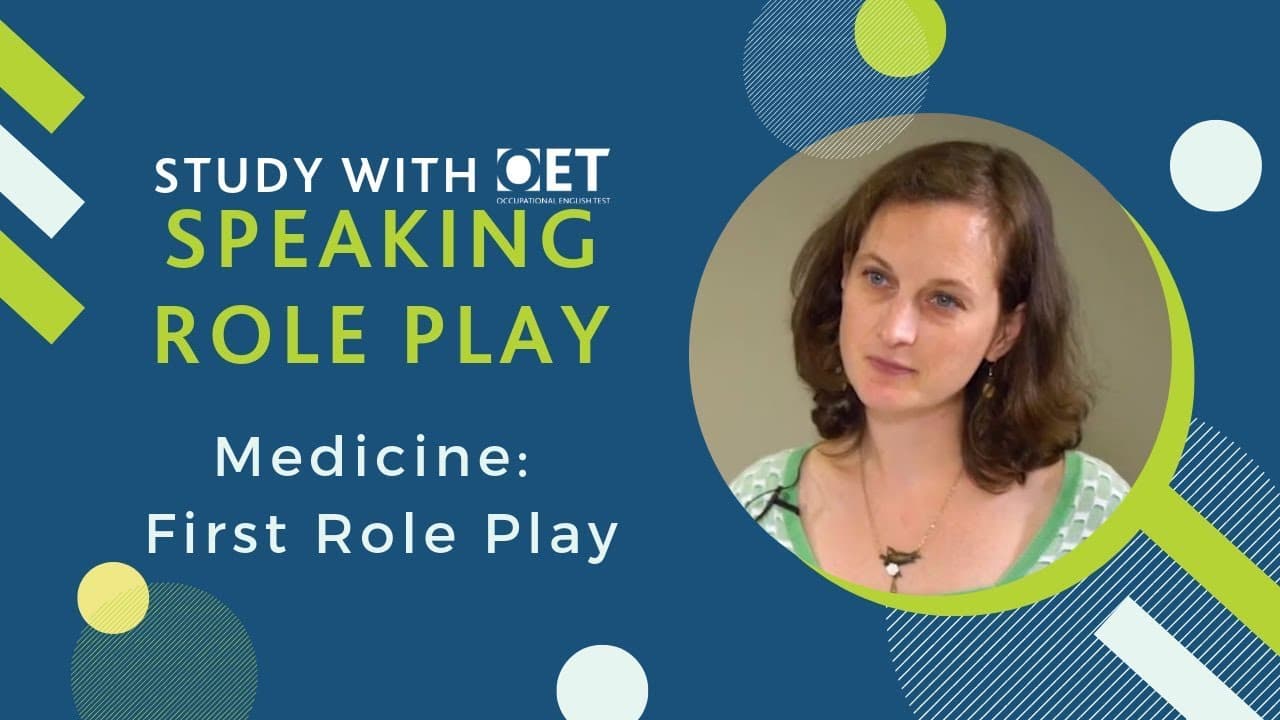
OET Speaking Role Play (Medicine): First Role Play
TL;DR
The video demonstrates an OET Medicine speaking role-play session.
Transcript
so let's move on to the role place now I'll take the part of the patients or perhaps a relative and you'll take your professional role each role play will last five minutes the purpose of the role play is to get evidence of your ability to communicate effectively with patients use your ability to fulfill as much of the rolep... Read More
Key Insights
- The video showcases an OET Medicine speaking role-play, focusing on communication between a medical professional and a patient.
- The candidate effectively uses a wide range of vocabulary and grammatical expressions to communicate with the patient.
- The role-play emphasizes the importance of using layman's terms, such as 'heart attack' instead of medical jargon, for better patient understanding.
- Active listening and appropriate information-gathering techniques are highlighted as key components of effective communication.
- The candidate is praised for sequencing the interview logically and purposefully, ensuring a smooth flow of conversation.
- Feedback suggests the candidate should avoid medical terms that might confuse the patient, maintaining a balance between professional and lay language.
- The importance of reassurance and empathy in patient communication is underscored, as the candidate reassures the patient about their condition.
- The video serves as a preparatory tool for candidates, providing insights into strengths and areas for improvement in the OET Speaking sub-test.
Install to Summarize YouTube Videos and Get Transcripts
Explore YouTube Video Summarizer or Get YouTube Transcript Extractor
Questions & Answers
Q: What is the main focus of the OET Medicine speaking role-play?
The main focus of the OET Medicine speaking role-play is to evaluate the candidate's ability to communicate effectively with patients. This includes using appropriate vocabulary and grammar, demonstrating active listening, providing reassurance, and maintaining a logical flow of conversation. The role-play serves as a practical exercise to prepare candidates for real-life medical interactions.
Q: How does the candidate reassure the patient about their condition?
The candidate reassures the patient by explaining that the tiredness they are experiencing is a normal bodily reaction following a heart attack. They emphasize that this symptom is temporary and that energy levels are expected to return. Additionally, the candidate introduces the idea of a cardiac rehabilitation program to help improve the patient's condition and reduce the risk of future heart issues.
Q: What feedback is given regarding the candidate's use of language?
The feedback commends the candidate's clear pronunciation and the use of a wide range of vocabulary and grammatical structures. However, it advises the candidate to avoid using complex medical terms like 'anterior acute myocardial infarct' with patients, suggesting that simpler terms like 'heart attack' are more appropriate for patient understanding. This balance ensures effective communication and patient comfort.
Q: What techniques does the candidate use to gather information from the patient?
The candidate employs active listening and appropriate information-gathering techniques to understand the patient's condition. They ask open-ended questions about the patient's symptoms, treatment history, and current concerns. This approach allows the candidate to collect comprehensive information, which is crucial for providing accurate reassurance and advice to the patient.
Q: Why is it important to use layman's terms in medical communication?
Using layman's terms in medical communication is important to ensure that patients fully understand their condition, treatment options, and any advice given. Medical jargon can be confusing and intimidating for patients, potentially leading to misunderstandings or increased anxiety. Clear, simple language fosters better communication, patient comfort, and adherence to medical advice.
Q: What is the role of the cardiac rehabilitation program mentioned in the role-play?
The cardiac rehabilitation program is designed to help patients recover from heart attacks by gradually increasing their exercise levels under professional guidance. It aims to improve circulation, reduce the risk of future ischemic events, and enhance the patient's overall well-being. The program is tailored to individual tolerance levels to ensure safety and effectiveness.
Q: How does the video serve as a preparatory tool for OET candidates?
The video serves as a preparatory tool by providing a real-life example of an OET Medicine speaking role-play. It offers insights into effective communication strategies, highlights common challenges, and provides feedback on performance. This helps candidates understand the expectations of the Speaking sub-test and identify areas for improvement in their own practice.
Q: What additional resources are available for candidates preparing for the OET Speaking sub-test?
Candidates preparing for the OET Speaking sub-test can access additional resources such as the OET website's preparation page, feedback vouchers, and masterclasses. These resources offer further tips, practice materials, and expert guidance to help candidates enhance their communication skills and perform well in the test. Social media platforms also provide updates and useful information.
Summary & Key Takeaways
-
The video features an OET Medicine speaking role-play, demonstrating effective communication skills between a medical professional and a patient. The candidate is assessed on vocabulary, grammatical accuracy, and the ability to maintain a logical flow in conversation, with feedback provided for improvement.
-
The role-play involves a patient recently discharged after a heart attack, expressing concerns about ongoing tiredness. The candidate reassures the patient, explaining the normalcy of such symptoms post-heart attack and introduces the concept of cardiac rehabilitation to aid recovery.
-
Feedback highlights the candidate's clear pronunciation and appropriate use of language, though advises against using complex medical terms with patients. The video serves as an educational resource for OET candidates, emphasizing the importance of empathy, active listening, and clear communication.
Read in Other Languages (beta)
Share This Summary 📚
Summarize YouTube Videos and Get Video Transcripts with 1-Click
Try YouTube Summary with ChatGPT & Claude or YouTube Transcript Generator
Explore More Summaries from Official OET 📚
Summarize YouTube Videos and Get Video Transcripts with 1-Click
Try YouTube Summary with ChatGPT & Claude or YouTube Transcript Generator