Mono-stable Multivibrator | Reverse saturation current | Pulse Digital Circuits ( PDC ) | Lec-56
TL;DR
This video explains derivation of gate width in monostable multivibrators by including reverse saturation current effects.
Transcript
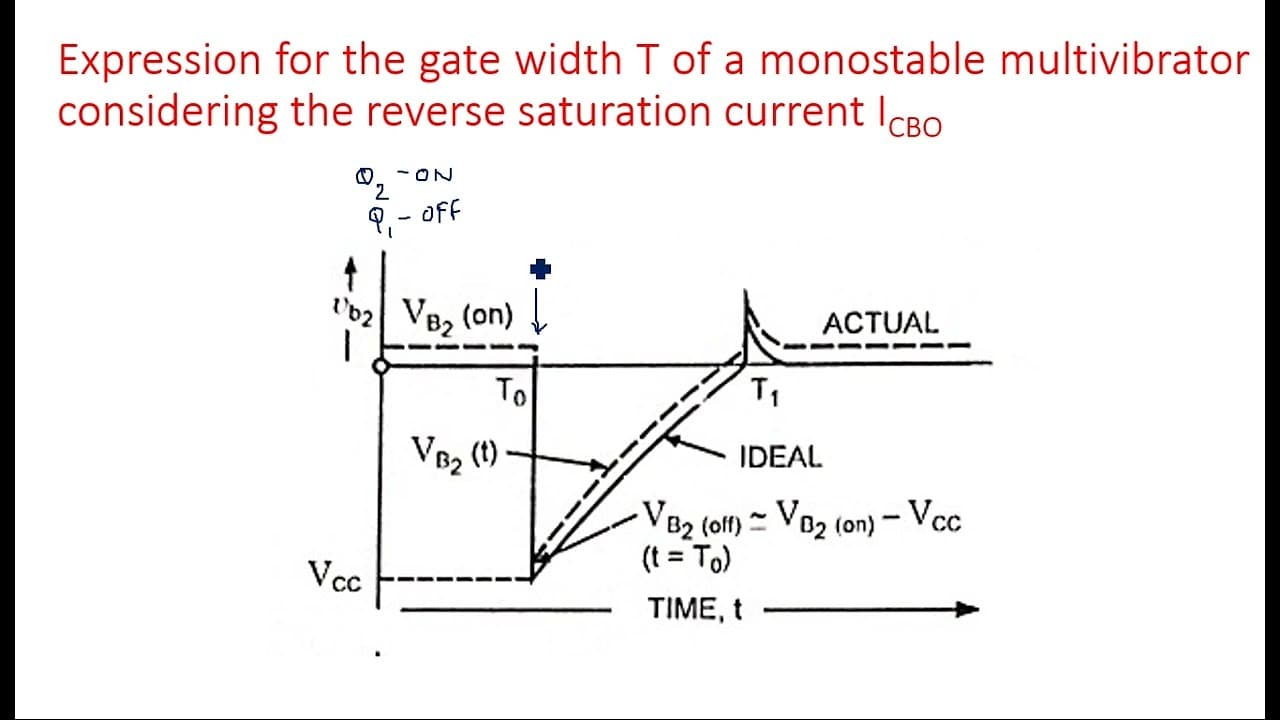
hi everyone in this video I am going to explain you about the derivation for the gate width of a monostable multivibrator by considering the reverse saturation current icbo icbo is nothing but rubber saturation current when emitter is acting as open circuited in the previous expression of the gate weight we have calculated the gate with like a t is... Read More
Key Insights
- ⚡ Reverse saturation current (icbo) is crucial in accurately calculating gate width and voltage levels in electronic circuits.
- ⌛ The charging behavior of capacitors in multivibrators must consider additional voltage contributions from icbo, altering traditional time calculations.
- 🍻 Temperature influences icbo significantly, linking thermal management directly to circuit timing and reliability.
- 🌍 The revised equations present a more holistic approach, merging classical multivibrator theory with real-world conditions for enhanced design fidelity.
- ⌛ Understanding the balance between charge time and voltage levels is essential in designing circuits for specific timing applications.
- 🥺 The dynamics between transistor states can be altered by variations in responding capacitor voltages, leading to complex behavior in multivibrator applications.
- ❓ Mitigating delays due to temperature-induced icbo increases will enhance circuit performance and responsiveness.
Install to Summarize YouTube Videos and Get Transcripts
Explore YouTube Video Summarizer or Get YouTube Transcript Extractor
Questions & Answers
Q: What is the significance of reverse saturation current in the context of a monostable multivibrator's gate width?
The reverse saturation current (icbo) significantly impacts the gate width calculation for a monostable multivibrator. By factoring this current into the derivation, it adjusts the voltage level (VCC) the capacitor must reach, thereby affecting the timing characteristics of the circuit. As icbo changes with temperature, it is crucial to incorporate this variable for accurate performance predictions.
Q: How does the charging period of the capacitor change when incorporating icbo?
When icbo is included in the calculations, the voltage that the capacitor charges to becomes VCC plus icbo times resistance R. This adjustment means that the capacitor must now charge to a higher voltage, which extends the time it takes for the transistor state change due to increased storage time, thereby influencing the overall timing delay of the multivibrator.
Q: What effect does temperature have on reverse saturation current and gate width?
As the temperature increases, the reverse saturation current (icbo) also increases, leading to a reduction in the delay time (Tau) of the multivibrator. This correlation implies that higher temperatures reduce the effective delay time, which impacts the overall performance of the circuit and necessitates careful thermal management in practical applications.
Q: Can you explain the equation used to calculate the gate width in detail?
The gate width (T) is derived from the equation involving the final and initial voltage conditions of the charging capacitor and incorporates the effects of icbo. The equation factors in both the voltage levels VCC and icbo multiplied by resistance R. It utilizes the natural logarithm to express the delay in relation to the charging characteristics and thermal variations, providing a comprehensive model that reflects real-world behavior.
Summary & Key Takeaways
-
The video discusses the calculation of gate width for a monostable multivibrator, incorporating the effects of reverse saturation current (icbo) for accuracy.
-
It elaborates on the charging behavior of the capacitor, explaining how the new voltage level takes icbo into account, changing the initial charge condition.
-
Finally, the video presents equations that revise the time characteristics of the multivibrator circuit based on temperature-related changes in reverse saturation current.
Read in Other Languages (beta)
Share This Summary 📚
Summarize YouTube Videos and Get Video Transcripts with 1-Click
Try YouTube Summary with ChatGPT & Claude or YouTube Transcript Generator