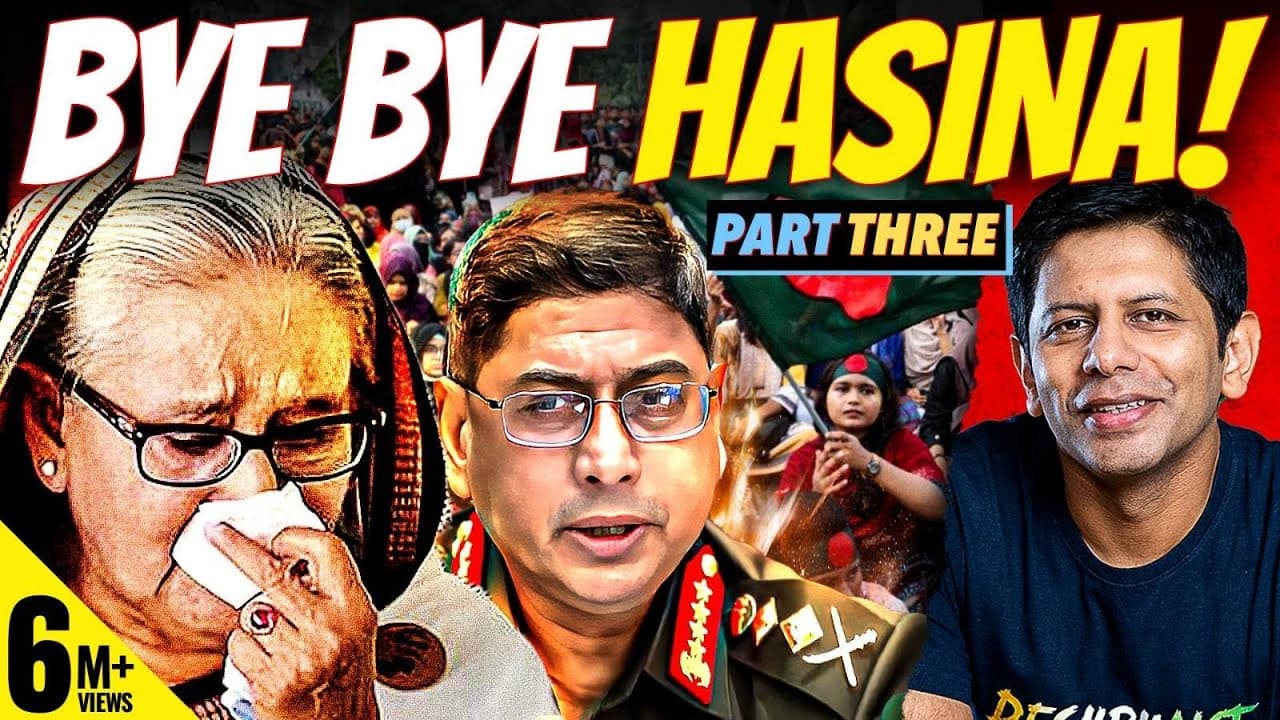
Pt.3- Last 48 Hours Of Dictator Sheikh Hasina | What Next For Bangladesh? | Akash Banerjee & Adwatih
TL;DR
Sheikh Hasina fled Bangladesh amid student protests seeking democracy after years of dictatorship.
Transcript
No matter how powerful or well-connected a dictator is, they are doomed in two ways. Either the people hang him from a lamppost or the dictator is lucky enough to flee the country Sheikh Hasina did the latter. 5th August 2024 will be a historic day in the history of Bangladesh. Sheikh Hasina fled from Bangladesh after ruling for 15 years via India... Read More
Key Insights
- 🥺 Sheikh Hasina's authoritarian tactics, including suppressing dissent, eventually led to her political demise during student protests.
- ❓ The protests were catalyzed by discontent over a reintroduced job quota system that marginalized the majority of young citizens.
- 🇨🇫 The army's decision not to suppress the protests reflects significant internal politics and public sentiment favoring democratic governance.
- 😥 The ousting of Hasina symbolizes a potential turning point for Bangladesh, with discussions emerging about creating an interim government that represents diverse voices.
- 💁 Students, who comprise a large part of the population, are crucial in shaping future political landscapes and must navigate the challenges of forming a stable government.
- 🏣 Ongoing violence and lawlessness post-Hasina’s exit highlight the volatility and uncertainty in transitioning towards democracy.
- 🥳 Relations between India and Bangladesh may be affected by the political shifts and the role of parties like the BNP in the new political climate.
Install to Summarize YouTube Videos and Get Transcripts
Explore YouTube Video Summarizer or Get YouTube Transcript Extractor
Questions & Answers
Q: What led to Sheikh Hasina's resignation?
Sheikh Hasina's resignation was a result of widespread protests, particularly from students, opposing her government's reintroduction of a controversial job quota system. The public outcry intensified following reported police violence against protesters, which fueled demands for her removal. As protests escalated, the support of the army for the protesters ultimately forced Hasina to resign and flee the country.
Q: How did the army's role impact the protests?
The army's refusal to engage violently with student protesters marked a pivotal moment in the protests. By siding with the students and stating they would not target them as terrorists, the army shifted public support in favor of the protest movement. This stance helped legitimize the demands for democratic governance and ultimately contributed to Hasina's resignation.
Q: What were the immediate consequences of Hasina's departure?
Following Hasina's resignation, there was jubilation among the public, signaling a moment of hope for democratic change. However, this was accompanied by chaos and violence, including looting and vandalism. An interim government was announced, aimed at restoring order and addressing the needs of students and citizens affected by the previous regime’s policies.
Q: What challenges does Bangladesh face moving forward?
Bangladesh faces significant challenges post-Hasina, including potential violence from radical groups, the need to address political instability, and ensuring that the interim government can effectively engage with the demands of the student protesters. The risk of a return to authoritarianism or military rule looms, as does the need to foster genuine democracy.
Q: What role do students play in the future of Bangladesh politics?
Students have emerged as a powerful political force during this upheaval. Their active involvement in protests and demands for accountability positions them as critical stakeholders in shaping a democratic future for Bangladesh. Their representation in the interim government could uniquely contribute to a government that reflects the aspirations of the youth population.
Q: Why is the international reaction towards the situation in Bangladesh important?
The international community's response to the crisis in Bangladesh can influence diplomatic relations and affect humanitarian and development aid. Concerns regarding human rights abuses under Hasina's rule drew criticism and could pressure the new government to uphold democratic principles and respect for civil liberties.
Summary & Key Takeaways
-
Sheikh Hasina's authoritarian regime faced mounting student protests demanding reforms, notably against a controversial job quota system, leading to escalating violence and her eventual resignation.
-
The Army positioned itself as a supportive force for the protesters, refusing to crack down on them, which shifted the balance of power and contributed to Hasina's downfall.
-
Following Hasina's departure, there are concerns regarding potential violence and the need for an interim government to restore order and address the demands of the protestors.
Read in Other Languages (beta)
Share This Summary 📚
Summarize YouTube Videos and Get Video Transcripts with 1-Click
Try YouTube Summary with ChatGPT & Claude or YouTube Transcript Generator
Explore More Summaries from The Deshbhakt 📚


Summarize YouTube Videos and Get Video Transcripts with 1-Click
Try YouTube Summary with ChatGPT & Claude or YouTube Transcript Generator