What if the Moon Fell Down to Earth? | Science Is Hard
TL;DR
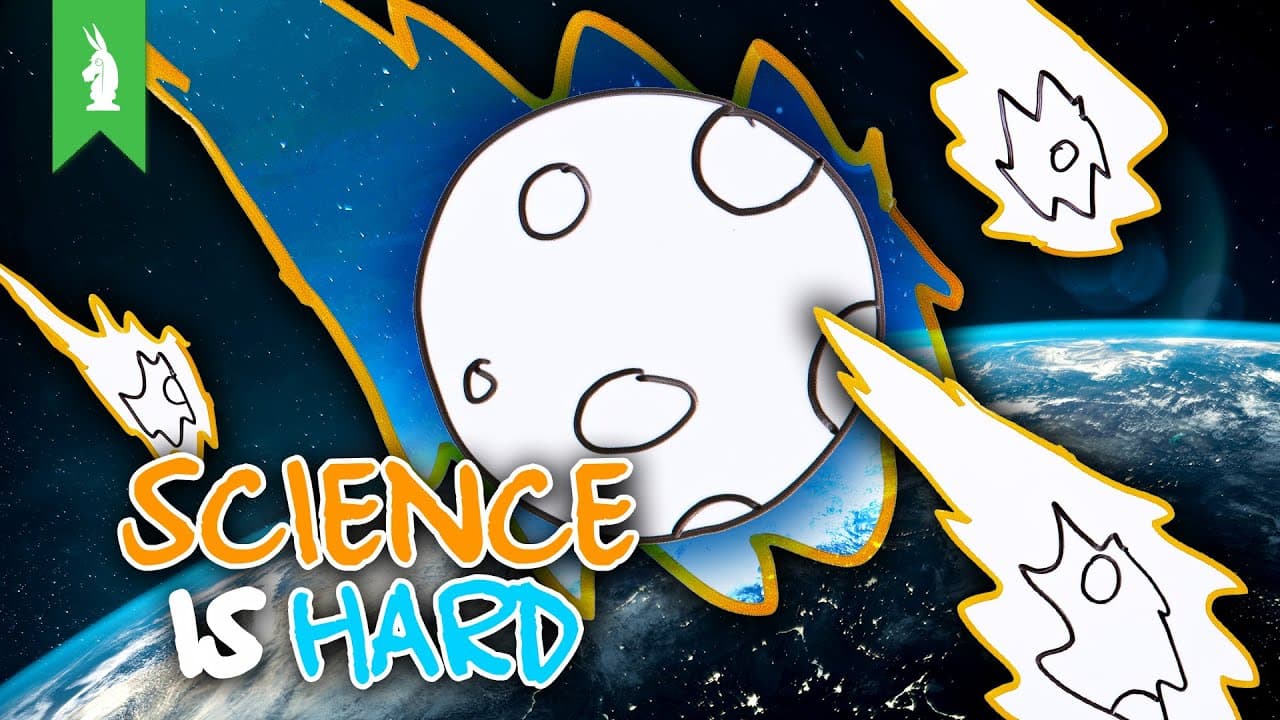
The possibility of the moon falling to Earth exists, but it is highly unlikely.
Transcript
- This video is brought to you by "Moonfall." (gentle electronic music) Do you ever go outside on a clear night, stare up at a bright, full moon, and think to yourself, "Holy (beep)! There's a giant rock circling our planet that, at any moment, could be thrown off its axis and sent down to cause immediate death for everyone and everything on Earth!... Read More
Key Insights
- 😘 The moon's orbit significantly influences Earth’s tides through gravitational forces, creating regular high and low tide patterns.
- 🥮 A massive celestial impact would be needed to knock the moon off its orbit, making such an occurrence extraordinarily unlikely.
- 😂 The Roche Limit explains the gravitational dynamics that protect the moon from being torn apart by Earth's forces if it gets too close.
- 🥮 The moon's presence stabilizes Earth's axial tilt, contributing to a consistent climate and seasonal patterns integral to life on Earth.
- 🤩 Without the moon, nighttime skies would be darker and stars brighter, leading to improved astronomical observation conditions.
- 🥺 The potential loss of the moon would result in climate chaos, as Earth's axial stability would be compromised, leading to radical changes in weather and seasons.
- 🤨 "Moonfall" raises intriguing scientific questions about cosmic events and their implications on Earth, fostering interest in astronomy education.
Install to Summarize YouTube Videos and Get Transcripts
Explore YouTube Video Summarizer or Get YouTube Transcript Extractor
Questions & Answers
Q: What is the main premise of the movie "Moonfall"?
"Moonfall" revolves around the catastrophic scenario where the moon is knocked off its orbit and begins to fall towards Earth, resulting in catastrophic tidal waves, gravitational shifts, and widespread destruction. The video explores whether such a scenario could occur in reality and examines the scientific aspects involved.
Q: How does the moon affect Earth's tides?
The moon influences ocean tides through its gravitational pull, which interacts with the Earth as they orbit each other. This gravitational relationship causes a variance in tidal levels, leading to high and low tides. If the moon were to be displaced from its orbit, these tidal effects could become more pronounced and chaotic.
Q: What is the Roche Limit, and why is it important?
The Roche Limit is the distance within which a celestial body, like the moon, would be torn apart by tidal forces exerted by the planet it orbits. For the moon, this limit is about 2.5 times Earth’s radius. If the moon were to pass within this limit, it could break apart and lead to catastrophic debris falling to Earth, even as parts may enter orbit.
Q: Could an asteroid impact significantly affect the moon's orbit?
Even the largest known asteroid, Ceres, would only create a crater on the moon and would not possess enough force to alter its orbit significantly or pull it down towards Earth. This emphasizes the stability of the moon’s current orbit and suggests that dramatic cosmic events would be necessary to cause such an occurrence.
Q: What would happen to Earth if the moon were to disappear?
If the moon were to vanish, Earth would experience more stable tides, roughly one-fourth the current size, creating less tidal chaos. However, the absence of the moon would lead to significant instability in Earth's axial tilt, resulting in unpredictable and extreme climate changes over time.
Q: Why is the moon's stability crucial for Earth's climate?
The moon provides stability to Earth's axial tilt, which is currently at about 23.4 degrees. This tilt helps create a relatively stable climate. Without the moon, shifts could exceed 45 degrees, drastically altering weather patterns, causing extreme seasons, and potentially resulting in severe ice ages.
Q: Is a real-life "Moonfall" scenario possible?
While technically feasible, a real-life "Moonfall" is very unlikely to occur. The likelihood of an event strong enough to displace the moon from its orbit is incredibly low. Therefore, while the film presents an entertaining story, it does not reflect probable scientific realities.
Q: What are the notable scientific aspects presented accurately in the film "Moonfall"?
The film accurately portrays the effects of the moon going out of orbit, including potential flooding, tsunamis, and other devastations that would arise. It also presents the Roche Limit concept correctly, allowing viewers to understand how such cosmic events could feasibly evolve scientifically.
Summary & Key Takeaways
-
The video discusses the fictional scenario of the movie "Moonfall," where the moon is knocked off its orbit and threatens Earth with disasters.
-
It explains the scientific realities behind the moon’s orbit, including the Roche Limit and how gravitational forces interact between the moon and Earth.
-
Despite the dramatic events portrayed in the film, the likelihood of such an occurrence is very low, though the consequences would be devastating if it were to happen.
Read in Other Languages (beta)
Share This Summary 📚
Summarize YouTube Videos and Get Video Transcripts with 1-Click
Try YouTube Summary with ChatGPT & Claude or YouTube Transcript Generator