L4.5 QED: Feynman Rules for QED
TL;DR
Learn how to apply Feynman rules in QED to calculate scattering processes and decays.
Transcript
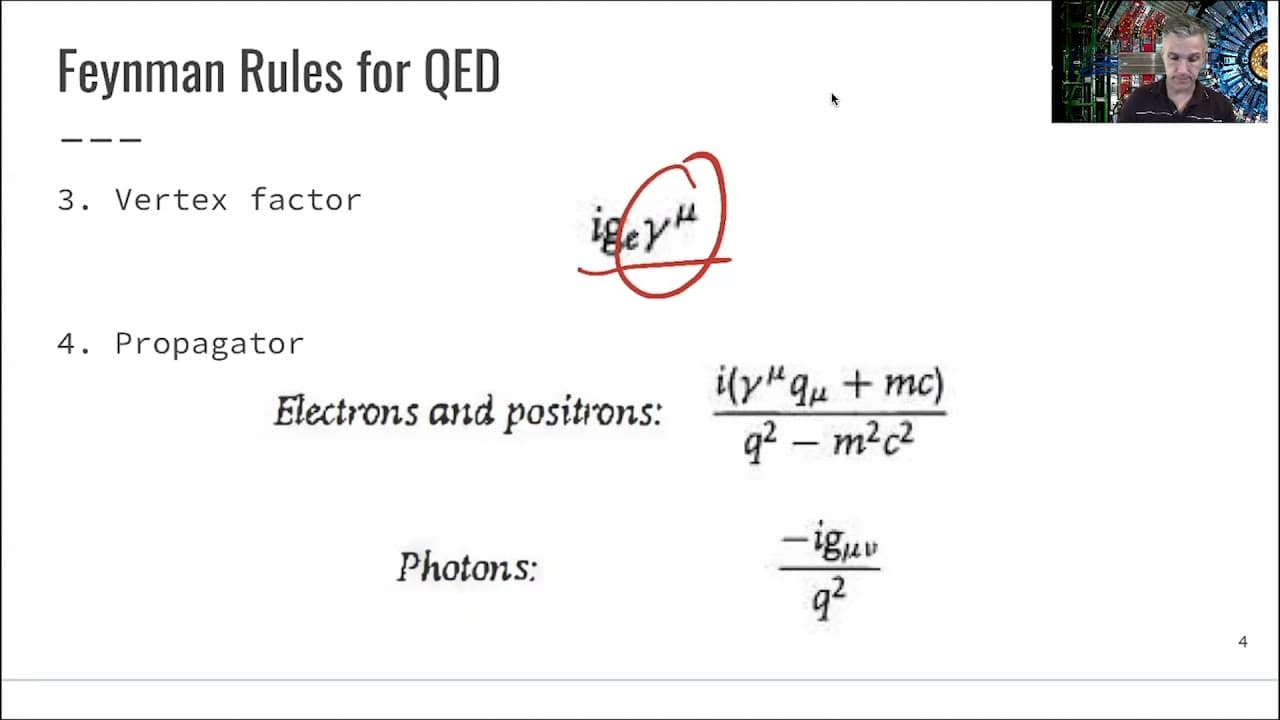
MARKUS KLUTE: All right. So welcome back to 8.701. So we have all ingredients now to prepare Feynman rules for QED. So that's the toolkit we need in order to make calculations to calculate scattering processes and decays. And we've already seen Feynman rules for our toy theory. Again, now the situation is a little bit more complicated, because we c... Read More
Key Insights
- 🧑🏭 QED Feynman rules involve notations, vertex factors, and propagators specific to the type of particles being considered, such as fermions and photons.
- 🍵 Renormalization is necessary to handle infinities generated from the integration of momentum in QED Feynman calculations.
- 🫥 The order in which calculations are executed in QED Feynman diagrams can impact the results, particularly when forming fermion lines.
Install to Summarize YouTube Videos and Get Transcripts
Explore YouTube Video Summarizer or Get YouTube Transcript Extractor
Questions & Answers
Q: What are the Feynman rules used for in QED?
Feynman rules are used to calculate scattering processes and decays in QED, providing a toolkit for physicists to make calculations.
Q: What is the significance of spin in QED Feynman diagrams?
Spin is an additional factor that needs to be considered in QED Feynman diagrams, along with energy and momentum. It affects the solutions and introduces new spinors and polarization vectors.
Q: How do QED Feynman diagrams account for internal lines?
QED Feynman diagrams include internal lines representing particles like electrons, positrons, and photons. These lines have different properties and vertex factors depending on whether they are massive or massless particles.
Q: How does energy and momentum conservation factor into QED Feynman calculations?
Energy and momentum conservation is enforced in QED Feynman calculations through the use of delta functions. Each internal line requires an integration factor and, after integration, cancels out with a delta function.
Summary & Key Takeaways
-
Feynman rules are essential tools for calculating scattering processes and decays in QED.
-
The rules for QED Feynman diagrams are similar to those of a toy theory, but with the addition of considering the spin of particles.
-
Notations, such as momentum and directions, must be clear and consistent when dealing with QED Feynman diagrams.
Read in Other Languages (beta)
Share This Summary 📚
Summarize YouTube Videos and Get Video Transcripts with 1-Click
Try YouTube Summary with ChatGPT & Claude or YouTube Transcript Generator
Explore More Summaries from MIT OpenCourseWare 📚


Summarize YouTube Videos and Get Video Transcripts with 1-Click
Try YouTube Summary with ChatGPT & Claude or YouTube Transcript Generator