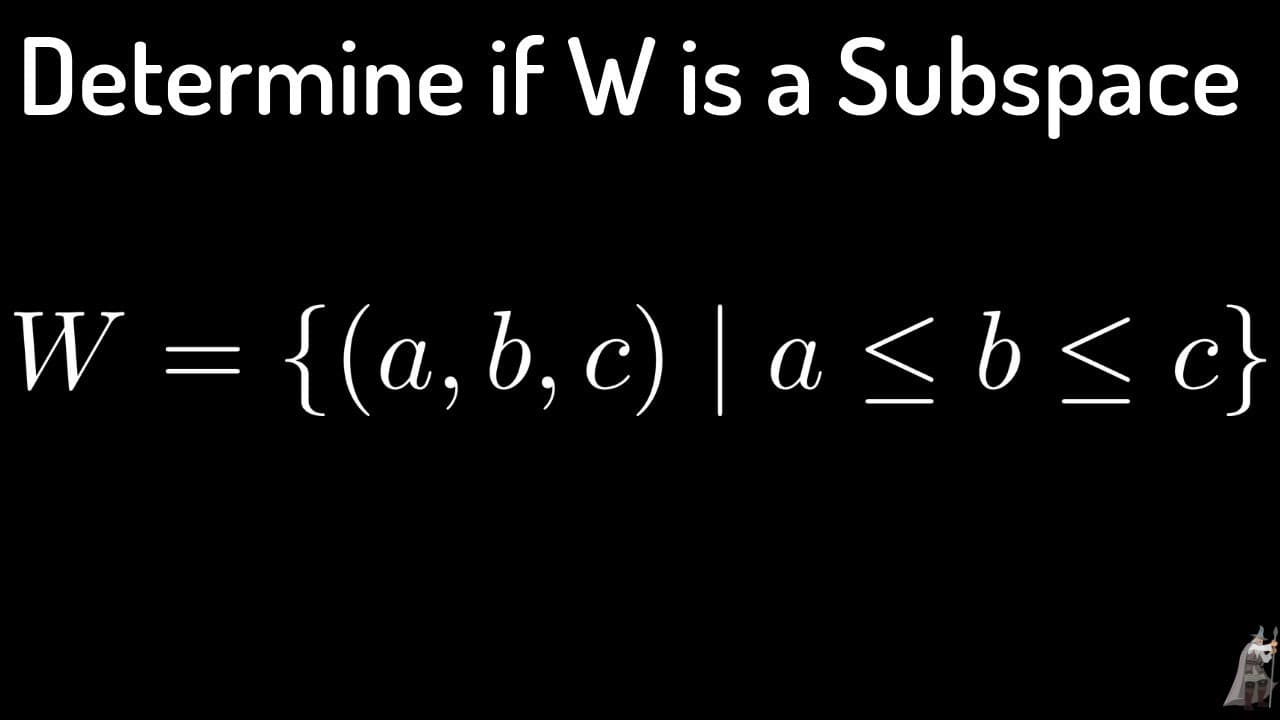
Determine if W= {(a, b, c)| a ≤ b ≤ c} is a Subspace of the Vector Space R^3
TL;DR
This video discusses the conditions for a set to be considered a subspace of a vector space and applies them to determine if set W is a subspace of R cubed.
Transcript
in this video we have a set W and we're being asked if it's a subspace of R cubed so over here on the right I've written down what it means for a set W to be a subspace of a vector space V so there's three conditions and if all three conditions are satisfied then we say that W is a subspace of V the first condition is that W is not equal to the emp... Read More
Key Insights
- 👾 A set W can be considered a subspace of a vector space V if it satisfies the conditions of non-emptiness, closure under vector addition, and closure under scalar multiplication.
- 😆 The first condition of non-emptiness is satisfied when the vector 0 0 0 is in set W.
- 😫 By violating the inequality in condition three, it is determined that set W is not a subspace of R cubed.
- 😫 Violating condition three means that there exists a vector and a scalar where the scalar product is not in set W, indicating that set W does not satisfy closure under scalar multiplication.
- ❎ The process of determining if the vector negative one times one two three is in set W involves multiplying each component of the vector by negative one and checking if the resulting inequality is true.
- ❎ The vector negative one negative two negative three is not in set W, as the inequality -1 ≤ -2 ≤ -3 is false.
Install to Summarize YouTube Videos and Get Transcripts
Explore YouTube Video Summarizer or Get YouTube Transcript Extractor
Questions & Answers
Q: What are the three conditions for a set to be considered a subspace of a vector space?
The three conditions for a set W to be a subspace of a vector space V are: 1) W is non-empty, 2) closure under vector addition (the sum of any two vectors in W is also in W), and 3) closure under scalar multiplication (the product of any vector in W with any scalar is also in W).
Q: How is set W determined to be non-empty in this problem?
In this problem, set W is determined to be non-empty by observing that the vector 0 0 0 satisfies the condition of having the first component less than or equal to the second, which is then less than or equal to the third.
Q: Why does violating condition three lead to the conclusion that set W is not a subspace?
Violating condition three, which states that for every vector X in W and every scalar C, the vector CX must also be in W, leads to the conclusion that set W is not a subspace. This is because if we can find just one vector and one scalar for which the scalar product is not in W, then set W does not satisfy closure under scalar multiplication.
Q: Can you explain the process of determining if the vector negative one times one two three is in set W?
The process involves multiplying each component of the vector one two three by negative one, resulting in the vector negative one negative two negative three. To determine if this vector is in set W, we check if the inequality -1 ≤ -2 ≤ -3 is true. However, since the inequality is false, it is concluded that the vector is not in set W.
Summary & Key Takeaways
-
A set W can be considered a subspace of a vector space V if it satisfies three conditions: non-emptiness, closure under vector addition, and closure under scalar multiplication.
-
In this video, the speaker evaluates whether set W is a subspace of R cubed based on these conditions.
-
The first condition is satisfied as set W is non-empty. However, by violating the inequality in condition three, it is concluded that set W is not a subspace of R cubed.
Read in Other Languages (beta)
Share This Summary 📚
Summarize YouTube Videos and Get Video Transcripts with 1-Click
Try YouTube Summary with ChatGPT & Claude or YouTube Transcript Generator
Explore More Summaries from The Math Sorcerer 📚
Summarize YouTube Videos and Get Video Transcripts with 1-Click
Try YouTube Summary with ChatGPT & Claude or YouTube Transcript Generator