10. Translation
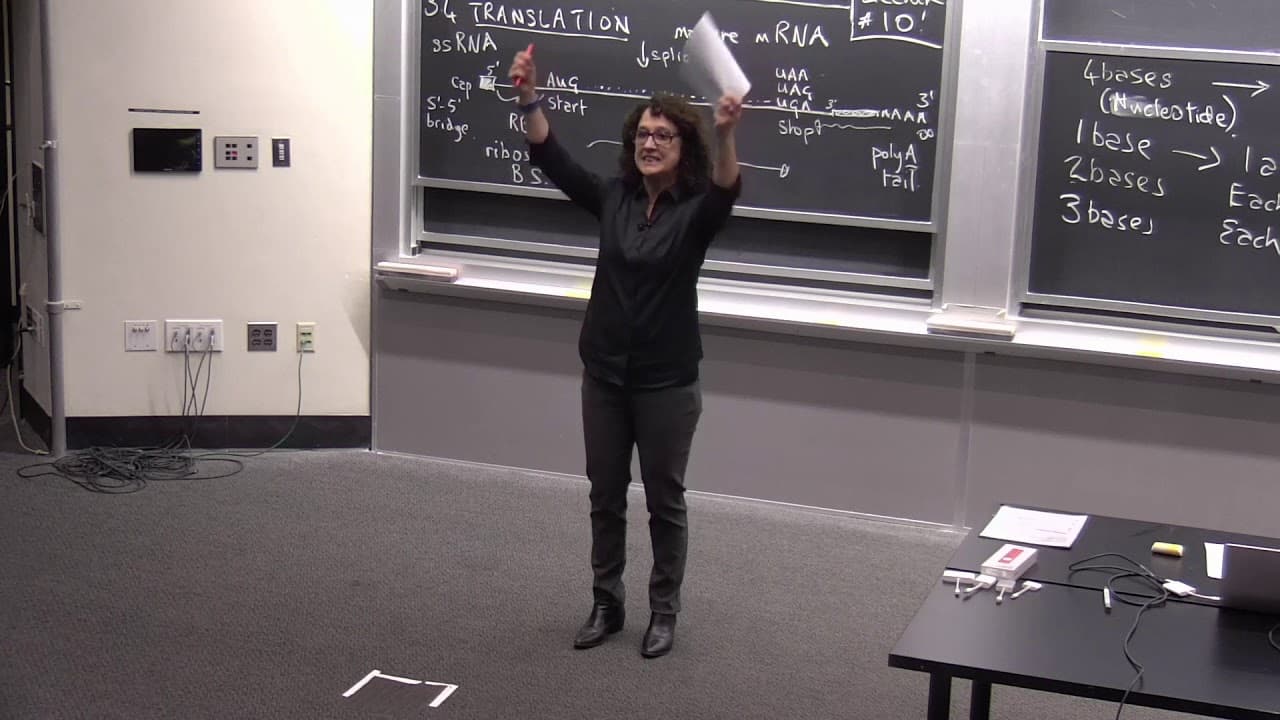
TL;DR
Translation is the process by which genetic information encoded in DNA is converted into proteins through the synthesis of messenger RNA (mRNA).
Transcript
[CREAKING] BARBARA IMPERIALI: So what we are going to talk about today, and I'm going to do something a little annoying, as usual, I want to take you somewhere here. Yeah, sure, back to carbon, that's fine. But what I want to show you is the sizes of the molecular players in translation because we are going here now from the smallest carbon atom. A... Read More
Key Insights
- 🖐️ Aminoacyl-tRNA synthetases play a crucial role in loading the correct amino acids onto tRNAs, ensuring accurate protein synthesis.
- 👨💻 The genetic code is degenerate, meaning multiple codons can code for the same amino acid, allowing for redundancy and flexibility in protein synthesis.
- 🥺 Errors in translation, such as frame-shift mutations and missense mutations, can lead to the production of abnormal proteins and potentially result in genetic diseases.
- 🫠 The ribosome is a large molecular complex that carries out the process of translation, reading codons on mRNA and synthesizing proteins.
- 🔂 Polysomes, which are clusters of ribosomes attached to a single mRNA molecule, can enable the simultaneous production of multiple copies of the same protein.
Install to Summarize YouTube Videos and Get Transcripts
Explore YouTube Video Summarizer or Get YouTube Transcript Extractor
Questions & Answers
Q: How are amino acids loaded onto transfer RNAs?
Amino acids are loaded onto tRNAs by aminoacyl-tRNA synthetases, which catalyze the attachment of amino acids to the 3' end of tRNAs, forming an ester bond.
Q: What is the role of the ribosome in translation?
The ribosome is the complex responsible for the synthesis of proteins. It consists of a small and large subunit that come together to form the active ribosome. The ribosome reads the codons on mRNA and catalyzes the formation of peptide bonds between amino acids, thereby assembling the protein.
Q: What happens during a frame-shift mutation?
A frame-shift mutation occurs when an insertion or deletion of nucleotides causes a shift in the reading frame of the mRNA. This results in a completely different sequence of codons and can lead to the production of a nonfunctional or truncated protein.
Q: What is the difference between a missense mutation and a nonsense mutation?
A missense mutation is a point mutation that changes a single nucleotide in the DNA sequence, resulting in the substitution of one amino acid for another in the protein sequence. A nonsense mutation, on the other hand, introduces a premature stop codon, leading to the truncation of the protein.
Summary & Key Takeaways
-
Translation is the process of converting the genetic information encoded in DNA into proteins through the synthesis of mRNA.
-
Transfer RNAs (tRNAs) play a crucial role in translation by carrying specific amino acids to the ribosomes, which act as the protein synthesis machinery.
-
The genetic code, consisting of codons, specifies the relationship between nucleotides in mRNA and amino acids in proteins.
-
Errors in translation can lead to mutations, such as nonsense and missense mutations, which can have varying effects on protein function.
Read in Other Languages (beta)
Share This Summary 📚
Summarize YouTube Videos and Get Video Transcripts with 1-Click
Try YouTube Summary with ChatGPT & Claude or YouTube Transcript Generator
Explore More Summaries from MIT OpenCourseWare 📚



Summarize YouTube Videos and Get Video Transcripts with 1-Click
Try YouTube Summary with ChatGPT & Claude or YouTube Transcript Generator