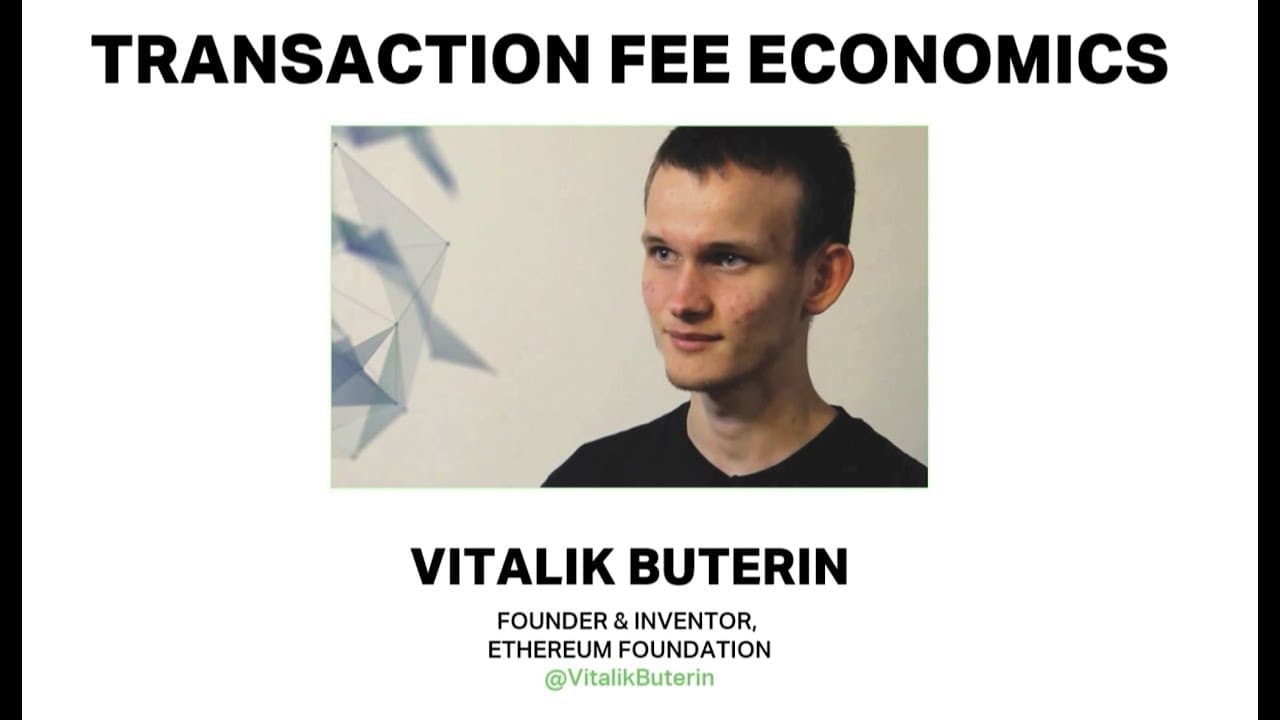
Keynote from Vitalik Buterin (Ethereum Foundation) at Ethereum Meetup 2018
TL;DR
Understanding the importance of transaction fee economics in ensuring the efficiency and sustainability of public blockchains.
Transcript
yeah the crazy annoying music is over okay so today I'm going to talk about a subject that's kind of a bit off the beaten path in that it doesn't tends to get as much media attention as some of the more flashy things like Casper and sharding and zero knowledge proof but at the same time it is something that is very important to a well-functioning p... Read More
Key Insights
- 🤱 Transaction fees in public blockchains provide a private benefit to the sender and a social cost to the network.
- 🎮 Pricing and controlling social costs in blockchain networks are essential for efficiency and sustainability.
- 🤱 Current transaction fee mechanisms can be inefficient, volatile, and manipulable.
- 🤱 The adoption of hybrid mechanisms like ongoing storage fees and hibernation can improve transaction fee markets and align incentives better.
Install to Summarize YouTube Videos and Get Transcripts
Explore YouTube Video Summarizer or Get YouTube Transcript Extractor
Questions & Answers
Q: Why are transaction fees important in public blockchains?
Transaction fees incentivize the inclusion of transactions in the blockchain and cover the social costs incurred by other nodes in the network.
Q: What are some issues with current transaction fee mechanisms?
Current mechanisms, such as first price auctions, can lead to inefficiencies, volatility, and manipulation by miners.
Q: How can transaction fee economics be improved?
Implementing hybrid mechanisms, like ongoing storage fees and hibernation, can align incentives better and improve the efficiency of transaction fee markets.
Q: What are the challenges in implementing ongoing storage fees?
Ongoing storage fees can make the developer experience more difficult, especially for contracts that may go bankrupt and public goods contracts.
Summary & Key Takeaways
-
Transaction fees in public blockchains provide a private benefit to the sender by successfully including their transaction in the blockchain.
-
However, the social cost of including a transaction is an externality paid by other nodes in the network, including proposers, validators, users, and even future users.
-
Current mechanisms for setting transaction fees, such as first price auctions, can be inefficient and lead to volatility and manipulation.
Read in Other Languages (beta)
Share This Summary 📚
Summarize YouTube Videos and Get Video Transcripts with 1-Click
Try YouTube Summary with ChatGPT & Claude or YouTube Transcript Generator
Explore More Summaries from TechCrunch 📚






Summarize YouTube Videos and Get Video Transcripts with 1-Click
Try YouTube Summary with ChatGPT & Claude or YouTube Transcript Generator