How to Convert a D Flip-Flop to a JK Flip-Flop
TL;DR
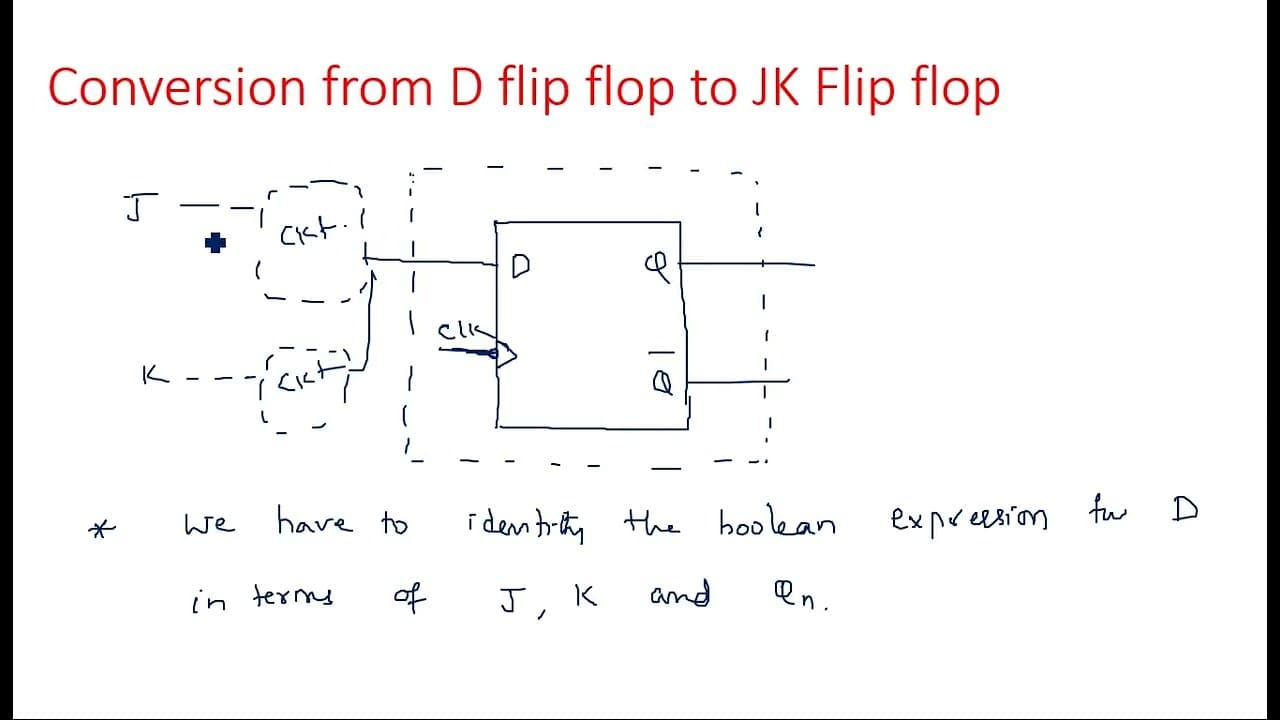
To convert a D flip-flop to a JK flip-flop, you need to add logic circuitry that generates the J and K inputs while maintaining the existing clock and output. The conversion relies on understanding the relationships between external inputs, present states, and next states, with a specific Boolean expression: D = K'QN + JQ'. This allows for the correct configuration of logic gates required for the conversion.
Transcript
hi everyone in this video I'm going to tell you about the conversion of a JK flip flop into sorry D flip plop into a JK flip plop conversion from a d flip plop into JK flip plop that means we have D flip flop with us that D flip flop needs to be converted into J and K okay uh listen carefully in the previous video so we have seen the conversion of ... Read More
Key Insights
- 🐬 The conversion process from a D flip-flop to a JK flip-flop requires additional logic circuitry to integrate inputs J and K.
- 🙈 Understanding the D flip-flop's core functionality is key, as the output reflects the input on the clock transition.
- 😄 The derived Boolean expression D = K'QN + JQ' enables the implementation of the logic circuit necessary for conversion.
- 🔬 Converting flip-flops involves using various logic gates, including AND gates for combining signals and NOT gates for signal inversion.
- 🎮 The video emphasizes the visual aspect with a diagrammatic representation of the logic circuit for clearer understanding.
- 🚰 Both truth tables and excitation tables are integral to mapping out the states and transitions in flip-flop conversions.
- 👣 The conversion table serves as a guide for tracking how inputs and states interrelate in achieving the desired functionality.
Install to Summarize YouTube Videos and Get Transcripts
Explore YouTube Video Summarizer or Get YouTube Transcript Extractor
Questions & Answers
Q: What is the main goal of the video?
The main goal of the video is to demonstrate how to convert a D flip-flop into a JK flip-flop. This process involves understanding key components like external inputs and the necessary logic circuitry. The speaker aims to make the concepts clear by providing step-by-step guidance and visual diagrams.
Q: Why is a conversion table important in this context?
A conversion table is crucial for understanding the relationship between the current state of a flip-flop and the desired output. It helps in tracking how external inputs, present states, and next states interact. This information is vital for accurately creating the Boolean expressions required for the conversion process.
Q: What are the inputs for the D flip-flop during the conversion?
The inputs for the D flip-flop during the conversion include the external inputs J and K, which are essential for defining the behavior of the JK flip-flop. Additionally, the current state or output (QN) from the D flip-flop is also used to determine the values for J and K in the conversion process.
Q: Can you describe the role of logic gates in the conversion?
Logic gates play a fundamental role in the conversion process, as they form the circuitry that generates the necessary inputs for the JK flip-flop from the D flip-flop. Specifically, AND gates combine the inputs while a NOT gate inverts the relevant signals. Together, these gates define the output D based on the states of J, K, and Q.
Summary & Key Takeaways
-
The tutorial explains how to convert a D flip-flop into a JK flip-flop by using additional logic circuits to create inputs J and K while retaining the flip-flop's clock and output.
-
A detailed conversion table is outlined, showing the relationship between external inputs, present states, and next states, emphasizing the importance of accurately mapping these variables.
-
The Boolean expression for the D flip-flop is derived along with a logic circuit diagram that visualizes the necessary components, including AND, OR, and NOT gates for the conversion process.
Read in Other Languages (beta)
Share This Summary 📚
Summarize YouTube Videos and Get Video Transcripts with 1-Click
Try YouTube Summary with ChatGPT & Claude or YouTube Transcript Generator