ImageGPT (Generative Pre-training from Pixels)
TL;DR
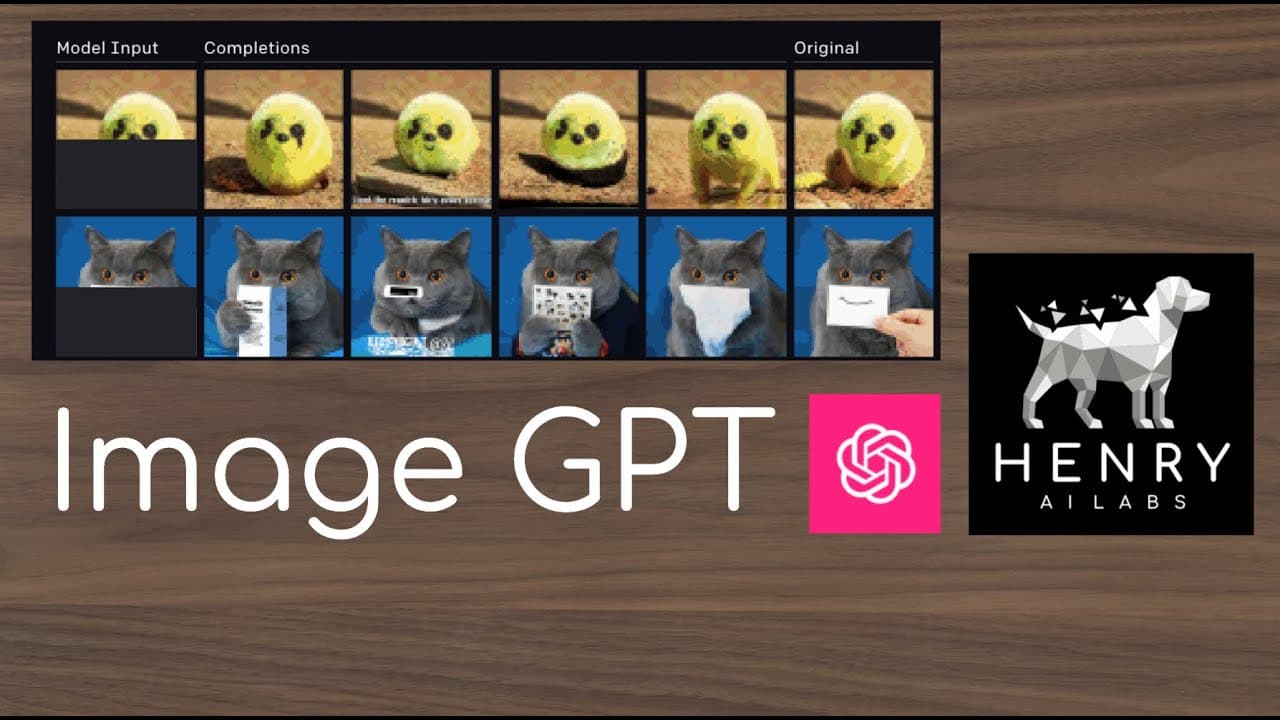
This video summarizes OpenAI's 6.8 billion parameter Image GPT model and its implications for computer vision.
Transcript
this video will explain the exciting new image GPT model from open AI natural language processing research has seen huge gains by pre-training transformer models with the famous self attention layer on large amounts of unlabeled text through Auto regressive language modeling and then fine-tuning the models for downstream tasks auto regressive langu... Read More
Key Insights
- 😑 OpenAI's Image GPT applies generative pre-training to image processing, demonstrating that larger models can yield better representation learning outcomes.
- 👻 The architecture incorporates a decoder-only transformer setup with self-attention, allowing it to handle the high dimensionality of image data effectively.
- 🤳 Techniques such as down-sampling and color clustering are employed to mitigate memory limitations inherent in standard self-attention mechanisms.
- 🛀 Comparative analysis shows Image GPT performs better in certain tasks than previous contrastive learning methods despite having a similar loss metric.
- ❓ Generative models can adaptively predict pixels using learned contexts, enhancing the capabilities in tasks such as image completion and generation.
- 👨🔬 Image GPT's findings suggest promising directions for further research in deep learning and representation learning, particularly regarding scaling and context management.
- 🖱️ The use of generative models to learn representations indicates a shift toward exploring new methodologies for computer vision challenges.
Install to Summarize YouTube Videos and Get Transcripts
Explore YouTube Video Summarizer or Get YouTube Transcript Extractor
Questions & Answers
Q: What is the primary goal of the Image GPT model?
The main goal of the Image GPT model is to explore generative pre-training for image representation learning, similarly to how GPT models function for text. By leveraging large-scale transformers, the researchers aim to improve the model's ability to predict pixels and learn meaningful representations from images.
Q: How does Image GPT handle the quadratic complexity associated with self-attention?
Image GPT manages quadratic complexity by employing context reduction and down-sampling images to lower resolutions, which allows the model to fit within memory limitations. Additionally, k-means clustering is used to represent colors in a simplified manner, making it feasible to compute the necessary operations without running into memory issues.
Q: What are the advantages of using generative pre-training over traditional contrastive learning methods?
Generative pre-training models like Image GPT have shown better performance in learning representations compared to traditional contrastive learning methods like SimCLR. By scaling the model size, generative models can yield improved results even when they have similar validation loss, allowing them to outperform contrastive approaches in downstream classification tasks.
Q: What are some innovative techniques discussed in the video for improving the efficiency of image modeling?
The video highlights two main techniques: context reduction, which involves down-sampling the images to lower resolutions, and k-means clustering for color representation. These methods help manage memory usage and computational efficiency, enabling the model to process high-dimensional inputs effectively without excessive resource consumption.
Q: How do the findings of Image GPT compare with previous models like BigGAN?
While BigGAN was among the most successful architectures for generative modeling, Image GPT significantly narrows the performance gap in representation learning by scaling up its model size to 6.8 billion parameters. This comparison emphasizes the advancements that come with larger models in effectively learning and fine-tuning representations for classification tasks.
Q: What is the relationship between pre-training tasks and downstream performance?
The video notes that a model’s performance on downstream tasks, like ImageNet classification, can correlate with the quality of its learned representations during pre-training. Through techniques like linear probing, researchers found that intermediate layers often provided better representations than those at the end, indicating the importance of generative training tasks in enhancing overall model efficacy.
Summary & Key Takeaways
-
The video explains the Image GPT model by OpenAI, which utilizes a transformer architecture with 6.8 billion parameters for generative pre-training, enabling significant advancements in image representation learning.
-
It discusses the challenges of implementing self-attention in high-dimensional inputs and how techniques like context reduction and k-means color clustering help overcome these issues.
-
The comparison with contrastive learning methods like SimCLR illustrates the advantages of generative approaches, demonstrating improved performance on tasks such as ImageNet classification.
Read in Other Languages (beta)
Share This Summary 📚
Summarize YouTube Videos and Get Video Transcripts with 1-Click
Try YouTube Summary with ChatGPT & Claude or YouTube Transcript Generator
Explore More Summaries from Connor Shorten 📚
Summarize YouTube Videos and Get Video Transcripts with 1-Click
Try YouTube Summary with ChatGPT & Claude or YouTube Transcript Generator