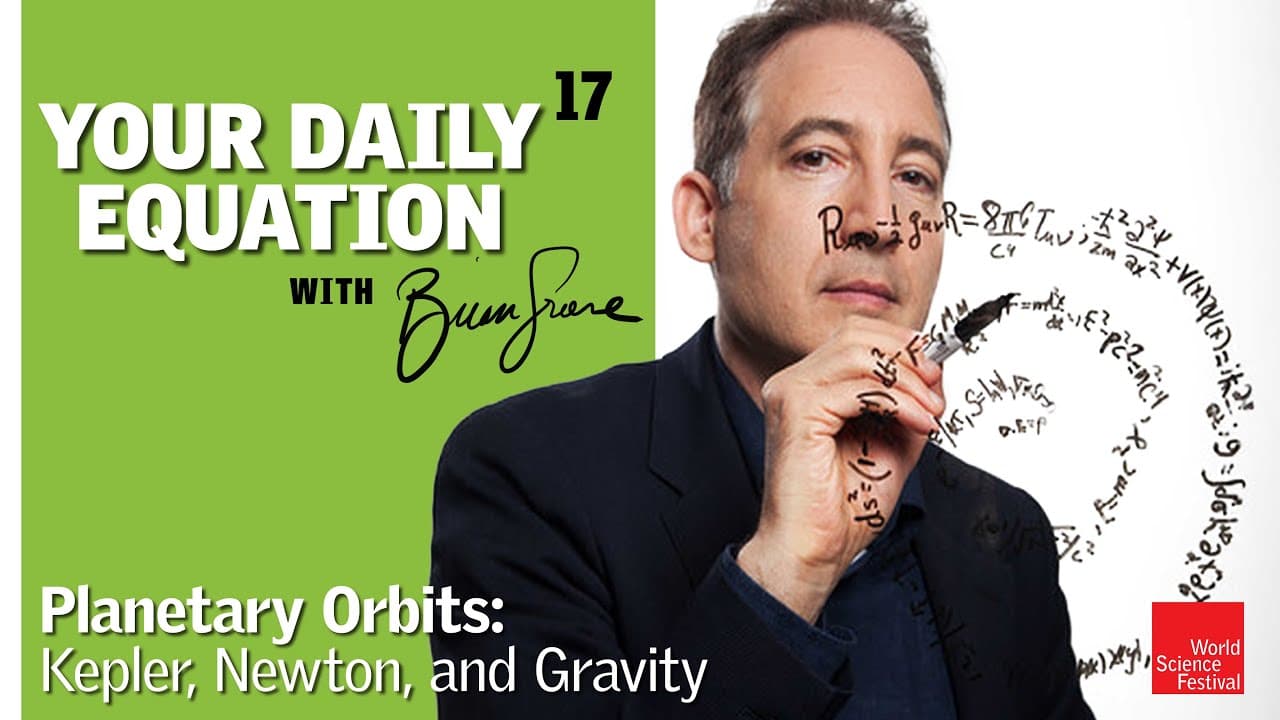
Your Daily Equation #17: Planetary Orbits: Kepler, Newton, and Gravity
TL;DR
Isaac Newton's equations of planetary motion revolutionized our understanding of the physical universe, revealing the relationship between mass, force, and acceleration.
Transcript
hi everyone welcome to this next episode of your daily equation and today I'm going to focus on some some very basic but very important very pivotal insights into the workings of the physical universe that forced us to cast our minds pretty far back to say even as far back as the late 1600s because I'm going to talk about planetary motion the very ... Read More
Key Insights
- ❓ Isaac Newton's equations of planetary motion revolutionized our understanding of the physical universe.
- 🗂️ The force of gravity is determined by the product of the masses of two objects divided by the square of their separation.
- 💆 Circular motion is achieved when the magnitude of the force of attraction is equal to the mass times the acceleration.
- 👮 Kepler's law states that the square of the period of an orbiting object is proportional to the cube of its distance from the central object.
- ❓ The escape velocity is the minimum velocity required for an object to escape the gravitational pull of another object.
- 🐎 The speed given to a planet determines the shape of its trajectory, with circular, elliptical, parabolic, and hyperbolic paths being possible.
- 👾 The equations of planetary motion involve concepts of space, time, and the relationship between force, mass, and acceleration.
Install to Summarize YouTube Videos and Get Transcripts
Explore YouTube Video Summarizer or Get YouTube Transcript Extractor
Questions & Answers
Q: How did Isaac Newton revolutionize our understanding of the physical universe?
Isaac Newton was able to encapsulate the patterns and relationships observed in planetary motion into simple mathematical equations, providing a foundation for our modern understanding of the physical universe.
Q: What is the force of gravity between two objects?
The force of gravity between two objects is determined by the product of their masses divided by the square of their separation. It is an attractive force that acts along the radial direction, pulling the objects together.
Q: What is the equation for circular motion?
Circular motion is achieved when the magnitude of the force of attraction between two objects is equal to the mass times the acceleration. This equation allows us to calculate the velocity required for an object to travel in a circular orbit.
Q: How are the shapes of planetary trajectories determined?
The initial velocity given to a planet determines the shape of its trajectory. Depending on the speed, the planet can follow a circular, elliptical, parabolic, or hyperbolic path, each corresponding to a different relationship between the speed and the escape velocity.
Summary & Key Takeaways
-
Isaac Newton's equations of planetary motion were groundbreaking and provided the first step into our modern understanding of the physical universe.
-
The force of gravity between two objects is determined by the product of their masses divided by the square of their separation.
-
Circular motion is achieved when the magnitude of the force of attraction is equal to the mass times the acceleration, which can be derived from the equations.
Read in Other Languages (beta)
Share This Summary 📚
Summarize YouTube Videos and Get Video Transcripts with 1-Click
Try YouTube Summary with ChatGPT & Claude or YouTube Transcript Generator
Explore More Summaries from World Science Festival 📚



Summarize YouTube Videos and Get Video Transcripts with 1-Click
Try YouTube Summary with ChatGPT & Claude or YouTube Transcript Generator