Speed Control Of DC Motor | Armature resistance control | DC machines | Lec-60
TL;DR
Armature resistance control is a method to manage the speed of DC motors.
Transcript
hello everyone in this session we will discuss about the armature resistance control so the armature resistance control actual this topic is reloaded related to the speed control of dc motor so in this how we can control the speed of the dc motor by using the armature resistance we have the very good relation between speed and armature is like this... Read More
Key Insights
- 🧑🦼 Armature resistance control effectively manages the speed of a DC motor by altering the voltage across the armature.
- 👻 The principle that speed is inversely proportional to the flux allows for strategic adjustments in operational settings.
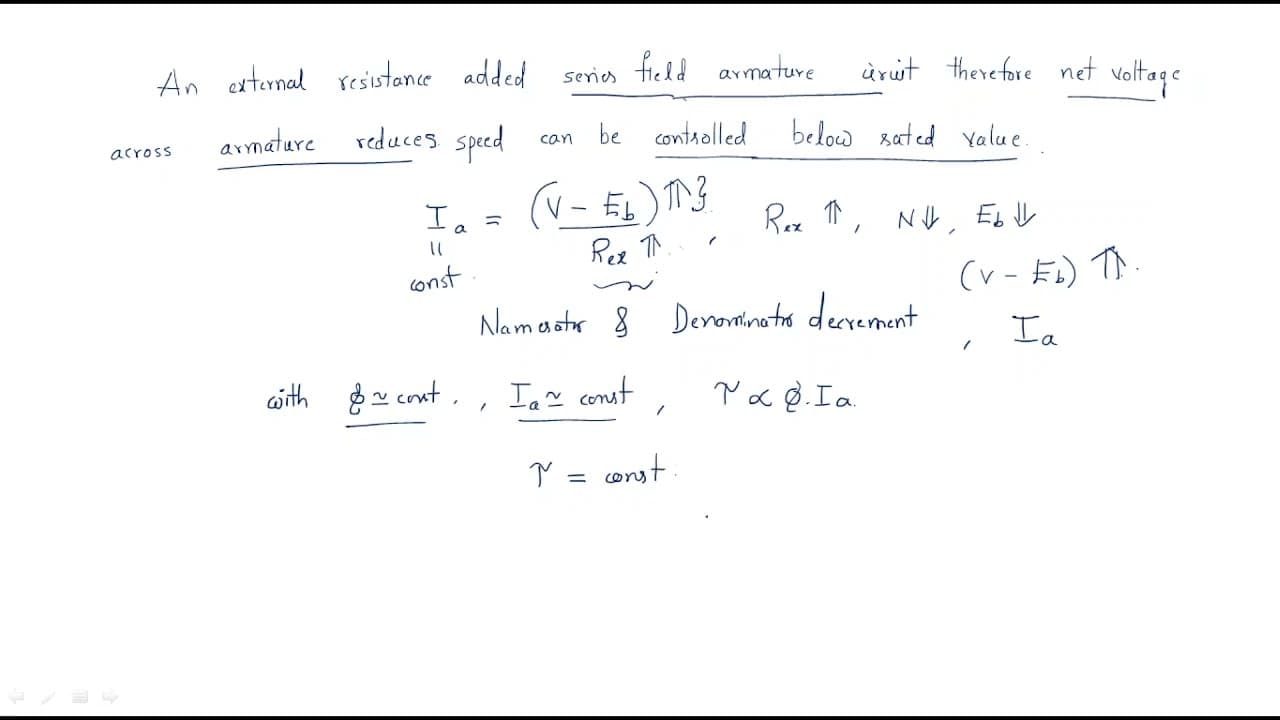
- ☠️ Introducing external resistance in series with the armature circuit helps regulate the motor's performance, especially below rated speeds.
- ✊ Constant torque is crucial for maintaining efficiency, even as power requirements change with speed adjustments.
- 🧑🦼 Back EMF and armature voltage differences are fundamental in calculating effective motor speed regulation.
- 🦾 Understanding electrical and mechanical relationships within the motor can enhance control strategies and operational decision-making.
- 🖐️ The dynamics of armature current play a significant role in both speed calculations and overall motor efficiency.
Install to Summarize YouTube Videos and Get Transcripts
Explore YouTube Video Summarizer or Get YouTube Transcript Extractor
Questions & Answers
Q: What is armature resistance control in a DC motor?
Armature resistance control is a method used to adjust the speed of a DC motor by incorporating additional external resistance in the armature circuit. This method impacts the voltage across the armature, allowing operators to decrease speed while maintaining other operational parameters, such as torque, constant.
Q: How does increasing external resistance affect motor speed?
Increasing external resistance lowers the total voltage available for the armature, resulting in decreased speed. This is because the speed of the motor is determined by the difference between the applied voltage and the drops due to armature and external resistances, leading to lower back EMF and thus a reduced operational speed.
Q: What is the relationship between torque and speed in this context?
In the context of armature resistance control, torque remains constant while speed becomes variable as resistance is added. This is because the power relationship indicates that for a constant torque, increased speed results in increased power demand, but adjusting resistance allows speed to be controlled without compromising torque.
Q: Why is flux considered constant in a shunt DC motor?
In a DC shunt motor, the field windings are in parallel to the armature circuit, allowing for a constant magnetic field (flux) as long as the shunt current remains stable. This constancy is critical as it stabilizes the operational characteristics of speed and torque while using armature resistance control methods.
Q: What is the formula for calculating armature current?
The armature current can be calculated using the formula: Ia = (V - Eb) / Ra, where V is the total voltage, Eb is the back EMF, and Ra is the armature resistance. This relationship highlights how external resistance adjustments impact both current flow and speed.
Q: Can the speed of a DC motor be controlled only using armature resistance?
Yes, the speed of a DC motor can primarily be controlled using armature resistance. However, while this method is effective for speeds below the rated value, it may also lead to increased power losses due to heat generated in the additional resistance.
Summary & Key Takeaways
-
Armature resistance control allows for the adjustment of the speed of a DC shunt motor by incorporating external resistance within the armature circuit.
-
By increasing external resistance, the total voltage across the armature decreases, leading to a reduction in the motor's speed while keeping the torque constant.
-
The relationship between power, speed, and torque indicates that a constant torque will result in variable power when the speed is controlled below the rated value.
Read in Other Languages (beta)
Share This Summary 📚
Summarize YouTube Videos and Get Video Transcripts with 1-Click
Try YouTube Summary with ChatGPT & Claude or YouTube Transcript Generator