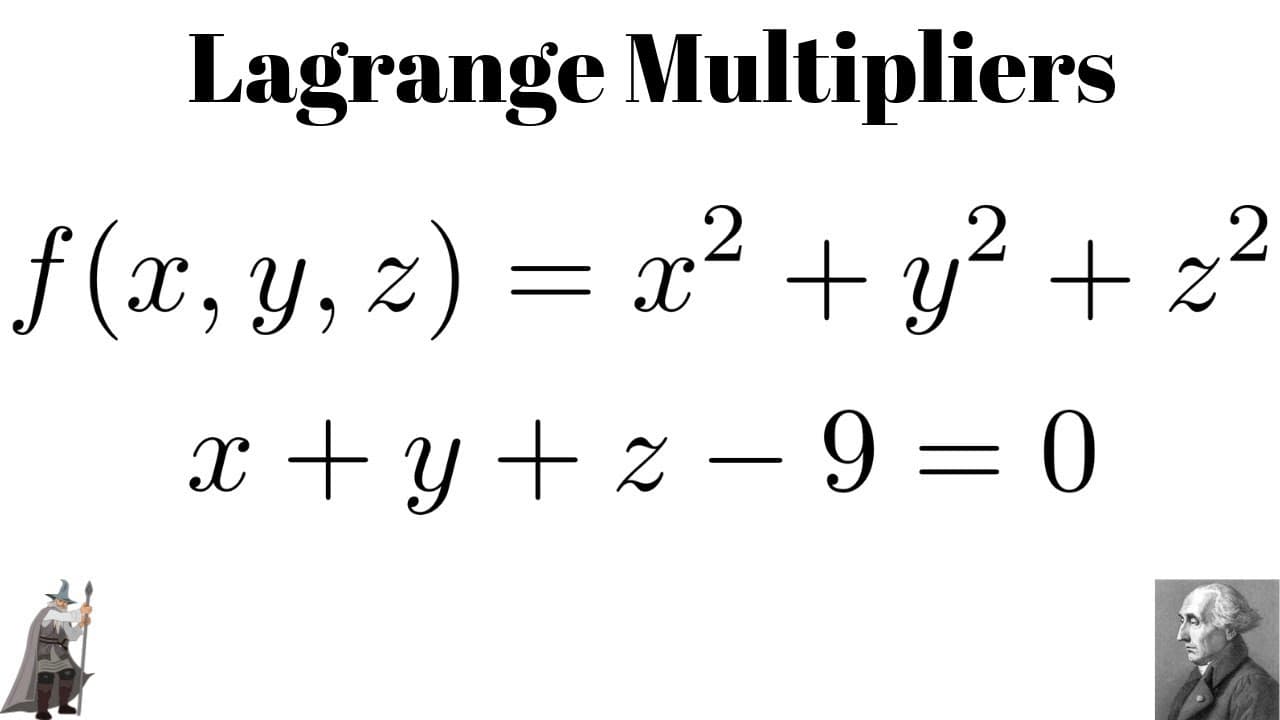
Lagrange Multipliers Minimum of f(x, y, z) = x^2 + y^2 + z^2 subject to x + y + z - 9 = 0
TL;DR
The video explains how to find the minimum value of a function using Lagrange multipliers, using a given constraint equation.
Transcript
in this video we're going to find the minimum of this function subject to this constraint over here using the method of LaGrange multipliers so when you're using the method of LaGrange multipliers you have to start by solving the following equations so we have the gradient of F X Y Z is equal to lambda times the gradient of G of X Y Z and you also ... Read More
Key Insights
- ❓ Lagrange multipliers are used to optimize functions subject to constraint equations.
- ❓ Solving gradient equations is a crucial step in using Lagrange multipliers.
- 🆘 The constraint equation helps determine the constant value in optimization problems.
Install to Summarize YouTube Videos and Get Transcripts
Explore YouTube Video Summarizer or Get YouTube Transcript Extractor
Questions & Answers
Q: What is the purpose of using Lagrange multipliers in optimization?
Lagrange multipliers are used to optimize a function subject to a constraint. They help find the maximum or minimum values of the function while satisfying the given constraint.
Q: How do you solve the gradient equations when using Lagrange multipliers?
To solve the gradient equations, you equate the partial derivatives of the function with the Lagrange multiplier times the partial derivatives of the constraint equation. This helps find the values of the variables and the multiplier.
Q: How do you handle the constraint equation in Lagrange multipliers?
The constraint equation is solved separately after finding the values of the variables and the Lagrange multiplier. By substituting the values into the constraint equation, the constant value of the constraint can be determined.
Q: What is the significance of finding the minimum function value using Lagrange multipliers?
Finding the minimum function value helps in optimization problems where minimizing a function under certain constraints is desired. Lagrange multipliers provide a systematic approach to finding these minimum values.
Summary & Key Takeaways
-
The video explains the process of using Lagrange multipliers to find the minimum value of a function subject to a given constraint equation.
-
It discusses the steps involved, including solving the gradient equations and the constraint equation.
-
By solving the equations, the video demonstrates how to find the values of the variables that correspond to the minimum function value.
Read in Other Languages (beta)
Share This Summary 📚
Summarize YouTube Videos and Get Video Transcripts with 1-Click
Try YouTube Summary with ChatGPT & Claude or YouTube Transcript Generator
Explore More Summaries from The Math Sorcerer 📚



Summarize YouTube Videos and Get Video Transcripts with 1-Click
Try YouTube Summary with ChatGPT & Claude or YouTube Transcript Generator