Averages aptitude | Squares & Cubes | Aptitude | Part- 04 | Bharath Kumar
TL;DR
The content explores how to calculate the average of squares and cubes of natural numbers.
Transcript
hi everyone welcome to the session in this session we will discuss about uh some more problems related to averages uh here in the last session we already started the problems uh the basic problems uh started in averages topic now we will discuss a few more problems in averages let's see the first question in this session see here find the average o... Read More
Key Insights
- 😒 The average of squares of natural numbers uses the formula n(n + 1)(2n + 1)/6, effectively aiding calculations.
- 🧊 For cubes, the average calculation relies on (n^2)(n + 1)^2/4, promoting efficient problem-solving.
- ❓ Proper substitutions and simplifications are crucial for correct average determination in mathematical problems.
- 🈸 Understanding both the formulas and their applications enhances one's competency in solving average-related problems in mathematics.
- 🕵️ A focus on the units place can facilitate quicker calculations and help detect errors earlier in the process.
- 🍳 Breaking down complex problems into simpler components boosts comprehension and problem-solving abilities.
- 📔 The concepts covered are foundational for more advanced math topics related to statistics and analytical problem-solving.
Install to Summarize YouTube Videos and Get Transcripts
Explore YouTube Video Summarizer or Get YouTube Transcript Extractor
Questions & Answers
Q: What is the formula used to calculate the average of squares of natural numbers?
The average of squares of natural numbers is calculated using the formula: Sum of squares divided by the number of observations. The sum of squares for the first n natural numbers is given by n(n + 1)(2n + 1)/6. This formula allows for efficient calculation of the average without needing to sum each square individually.
Q: How is the average of cubes of natural numbers determined?
To find the average of cubes from 1 to n, you use the formula: Sum of cubes divided by the number of observations, where the sum of cubes for the first n natural numbers is given by (n^2)(n + 1)^2/4. This method provides a quick means to derive the average without extensive calculations.
Q: Why is simplification important in calculating these averages?
Simplification streamlines calculations, making them more manageable and less prone to error. In working through the problems, the presenter highlights canceling terms, performing unit digit checks, and directly substituting to avoid lengthy computations, which increases precision and efficiency.
Q: How can one verify their answer when calculating averages?
Verification involves cross-checking with multiple calculation methods if possible, using estimation techniques, or comparing with known results. Checking units place digits during calculations can also signal potential errors and guide you towards the correct answer.
Summary & Key Takeaways
-
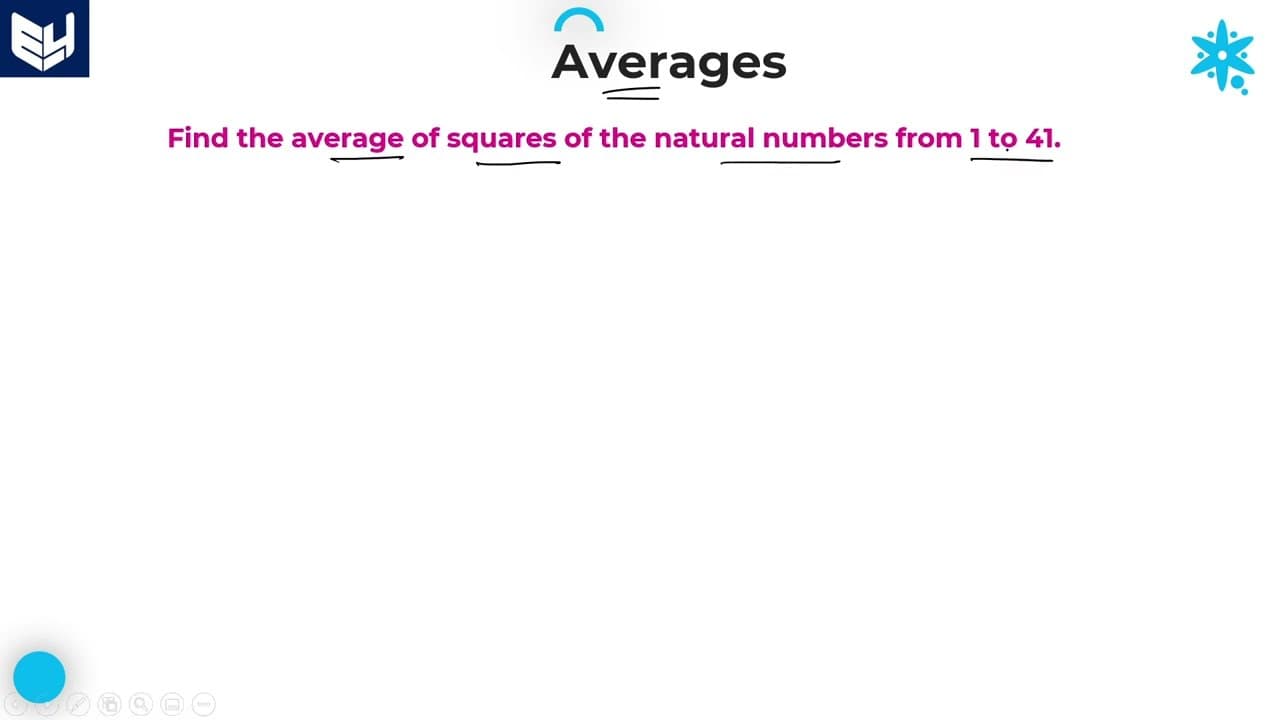
The session begins with calculating the average of the squares of natural numbers from 1 to 41, using the formula for the sum of squares and substituting the appropriate values.
-
Following the squares, the session explains how to find the average of the cubes of natural numbers from 1 to 27, utilizing the formula for the sum of cubes and demonstrating the calculation step-by-step.
-
The presenter emphasizes importance of careful substitutions and simplifications in calculations, providing examples to ensure understanding of average computation in mathematical contexts.
Read in Other Languages (beta)
Share This Summary 📚
Summarize YouTube Videos and Get Video Transcripts with 1-Click
Try YouTube Summary with ChatGPT & Claude or YouTube Transcript Generator