Quantum Chemistry 1.2 - Photoelectric Effect
TL;DR
Einstein's quantum hypothesis explains the photoelectric effect, contradicting classical physics.
Transcript
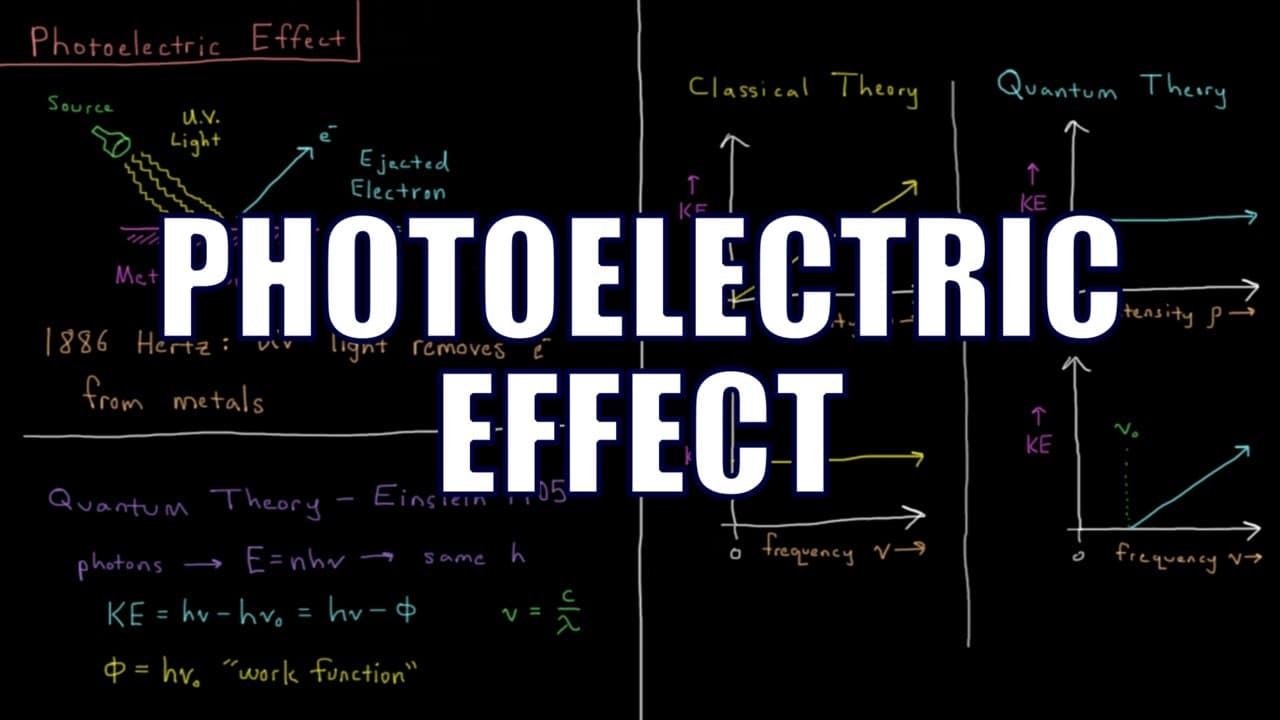
this video will cover the photoelectric effect which is a second example of when a Quantum hypothesis solved a problem for classical physics so let's imagine we have some light source here which I've drawn sort of shaped like a flashlight and it's emitting some kind of ultraviolet light so light which is a little bit higher ... Read More
Key Insights
- The photoelectric effect involves ultraviolet light hitting a metal surface, causing electron ejection, a phenomenon unexplained by classical physics.
- Einstein proposed that light consists of photons with quantized energy, explaining the photoelectric effect accurately.
- The kinetic energy of ejected electrons depends on the frequency of light, not its intensity, contrary to classical predictions.
- Einstein's hypothesis introduced the concept of photons, each carrying energy proportional to its frequency, quantified as H Nu.
- The work function, H Nu naught, is the energy threshold required to eject an electron from a metal surface.
- Classical physics incorrectly predicted that electron kinetic energy would increase with light intensity, regardless of frequency.
- Einstein's theory aligned with experimental results, showing that only light above a certain frequency threshold can eject electrons.
- The same Planck's constant used in blackbody radiation theory was crucial in formulating the equations for the photoelectric effect.
Install to Summarize YouTube Videos and Get Transcripts
Explore YouTube Video Summarizer or Get YouTube Transcript Extractor
Questions & Answers
Q: What is the photoelectric effect?
The photoelectric effect is a phenomenon where ultraviolet light striking a metal surface causes the ejection of electrons. This effect challenged classical physics, which could not explain why electron ejection depended on light frequency rather than intensity. Einstein's quantum hypothesis provided an accurate explanation by introducing the concept of photons.
Q: How did Einstein's hypothesis explain the photoelectric effect?
Einstein's hypothesis explained the photoelectric effect by proposing that light is composed of photons, each with quantized energy proportional to its frequency. He suggested that electron ejection occurs when a photon transfers its energy to an electron. This explained why kinetic energy depends on frequency, not intensity, aligning with experimental observations.
Q: What is the role of frequency in the photoelectric effect?
In the photoelectric effect, the frequency of light plays a crucial role because it determines the energy of the photons. Only photons with energy exceeding the metal's work function can eject electrons. Thus, the kinetic energy of ejected electrons increases with frequency, contradicting classical predictions that intensity would affect kinetic energy.
Q: What was the classical physics prediction about the photoelectric effect?
Classical physics predicted that the kinetic energy of electrons ejected in the photoelectric effect would increase with the intensity of light, regardless of its frequency. It also suggested that changing the frequency of light would not affect the kinetic energy. These predictions were proven incorrect by experimental observations and Einstein's quantum hypothesis.
Q: What is the work function in the context of the photoelectric effect?
The work function in the photoelectric effect is the minimum energy required to eject an electron from a metal surface. It represents the energy barrier that photons must overcome to release electrons. If a photon's energy is less than the work function, no electron ejection occurs, highlighting the importance of light frequency in the process.
Q: How did Einstein's theory align with experimental results?
Einstein's theory aligned with experimental results by accurately predicting that the kinetic energy of ejected electrons depends on the frequency of light, not its intensity. This was contrary to classical predictions and confirmed by experiments showing that only light above a certain frequency threshold could eject electrons, validating the concept of quantized photon energy.
Q: What is the significance of Planck's constant in the photoelectric effect?
Planck's constant is significant in the photoelectric effect as it quantifies the energy of photons in relation to their frequency. Einstein used the same constant from blackbody radiation theory to formulate equations explaining the photoelectric effect. This constant was crucial in demonstrating that energy is quantized, supporting the quantum theory of light.
Q: Why was the classical theory's prediction about intensity incorrect?
The classical theory's prediction about intensity was incorrect because it assumed that increasing light intensity would increase the kinetic energy of ejected electrons. However, experiments showed that electron kinetic energy depends on the frequency of light, not intensity. Einstein's hypothesis explained this by introducing photons, whose energy is determined by frequency, not intensity.
Summary & Key Takeaways
-
The video explains the photoelectric effect, where ultraviolet light causes electron ejection from a metal surface, challenging classical physics predictions. Einstein's quantum hypothesis introduced photons, explaining the phenomenon accurately.
-
Einstein's theory showed that the kinetic energy of ejected electrons depends on light frequency, not intensity. This contradicted classical physics, which predicted intensity would affect kinetic energy.
-
The concept of photons, each with quantized energy, and the work function, an energy threshold, were crucial in explaining why only light above a certain frequency can eject electrons, aligning with experimental results.
Read in Other Languages (beta)
Share This Summary 📚
Summarize YouTube Videos and Get Video Transcripts with 1-Click
Try YouTube Summary with ChatGPT & Claude or YouTube Transcript Generator