Registers | 4-bit PIPO VHDL code | Digital Systems Design | Lec-88
TL;DR
This video details parallel in parallel out shift registers and their VHDL implementation.
Transcript
hi everyone this video I'm going to explain about the operation of parallel in parall out shift register followed by the vhdl program so parallel in parallel out shift register so we know the purpose of shift register is to shift the data bit by bit okay so whether the data is coming out parall or the data is going inside parallely that depends upo... Read More
Key Insights
- 🐎 Parallel in parallel out shift registers (PIPO) enable simultaneous data processing in digital systems, improving speed and efficiency.
- 🐬 Each flip-flop in a shift register operates independently, but their behavior is synchronized by a common clock signal to ensure coordinated data management.
- 👨💻 The VHDL code for PIPO includes essential components such as data input, output, reset, and clock, showcasing the structure and functionality of the register.
- 🎨 Understanding the VHDL implementation of shift registers is crucial for designing effective digital circuits for various applications.
- 🎨 The transition from PIPO to more complex paradigms like parallel in serial out highlights the evolving challenges in digital design.
- 🖐️ Shift registers play a significant role in data storage and transfer, critical in computing and communications technologies.
- 💦 Knowledge of VHDL is fundamental for anyone looking to work with hardware description languages and digital circuit design.
Install to Summarize YouTube Videos and Get Transcripts
Explore YouTube Video Summarizer or Get YouTube Transcript Extractor
Questions & Answers
Q: What is the main purpose of a parallel in parallel out shift register?
The primary purpose of a parallel in parallel out (PIPO) shift register is to facilitate the simultaneous input and output of data bits. This means that multiple bits can be entered into the register at once and can also be retrieved concurrently, enabling quick data processing and transfer within digital circuits.
Q: How does the clock signal contribute to a PIPO shift register operation?
The clock signal in a parallel in parallel out shift register provides synchronization among the flip-flops, ensuring that all input and output operations occur simultaneously. It essentially dictates when data is read or passed to the output, allowing all the flip-flops to function in unison during each clock cycle, typically at the rising edge.
Q: Can you explain how the VHDL code enables PIPO functionality?
The VHDL code for the PIPO shift register defines input and output data sizes and includes a reset and clock signal. The process structure in the architecture ensures that when a reset signal is high, all outputs are set to zero, while the clock controls the transfer of data from inputs to outputs upon detecting a rising edge, thereby achieving parallel data movement effectively.
Q: What challenges arise when implementing a parallel in serial out (PISO) shift register compared to PIPO?
Implementing a parallel in serial out (PISO) shift register is more complex because, after loading data in parallel, that data needs to be shifted out serially. This requires additional circuitry to manage the bit transfer sequentially through the flip-flops, highlighting the need for more intricate logic to handle both parallel input and serial output operations effectively.
Summary & Key Takeaways
-
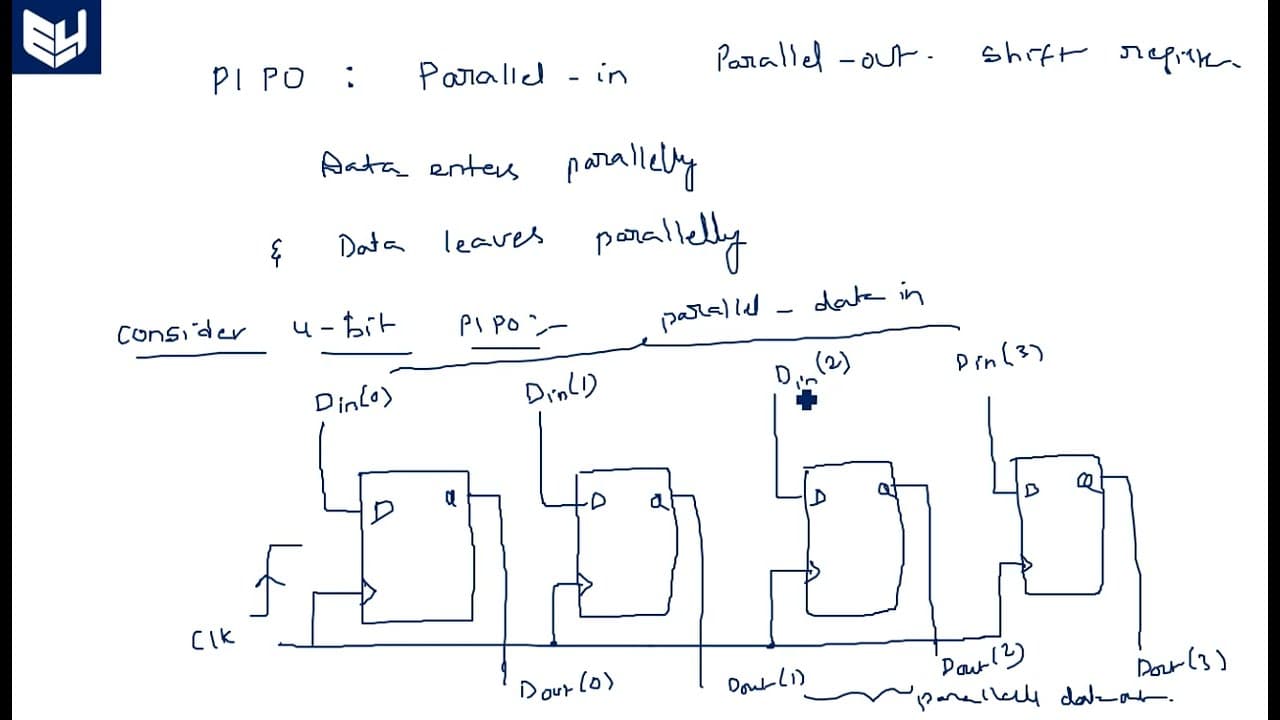
The video explains the function and operation of parallel in parallel out (PIPO) shift registers, emphasizing how they allow simultaneous data input and output.
-
It also covers the arrangement of flip-flops needed for a 4-bit PIPO shift register, highlighting how each flip-flop independently processes data while synchronized by a common clock signal.
-
The VHDL code implemented for a PIPO shift register is discussed, detailing input, clock, and reset functionalities, alongside the behavior during operations.
Read in Other Languages (beta)
Share This Summary 📚
Summarize YouTube Videos and Get Video Transcripts with 1-Click
Try YouTube Summary with ChatGPT & Claude or YouTube Transcript Generator