What is the Surface Area of a Cuboid? | Don't Memorise
TL;DR
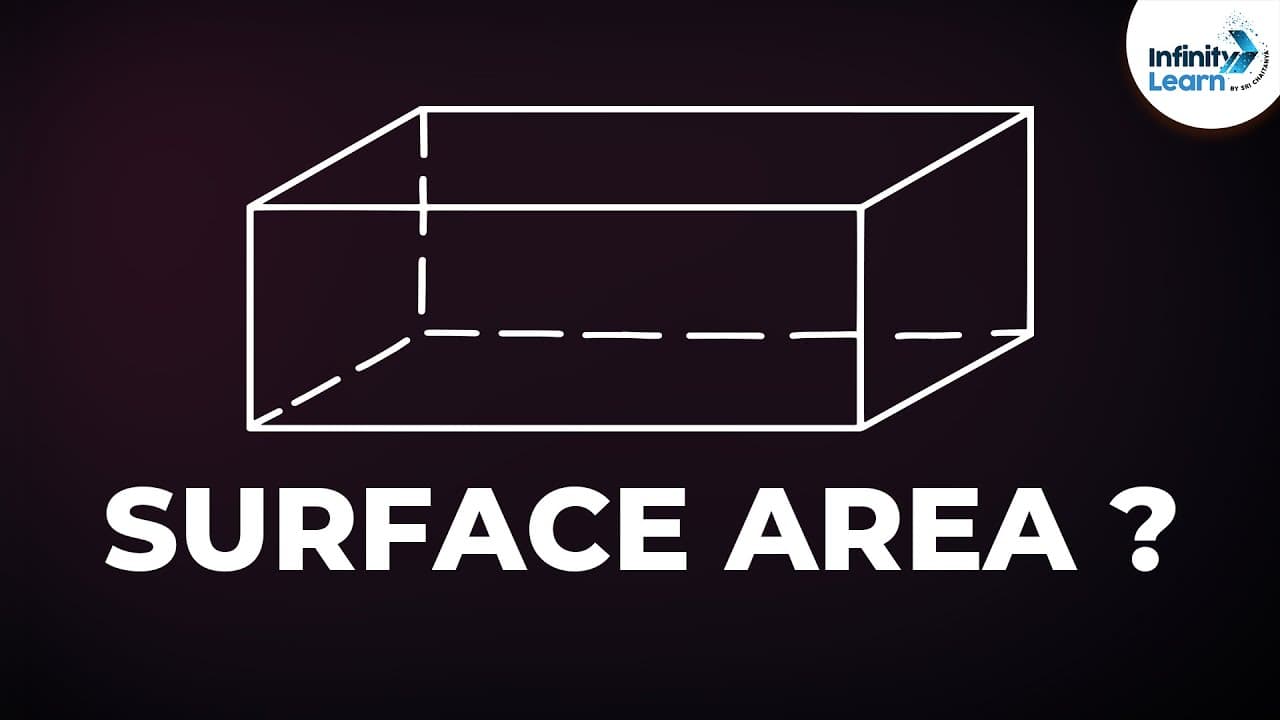
The surface area of a cuboid is calculated by finding the sum of the areas of its six rectangles. The lateral surface area refers to the total area of its side rectangles.
Transcript
how do we find the surface area of a cuboid this three-dimensional shape is called a cuboid it is bounded by rectangles from all sides the most important thing we should know about a cuboid is that it is defined by its length breadth and height we call them L B and H respectively we now need to understand how it surface area is calculated its surfa... Read More
Key Insights
- 🙃 A cuboid is defined by its length, breadth, and height, and has six rectangular sides.
- 🍹 The surface area of a cuboid is the sum of the areas of its six rectangles: 2LH + 2LB + 2BH.
- ❓ Lateral surface area refers to the total area of the side rectangles of a cuboid: 2LH + BH.
- 💠 Understanding the concept of lateral surface area is important for calculating paint or material requirements for the sides of cuboid-shaped objects.
- ❓ The surface area calculations for the front and back rectangles are LH, while those for the top and bottom rectangles are LB.
- 😪 The lateral surface area calculations involve LH for the green rectangles and BH for the red rectangles.
- 🧑🏭 The surface area of a cuboid can be simplified by factoring out 2: 2(LH + LB + BH).
Install to Summarize YouTube Videos and Get Transcripts
Explore YouTube Video Summarizer or Get YouTube Transcript Extractor
Questions & Answers
Q: How is the surface area of a cuboid calculated?
The surface area of a cuboid is calculated by finding the sum of the areas of its six rectangles: 2LH + 2LB + 2BH.
Q: What does lateral surface area mean?
Lateral surface area refers to the total area of the side rectangles of a cuboid. It excludes the top and bottom rectangles.
Q: How do you calculate the lateral surface area of a cuboid?
The lateral surface area of a cuboid is found by adding the areas of the side rectangles: 2LH + BH.
Q: What is the significance of lateral surface area?
The concept of lateral surface area is useful in applications such as calculating the amount of paint needed to paint the sides of a cuboid-shaped object, like the exterior of a house.
Summary & Key Takeaways
-
A cuboid is a three-dimensional shape with six rectangular sides defined by its length, breadth, and height.
-
The surface area of a cuboid is calculated by finding the sum of the areas of its six rectangles: 2LH + 2LB + 2BH.
-
Lateral surface area refers to the total area of the side rectangles, which is equal to 2LH + BH.
Read in Other Languages (beta)
Share This Summary 📚
Summarize YouTube Videos and Get Video Transcripts with 1-Click
Try YouTube Summary with ChatGPT & Claude or YouTube Transcript Generator
Explore More Summaries from Infinity Learn NEET 📚

Summarize YouTube Videos and Get Video Transcripts with 1-Click
Try YouTube Summary with ChatGPT & Claude or YouTube Transcript Generator