How to Rescue a Sinking Water Table
TL;DR
Drying aquifers are threatening human survival, but the solution lies in understanding aquifer types and implementing watershed restoration techniques.
Transcript
drying aquifers are threatening the very survival of human civilization I hear about this everywhere I travel all over the world in cities and in farmlands Wells are drying up as water tables drop from overuse and changing rainfall patterns but we know how to fix this so in this video I'm going to lay out the basics of how to regenerate a drying aq... Read More
Key Insights
- 🗂️ Aquifers can be divided into three types: perched, unconfined, and confined, each with unique characteristics and recharge mechanisms.
- 🥺 Over-pumping of unconfined aquifers can lead to the depletion of surface water bodies like rivers and streams.
- 💦 Watershed restoration techniques, such as forestation, structures to slow water flow, and ponds, are essential for recharging drying aquifers.
- 🎮 Aquifer regeneration requires controlling as much of the watershed as possible to maximize the cumulative effects of restoration efforts.
- 💦 Urban areas can contribute to aquifer restoration through practices like collecting and percolating water runoff.
- 💦 Land degradation and urbanization contribute to aquifer depletion, necessitating water conservation and regulation to prevent over-extraction.
- 🌥️ Restoring drying aquifers requires a larger-scale approach to watershed restoration.
Install to Summarize YouTube Videos and Get Transcripts
Explore YouTube Video Summarizer or Get YouTube Transcript Extractor
Questions & Answers
Q: What are the three main types of aquifers?
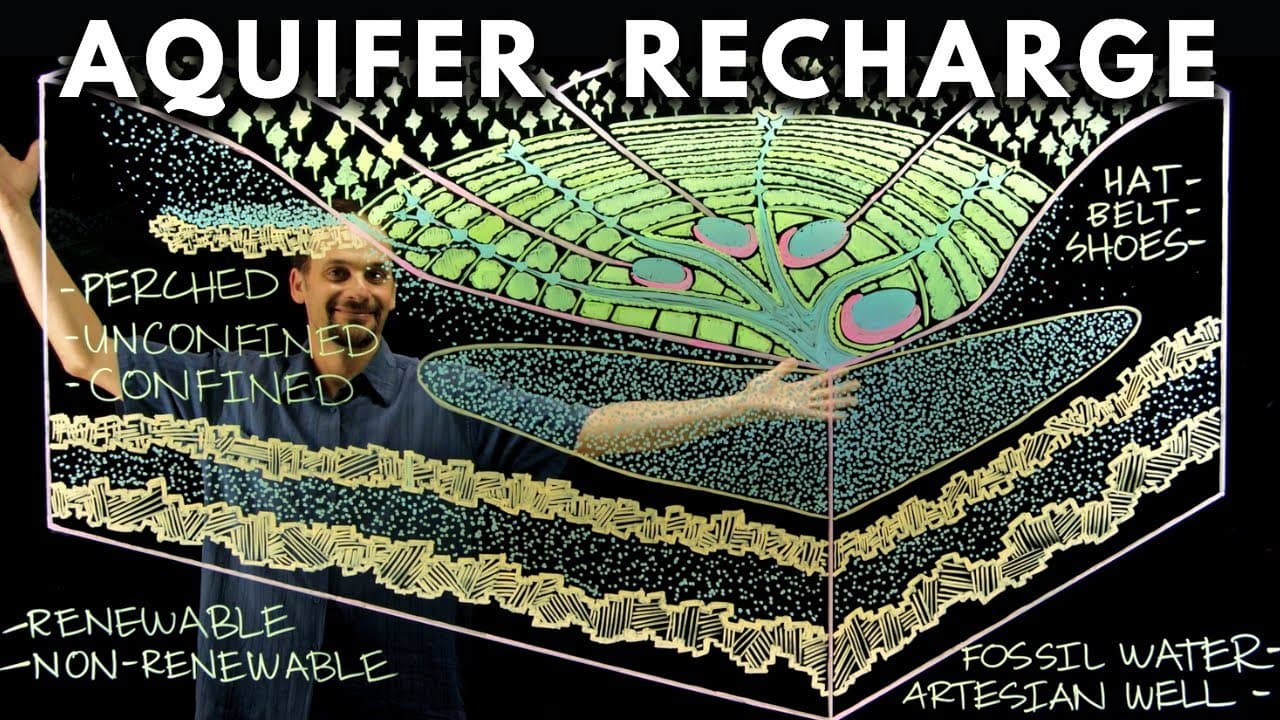
The three types are perched aquifers, unconfined aquifers, and confined aquifers. Perched aquifers are fed by water that comes from a higher point in the landscape, unconfined aquifers follow the topography of the land and are connected to surface water, and confined aquifers have impermeable rock layers both above and below.
Q: How does over-pumping of unconfined aquifers affect rivers and streams?
Over-pumping can lead to the drying up of rivers and streams connected to unconfined aquifers. When water is extracted faster than it can be replenished by rainfall and snow, the water levels drop, causing surface water bodies to diminish.
Q: What is the role of watershed restoration in aquifer regeneration?
Watershed restoration techniques, such as foresting hilltops, creating structures to slow and sink water flow, and utilizing ponds for percolation, are vital for aquifer regeneration. By controlling the entire watershed and enhancing water percolation, aquifers can be replenished.
Q: How can urban areas contribute to aquifer restoration?
In urban areas, intercepting water as close to where it falls and facilitating its percolation into the ground is important. This can be achieved through practices like collecting road runoff in small basins or utilizing dry wells.
Summary & Key Takeaways
-
Drying aquifers pose a threat to human civilization, with wells drying up and water tables dropping from overuse and changing rainfall patterns.
-
There are three main types of aquifers: perched aquifers, unconfined aquifers, and confined aquifers, each with different characteristics and recharging abilities.
-
Restoring drying aquifers involves implementing watershed restoration techniques such as foresting hilltops, creating structures to slow and sink water flow, and utilizing ponds for percolation and irrigation.
Read in Other Languages (beta)
Share This Summary 📚
Summarize YouTube Videos and Get Video Transcripts with 1-Click
Try YouTube Summary with ChatGPT & Claude or YouTube Transcript Generator
Explore More Summaries from Andrew Millison 📚




Summarize YouTube Videos and Get Video Transcripts with 1-Click
Try YouTube Summary with ChatGPT & Claude or YouTube Transcript Generator