7 factorials you probably didn't know
TL;DR
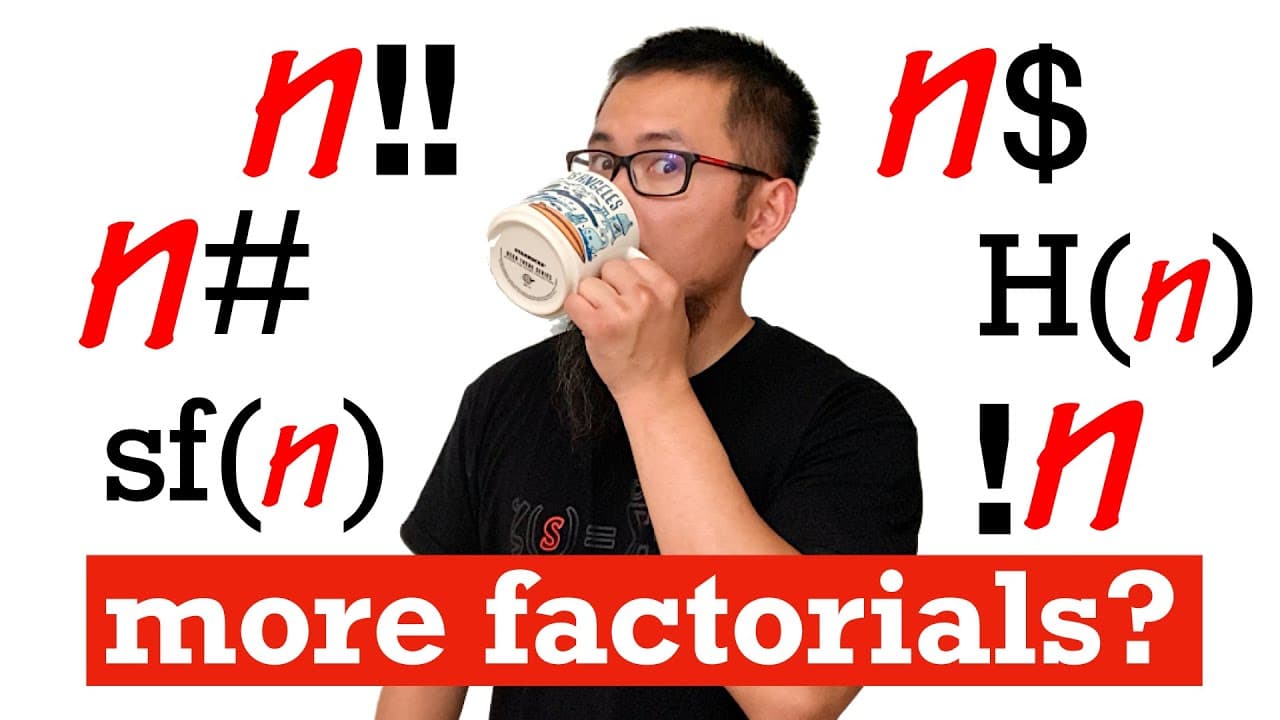
This content discusses various types of factorials, including double factorials, triple factorials, subfactorials, prime morials, super factorials, exponential factorials, and hyper factorials.
Transcript
today i wanted to talk about seven factorials that you probably didn't know and let's just get into it first of course we should talk about the usual factorial and let's talk about four factorial it's just four and you put an exclamation mark after that and to do this is just four times three times two times one perfect the question for you guys is... Read More
Key Insights
- 🦸 Factorials can be extended beyond regular factorials to include double factorials, triple factorials, subfactorials, prime morials, super factorials, exponential factorials, and hyper factorials.
- 🤨 The notation and calculations for each type of factorial vary, but they all involve multiplying or raising numbers in specific patterns.
- 🦸 Different definitions exist for super factorials, with Sloan and Pick providing alternative approaches.
- 💲 Factorials with hashtags, dollars signs, or power towers in their notation yield increasingly complex results.
Install to Summarize YouTube Videos and Get Transcripts
Explore YouTube Video Summarizer or Get YouTube Transcript Extractor
Questions & Answers
Q: What is a double factorial and how is it calculated?
A double factorial is when factors are multiplied separately based on whether they are even or odd. For example, 4!! is calculated as 4 x 2 = 8.
Q: What is the difference between even and odd cases in double factorials?
In the even case, factors start from the given number and decrease by 2 until reaching 2. In the odd case, factors start from the given number and decrease by 2 until reaching 3.
Q: What is a subfactorial and what is its application?
A subfactorial pertains to the arrangement of items without returning to their original positions. It is useful in discrete math when studying arrangements. It is calculated using a formula involving fractions and factorials.
Q: What is a prime morial and how is it calculated?
A prime morial involves multiplying all primes less than or equal to a given number. For example, 4# is calculated as 4 x 3 x 2 = 24.
Q: What are super factorials and how are they defined?
Sloan's definition of super factorials involves multiplying all factorials from 1 to n. Pick's definition, on the other hand, involves raising n to progressively decreasing powers. Both definitions provide different results.
Q: What is an exponential factorial and how is it calculated?
An exponential factorial involves raising a number to decreasing powers. For example, 4$ is calculated as 4^3^2^1.
Q: What is a hyper factorial and how is it calculated?
A hyper factorial involves raising a number to the power of decreasing numbers. For example, h(4) is calculated as 4^4 x 3^3 x 2^2 x 1^1.
Summary & Key Takeaways
-
The content introduces the concept of factorials and explains the notation for regular factorials.
-
It goes on to discuss double factorials, which involve multiplying even numbers and odd numbers separately, and provides examples.
-
The content then explores triple factorials, subfactorials, prime morials, super factorials, exponential factorials, and hyper factorials, explaining the notation and providing examples.
Read in Other Languages (beta)
Share This Summary 📚
Summarize YouTube Videos and Get Video Transcripts with 1-Click
Try YouTube Summary with ChatGPT & Claude or YouTube Transcript Generator
Explore More Summaries from blackpenredpen 📚

Summarize YouTube Videos and Get Video Transcripts with 1-Click
Try YouTube Summary with ChatGPT & Claude or YouTube Transcript Generator