18.2.4 Real Time
TL;DR
Real-time systems require guarantees on completion times, and interrupt latency is a key factor in meeting these deadlines.
Transcript
So far in constructing our timesharing system, we've worked hard to build an execution environment that gives each process the illusion of running on its own independent virtual machine. The processes appear to run concurrently although we're really quickly switching between running processes on a single hardware system. This often leads to better ... Read More
Key Insights
- ⌛ Timesharing systems provide the illusion of independent virtual machines but struggle with predicting process completion times.
- 🧑🏭 Real-time systems aim to meet specific deadlines for completion, making interrupt latency a significant factor.
- ⌛ Interrupt latency can be minimized by optimizing interrupt handler setup, avoiding data-dependent instructions, and reducing time in kernel mode.
- ⌛ Hard real-time constraints demand guarantees on completion times for critical subroutines.
- ⌛ Minimizing interrupt latency is crucial for real-time systems to meet hard real-time constraints.
- 🏍️ Complex multi-cycle instructions and execution of interrupt handlers in kernel mode contribute to interrupt latency.
- ⌛ Writing programs with hard real-time constraints can be complicated.
Install to Summarize YouTube Videos and Get Transcripts
Explore YouTube Video Summarizer or Get YouTube Transcript Extractor
Questions & Answers
Q: What is the main difference between a timesharing system and a real-time system?
The main difference is that timesharing systems focus on overall utilization by switching between processes, while real-time systems prioritize meeting specific deadlines for completion.
Q: Why is interrupt latency important in real-time systems?
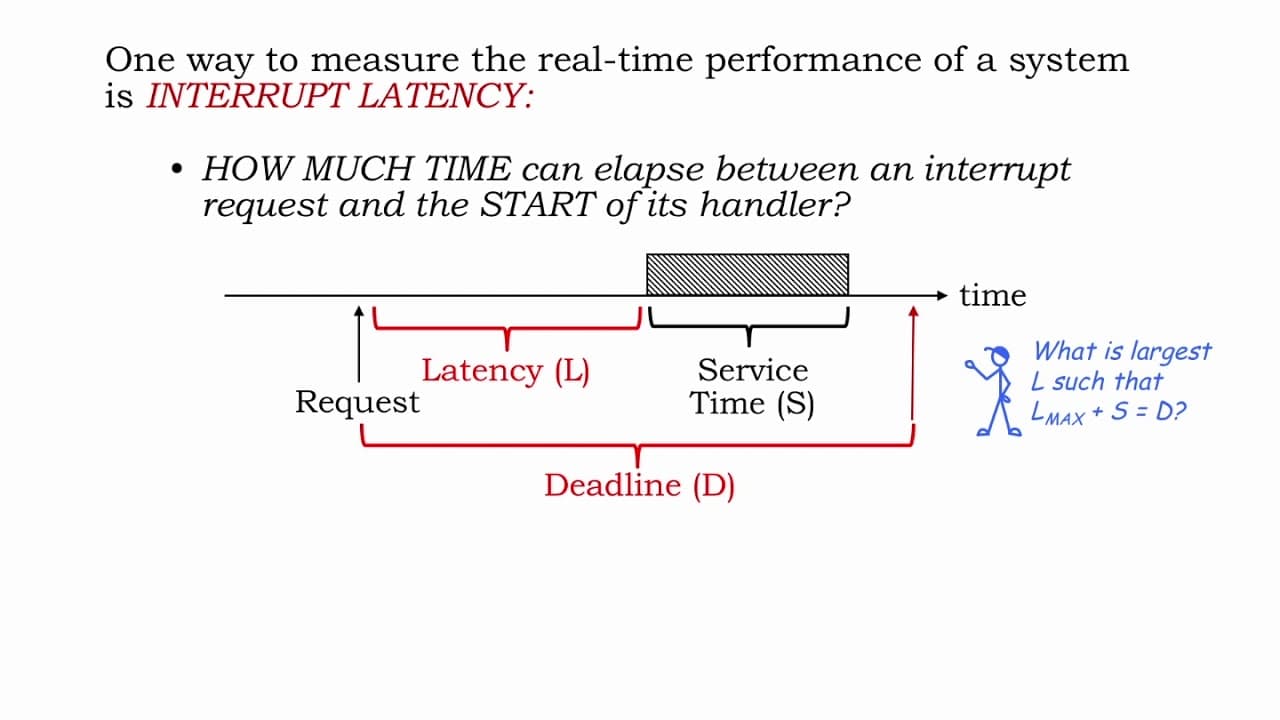
Interrupt latency refers to the time between a request to run code and when it actually starts executing. In real-time systems, it is crucial to minimize interrupt latency to meet hard real-time constraints and avoid missing critical deadlines.
Q: How can interrupt latency be minimized?
Minimizing interrupt latency involves optimizing the setup phase of interrupt handlers, avoiding data-dependent instructions, minimizing time in kernel mode, and potentially allowing interrupts in kernel mode in some cases.
Q: What are hard real-time constraints?
Hard real-time constraints refer to critical deadlines that must be met in a real-time system. These constraints require guarantees that certain subroutines will complete within a predetermined time of a sensor event.
Summary & Key Takeaways
-
Timesharing systems allow for better overall utilization by switching between running processes on a single hardware system.
-
In timesharing systems, it is difficult to predict process completion times due to CPU time allocation to other processes.
-
Real-time systems, like the electronic stability control system in cars, require guarantees on completion times to ensure safety.
Read in Other Languages (beta)
Share This Summary 📚
Summarize YouTube Videos and Get Video Transcripts with 1-Click
Try YouTube Summary with ChatGPT & Claude or YouTube Transcript Generator
Explore More Summaries from MIT OpenCourseWare 📚



Summarize YouTube Videos and Get Video Transcripts with 1-Click
Try YouTube Summary with ChatGPT & Claude or YouTube Transcript Generator