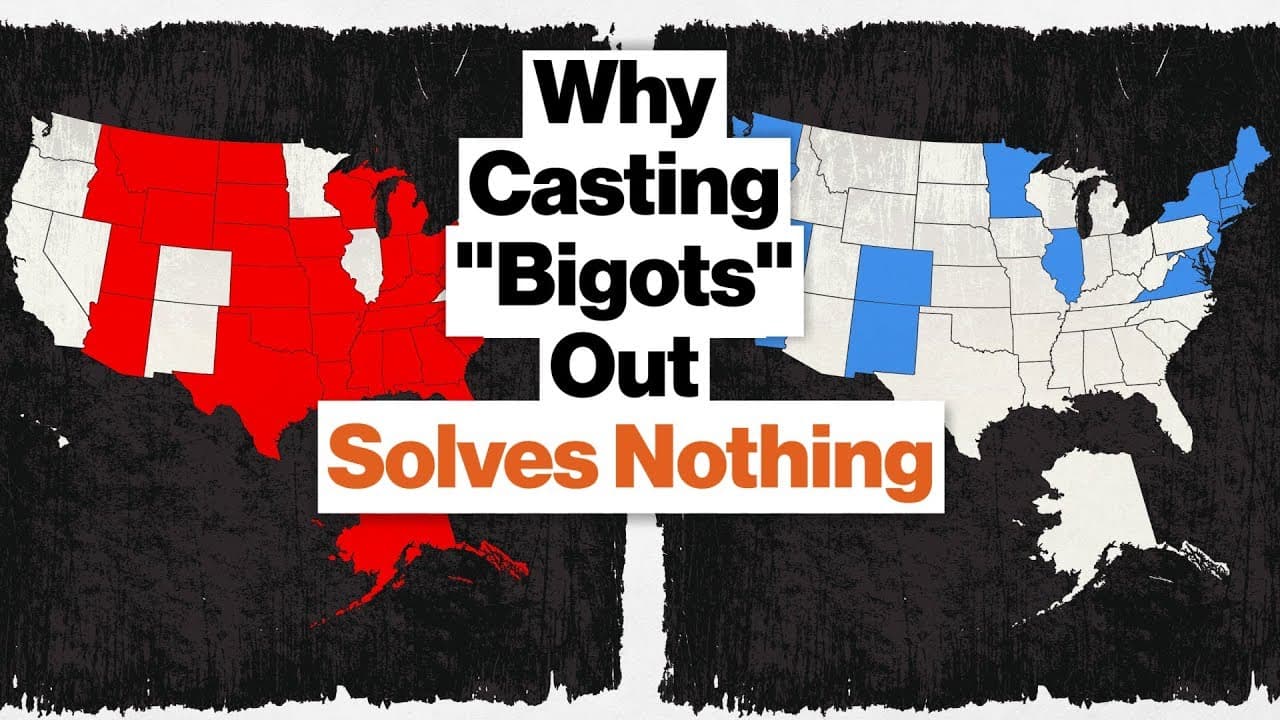
Why Casting “Bigots” Out Doesn’t Move America Forward | Van Jones
TL;DR
Balancing the defense of vulnerable communities with empathy for those resistant to change is challenging, and requires tough conversations and understanding.
Transcript
This whole question around tolerance and empathy and understanding and where the limits are is a very, very tough conversation and I come down in an odd place. On the one hand I think we have to defend very aggressively the most vulnerable constituencies in America: Muslims, immigrants, transgender people, LGBT, women, African Americans, low-income... Read More
Key Insights
- 😨 Aggressively defend vulnerable communities while still showing empathy towards those who fear change.
- 🙃 Change is difficult for everyone, and empathy is needed on both sides for productive conversations.
- ❓ It is possible to understand someone's concerns without endorsing their beliefs, fostering dialogue and understanding.
- 🥳 Gentrification can have positive and negative impacts, necessitating consideration for all affected parties.
- ⚖️ Intolerance for the intolerant may create more intolerance, requiring a delicate balance in our approach.
- 💦 A democracy with diverse individuals necessitates tough conversations and understanding to work together.
Install to Summarize YouTube Videos and Get Transcripts
Explore YouTube Video Summarizer or Get YouTube Transcript Extractor
Questions & Answers
Q: How can we defend vulnerable communities while still understanding the concerns of those who resist change?
It is vital to be aggressive in defending vulnerable communities, but also important to acknowledge the anxieties and grievances of individuals resistant to change. The goal is to find a balance where empathy is extended to both sides, without compromising the pursuit of equality.
Q: Can we have understanding for individuals who fear change without condoning their intolerant beliefs?
Yes, it is possible to understand and acknowledge someone's anxieties without agreeing with their beliefs. Labeling someone as morally deficient or pushing them outside the circle does not foster dialogue or change. Instead, we should engage in respectful conversations and work towards mutual understanding.
Q: How do we navigate the complex issue of gentrification and its impact on communities?
Gentrification is a multi-faceted issue that affects communities differently. While change can be positive for some, it can cause anxiety and the loss of a familiar environment for others. It's essential to listen to all perspectives and work towards inclusive solutions that address both the desire for progress and the preservation of community identity.
Q: Does our intolerance for intolerant views lead to more intolerance?
It is a challenging balance. While it is important to challenge intolerant views and protect marginalized communities, a complete lack of tolerance for those who hold different beliefs may lead to further intolerance. Finding ways to respectfully engage in dialogue and understand each other's perspectives is crucial for progress.
Summary & Key Takeaways
-
Defend vulnerable constituencies like Muslims, immigrants, transgender people, LGBT, women, African Americans, and low-income individuals.
-
Recognize that some may feel a loss of ground as equality is pursued, and empathize with their concerns.
-
Change is difficult for everyone, so finding a bridge of empathy is necessary when discussing sensitive topics.
Read in Other Languages (beta)
Share This Summary 📚
Summarize YouTube Videos and Get Video Transcripts with 1-Click
Try YouTube Summary with ChatGPT & Claude or YouTube Transcript Generator
Explore More Summaries from Big Think 📚


Summarize YouTube Videos and Get Video Transcripts with 1-Click
Try YouTube Summary with ChatGPT & Claude or YouTube Transcript Generator