Domino Logic | np CMOS | Cascading dynamic gates | VLSI | Lec-96
TL;DR
This video explains cascading dynamic CMOS logic circuits and addresses their associated challenges and solutions.
Transcript
hi everyone in this video you are going to learn about the cascading of dynamic Gates so Dynamic logic design and static logic design as we know there are two types of static and dynamic designs are there which are used to design CMOS logic circuitry static design is nothing but where the inputs are constant and dynamic CMOS logic circuit design is... Read More
Key Insights
- 💗 Static CMOS logic circuits maintain constant input conditions, while dynamic CMOS designs operate under clock-pulsed conditions.
- ❓ Cascading issues in dynamic CMOS logic can prevent circuits from effectively discharging outputs, impacting performance.
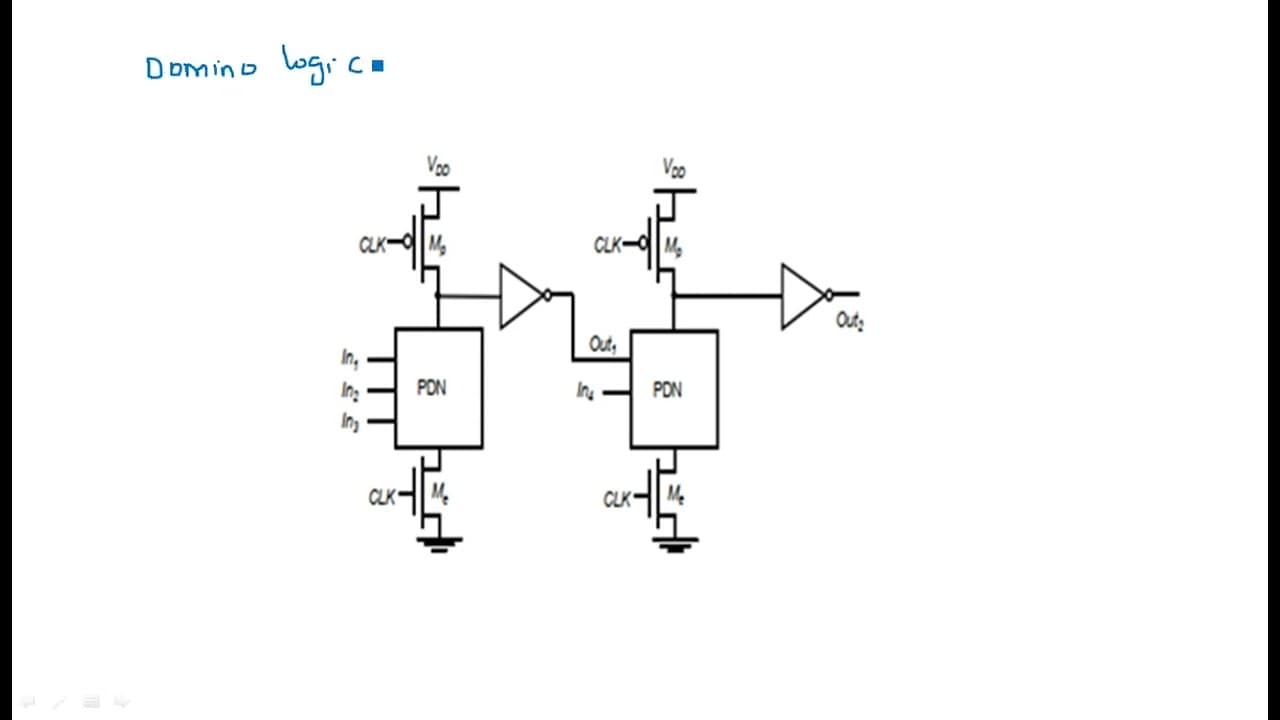
- 👻 Solutions like Domino logic enhance operational stability by integrating static inverters, allowing for non-inverting outputs.
- 🐎 NP CMOS logic offers an alternative to cascading issues but can result in slower operational speeds due to P-type transistor limitations.
- 🐎 Effective design of dynamic CMOS circuits necessitates a careful balance between speed, area, and functional reliability.
- 🥺 The introduction of additional inverters in Domino logic simplifies cascading processes but can lead to higher area requirements.
- 🎨 Understanding the disadvantages of different circuit configurations is crucial for optimizing performance in integrated circuit design.
Install to Summarize YouTube Videos and Get Transcripts
Explore YouTube Video Summarizer or Get YouTube Transcript Extractor
Questions & Answers
Q: What is the main difference between static and dynamic CMOS logic designs?
Static CMOS logic maintains constant inputs, whereas dynamic CMOS logic uses clock signals that continuously vary over time. This volatility in dynamic designs allows for more efficient use of circuitry but introduces unique challenges, particularly when used in cascaded configurations.
Q: What problems arise when cascading dynamic CMOS logic circuits?
Cascading dynamic CMOS circuits leads to issues such as lack of discharge paths during state transitions. When inputs change from 0 to 1, if the circuits are not designed effectively, it can result in prolonged output states without proper discharge, affecting overall circuit efficiency.
Q: How does Domino logic address the problems of cascading in dynamic CMOS circuits?
Domino logic introduces a static inverter between stages of cascading circuits, preventing unwanted paths for discharging and ensuring that voltages do not revert back improperly. This design enhances stability and allows for higher speeds, thus improving overall circuit performance.
Q: What are the drawbacks of NP CMOS logic when cascaded?
NP CMOS logic, while mitigating some cascading issues, suffers from slower P3 blocks that result from the lower driving capabilities of P-type transistors. Additionally, the design may require more area to equalize propagation delays, presenting a challenge in efficient circuit design.
Summary & Key Takeaways
-
The video discusses the differences between static and dynamic CMOS logic designs, including the role of clock signals in dynamic circuits, which impact their functionality.
-
It details the problems encountered in cascading networks of dynamic CMOS logic, particularly when transitioning from logic states and the resulting lack of discharge paths.
-
Two solutions, Domino logic and NP CMOS logic, are introduced to mitigate cascading issues, each with distinct advantages and disadvantages, emphasizing the complexities of design.
Read in Other Languages (beta)
Share This Summary 📚
Summarize YouTube Videos and Get Video Transcripts with 1-Click
Try YouTube Summary with ChatGPT & Claude or YouTube Transcript Generator