Coding Challenge #130: Fourier Transform Drawing with Complex Number Input
TL;DR
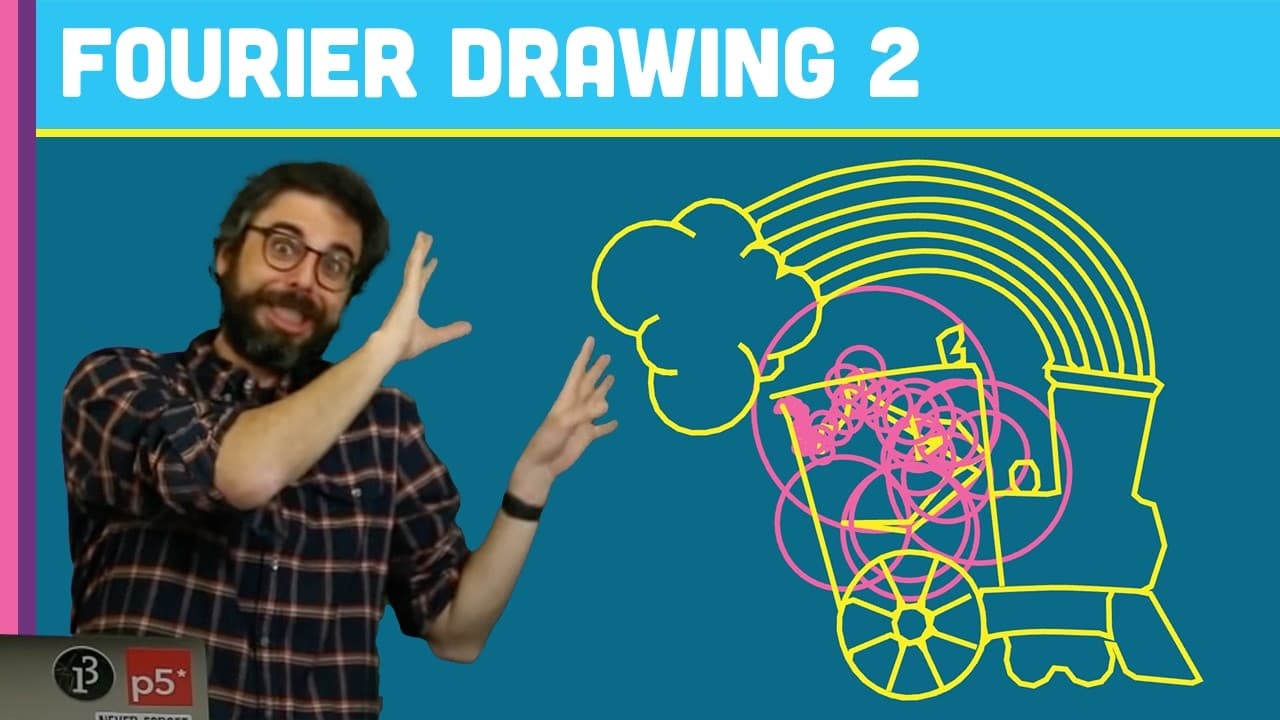
This video explains the concept of Fourier Transform, which breaks down a signal into wave patterns represented by rotating circles. It demonstrates how to use the Discrete Fourier Transform algorithm to draw complex paths using nested orbits.
Transcript
(whistling) - Hello it is time for yet another video about the Fourier Transforming epicycles. Now you might be asking yourself, what? Why? I mean what's wrong with you? What's this weird, unhealthy obsession you have with Fourier Transform? That's a good question, I'm not so sure actually> But I do know that there is absolutely at least if not mor... Read More
Key Insights
- 👋 The Fourier Transform algorithm is used to break down a signal into wave patterns with specific frequencies, amplitudes, and phases.
- 👻 Complex numbers are an essential part of the Fourier Transform, allowing for the representation of the signal data and the calculation of wave patterns.
- 👂 The Discrete Fourier Transform algorithm takes a list of numbers (signal) and converts it into a list of complex numbers representing the wave patterns.
Install to Summarize YouTube Videos and Get Transcripts
Explore YouTube Video Summarizer or Get YouTube Transcript Extractor
Questions & Answers
Q: What is the purpose of the Fourier Transform algorithm?
The Fourier Transform algorithm is used to break down a signal into wave patterns with specific frequencies, amplitudes, and phases, allowing for the representation and analysis of complex data.
Q: How does the Discrete Fourier Transform work?
The Discrete Fourier Transform algorithm takes a list of numbers representing a signal and calculates the frequencies, amplitudes, and phases of wave patterns that make up the signal. This is done by representing the signal as a collection of complex numbers and performing complex number multiplication.
Q: How are complex numbers used in the Fourier Transform?
Complex numbers are used to represent the signal data, with each number consisting of a real component (representing the x-value of a point) and an imaginary component (representing the y-value of a point). By treating the signal as a list of complex numbers, the Fourier Transform can analyze and manipulate the data efficiently.
Q: How are wave patterns represented in the Fourier Transform algorithm?
Wave patterns are represented as rotating circles, where each circle corresponds to a specific frequency, amplitude, and phase. The Fourier Transform algorithm calculates these parameters based on the input signal, allowing for the visualization and manipulation of the wave patterns.
Summary & Key Takeaways
-
The video introduces the concept of the Fourier Transform and its algorithm, which breaks down a signal into wave patterns with specific frequencies, amplitudes, and phases.
-
The Discrete Fourier Transform is applied to a set of data points to calculate the frequencies, amplitudes, and phases for drawing a complex path using nested orbits of rotating circles.
-
The video also introduces the use of complex numbers in representing the signal data, where each number consists of a real and imaginary component.
Read in Other Languages (beta)
Share This Summary 📚
Summarize YouTube Videos and Get Video Transcripts with 1-Click
Try YouTube Summary with ChatGPT & Claude or YouTube Transcript Generator
Explore More Summaries from The Coding Train 📚





Summarize YouTube Videos and Get Video Transcripts with 1-Click
Try YouTube Summary with ChatGPT & Claude or YouTube Transcript Generator