30. Nitrogen/Amino Acid Metabolism I
TL;DR
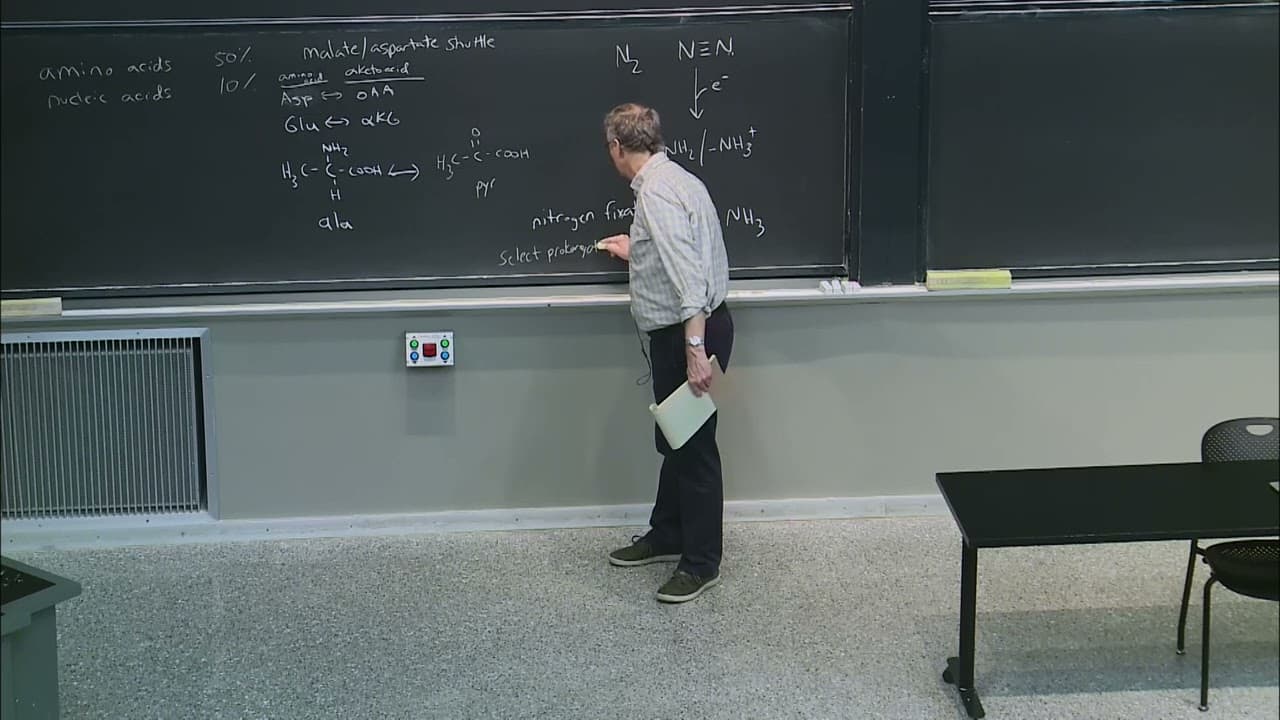
This video discusses the importance of nitrogen metabolism in cells and the role of the urea cycle in excreting excess nitrogen as urea.
Transcript
[SQUEAKING] [RUSTLING] [CLICKING] PROFESSOR: OK, good morning. So today, we're going to begin our discussion of nitrogen metabolism, which is really going to continue over the final three lectures in the class. Now, nitrogen, of course, is critical for life. You need nitrogen to make RNA and DNA, as well as protein. And so what we will see is that ... Read More
Key Insights
- 🛟 Nitrogen is critical for life as it is required for the synthesis of RNA, DNA, and proteins.
- 🍵 Cells can handle excess nitrogen by either excreting it as ammonia or converting it into urea.
- 👻 The urea cycle in the liver and kidneys allows for the conversion of excess nitrogen into urea, which can be excreted.
- 🖐️ Transamination reactions, facilitated by the cofactor pyridoxal phosphate, play a crucial role in transferring nitrogen between amino acids and alpha-keto acids.
- 🐦 Different organisms have different strategies for handling nitrogen, such as excreting ammonia directly (aquatic organisms) or converting it into uric acid (birds and reptiles).
Install to Summarize YouTube Videos and Get Transcripts
Explore YouTube Video Summarizer or Get YouTube Transcript Extractor
Questions & Answers
Q: Why is nitrogen important for life?
Nitrogen is essential for the synthesis of RNA, DNA, and proteins, which are crucial for the functioning of cells and the heritability of life.
Q: How do cells handle excess nitrogen?
Cells can either excrete excess nitrogen as ammonia or convert it into urea, which is then excreted in urine.
Q: What is the urea cycle and why is it important?
The urea cycle is a series of reactions that occur in the liver and kidneys to convert excess nitrogen into urea, which can be excreted. It is important for maintaining nitrogen balance in the body.
Q: How is nitrogen transferred between amino acids and alpha-keto acids?
Nitrogen can be transferred between amino acids and alpha-keto acids through transamination reactions, which involve the use of a cofactor called pyridoxal phosphate.
Summary & Key Takeaways
-
Nitrogen is crucial for life as it is required for the synthesis of important biological molecules such as RNA, DNA, and proteins.
-
The metabolism of amino acids and nucleic acids is all about how organisms handle nitrogen and how it is synthesized and broken down.
-
Cells can handle excess nitrogen by excreting it as ammonia or converting it into urea, which is then excreted in urine.
Read in Other Languages (beta)
Share This Summary 📚
Summarize YouTube Videos and Get Video Transcripts with 1-Click
Try YouTube Summary with ChatGPT & Claude or YouTube Transcript Generator
Explore More Summaries from MIT OpenCourseWare 📚



Summarize YouTube Videos and Get Video Transcripts with 1-Click
Try YouTube Summary with ChatGPT & Claude or YouTube Transcript Generator