L7.1 The WKB approximation scheme
TL;DR
WKB approximation is a method in quantum mechanics that uses position-dependent momentum and exponential wave functions to solve the Schrodinger equation.
Transcript
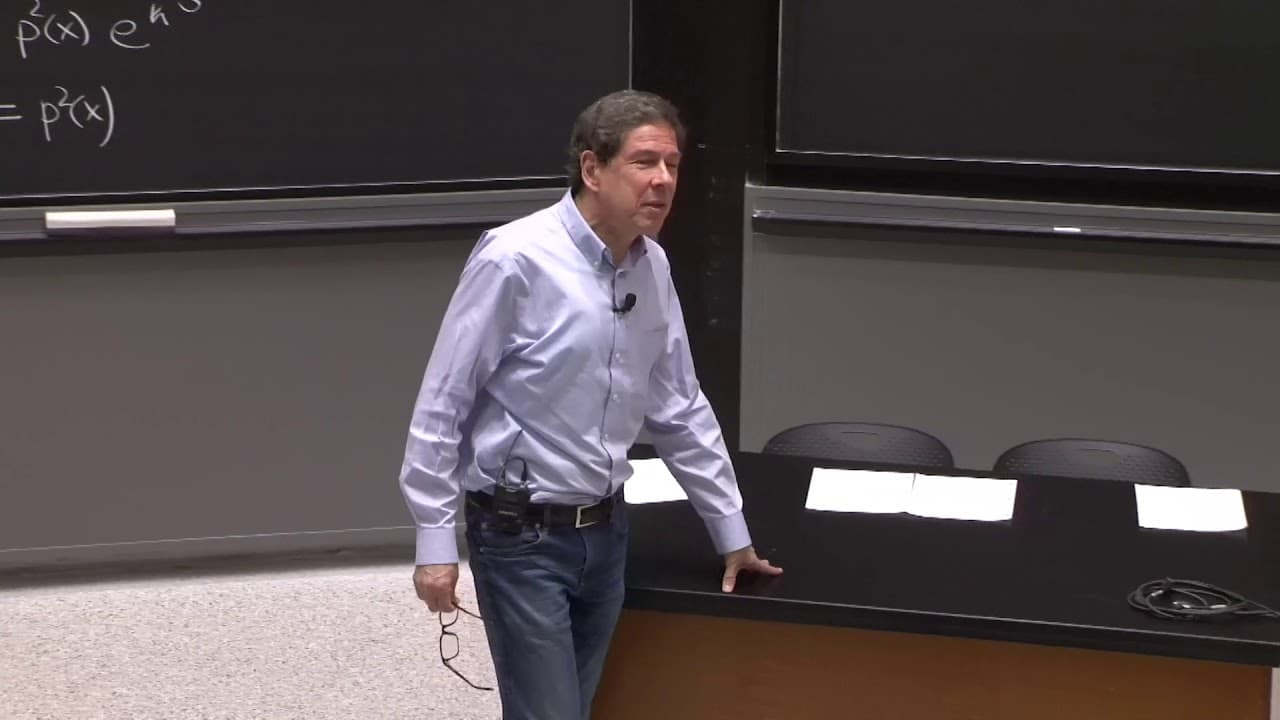
PROFESSOR: Today, we continue with our discussion of WKB. So a few matters regarding the WKB were explained in the last few segments. We discussed there would be useful to define a position-dependent momentum for a particle that's moving in a potential. That was a completely classical notion, but helped our terminology in solving the Schrodinger eq... Read More
Key Insights
- 👋 The WKB approximation involves defining position-dependent momentum and exponential wave functions to solve the Schrodinger equation.
- 👋 The charge density can be obtained from the norm squared of the wave function in the WKB approximation.
- 👋 The current in the WKB method is perpendicular to the surfaces of constant phase in the wave function.
Install to Summarize YouTube Videos and Get Transcripts
Explore YouTube Video Summarizer or Get YouTube Transcript Extractor
Questions & Answers
Q: What is the significance of defining a position-dependent momentum in the WKB approximation?
Defining a position-dependent momentum helps in solving the Schrodinger equation and sets the stage for other definitions in the WKB approximation.
Q: How can the charge density be obtained from the wave function in the WKB approximation?
The charge density can be obtained by taking the norm squared of the wave function, which cancels out the phase and leaves only the magnitude.
Q: What is the relationship between the current and the surfaces of constant phase in the wave function?
The current is computed as the charge density multiplied by the gradient of the phase, and it is perpendicular to the surfaces of constant phase in the wave function.
Q: When is the semiclassical approximation valid in the WKB method?
The semiclassical approximation is valid when the de Broglie wavelength is small compared to the physical length of the system or when it changes slowly with position.
Summary & Key Takeaways
-
The WKB approximation involves defining a position-dependent momentum for a particle moving in a potential, which helps in solving the Schrodinger equation.
-
Wave functions in the WKB approximation take the form of an exponential with a phase and magnitude, and the charge density can be obtained from the norm squared of the wave function.
-
The WKB approximation also involves the computation of the current, which is perpendicular to the surfaces of constant phase in the wave function.
-
The semiclassical approximation is valid when the de Broglie wavelength is small compared to the physical length of the system or when it changes slowly with position.
Read in Other Languages (beta)
Share This Summary 📚
Summarize YouTube Videos and Get Video Transcripts with 1-Click
Try YouTube Summary with ChatGPT & Claude or YouTube Transcript Generator
Explore More Summaries from MIT OpenCourseWare 📚


Summarize YouTube Videos and Get Video Transcripts with 1-Click
Try YouTube Summary with ChatGPT & Claude or YouTube Transcript Generator