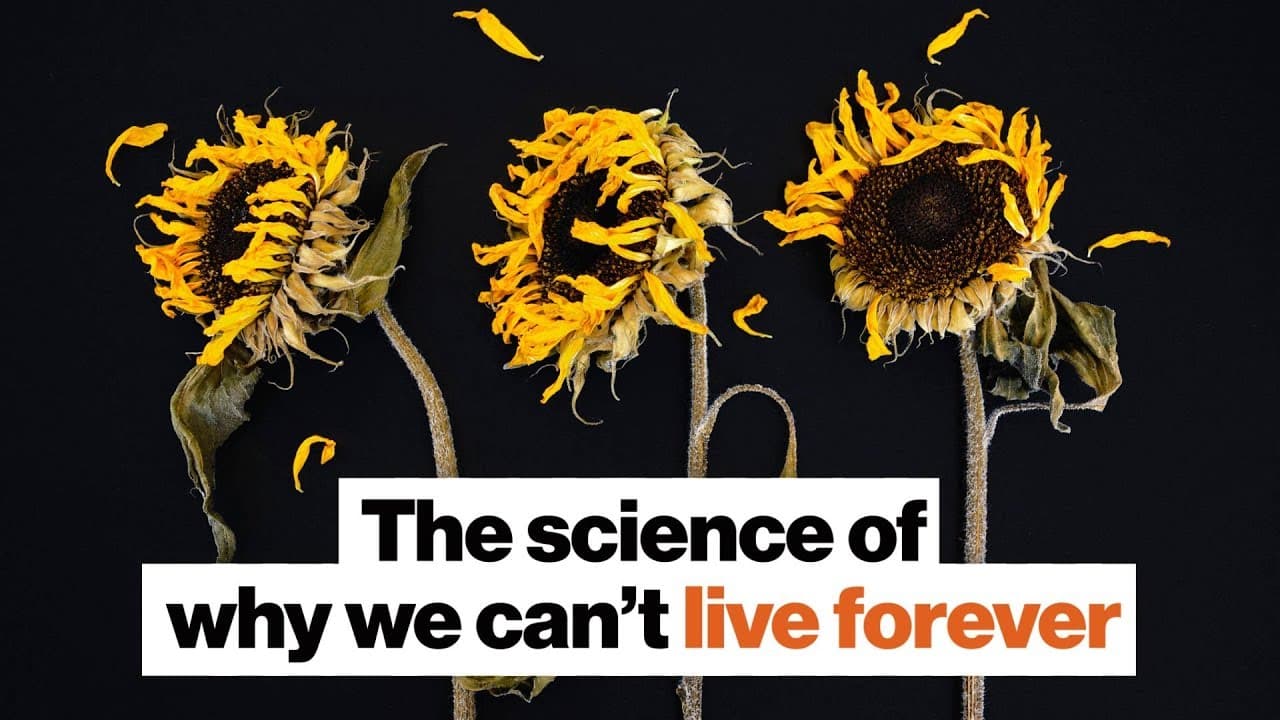
The science of why we die | Michael Shermer | Big Think
TL;DR
Our understanding of death from a scientific perspective is different from religious beliefs, with the ultimate cause being the laws of nature and the principles of natural selection.
Transcript
From a scientist's prospective it's going to be rather different from that of most religious traditions, which holds that we die because this is only a temporary staging area before we go to the big show the next stage in which we go to heaven or hell or wherever some kind of afterlife. For scientists the question has a rather different answer and ... Read More
Key Insights
- 🫵 Scientists view death differently from religious beliefs, attributing it to proximate causes (such as diseases) and ultimate causes (the laws of nature and natural selection).
- 🥰 Proximate causes of death include cancer, heart disease, and arthrosclerosis, which are specific reasons for individual deaths.
- 👮 The ultimate causes of death are rooted in the second law of thermodynamics (entropy) and the principles of natural selection, which drive evolution and resource allocation.
- 🥺 Natural selection favors the well-being and reproductive success of infants and toddlers, leading to rapid cell division and healing abilities.
- 🤕 As humans age beyond reproductive age, they no longer receive as many resources, as their genes are already being passed on by their offspring.
- ⚾ Nature operates based on limited resources, with natural selection prioritizing those who are most likely to reproduce successfully.
- 👮 The concept of death is linked to the laws of thermodynamics and the principle of natural selection, which dictate the allocation of resources.
Install to Summarize YouTube Videos and Get Transcripts
Explore YouTube Video Summarizer or Get YouTube Transcript Extractor
Questions & Answers
Q: How does the scientific perspective on death differ from religious beliefs?
While religious traditions often describe death as a temporary stage before an afterlife, scientists view death as a result of proximate causes (diseases) and ultimate causes (the laws of nature and natural selection).
Q: What are some proximate causes of death?
Proximate causes of death include cancer, heart disease, and arthrosclerosis, which are specific diseases that lead to individual deaths.
Q: What are the ultimate causes of death according to science?
The ultimate causes of death are explained by the second law of thermodynamics (entropy or the gradual decay of the universe) and the principle of natural selection (resource allocation to ensure reproductive success).
Q: Why don't humans have the ability to live longer or indefinitely?
From an evolutionary perspective, humans do not need to live indefinitely because after the reproductive age, they have fulfilled their purpose of passing on their genes. Natural selection prioritizes resources for organisms that can contribute to reproductive success.
Summary & Key Takeaways
-
From a scientific perspective, the cause of death is explained by proximate causes (like cancer or heart disease) and ultimate causes (the laws of thermodynamics and principles of natural selection).
-
Proximate causes for why we die include diseases like cancer, heart disease, and arthrosclerosis, which are specific reasons for individual deaths.
-
Ultimate causes for why we die are rooted in the second law of thermodynamics and the principle of natural selection, which explain the eventual decay of our bodies and the need for resource allocation.
Read in Other Languages (beta)
Share This Summary 📚
Summarize YouTube Videos and Get Video Transcripts with 1-Click
Try YouTube Summary with ChatGPT & Claude or YouTube Transcript Generator
Explore More Summaries from Big Think 📚


Summarize YouTube Videos and Get Video Transcripts with 1-Click
Try YouTube Summary with ChatGPT & Claude or YouTube Transcript Generator