Registers SISO | Introduction & Types | Digital Systems Design | Lec-84
TL;DR
Registers, made of flip-flops, store and shift n-bit data in digital systems.
Transcript
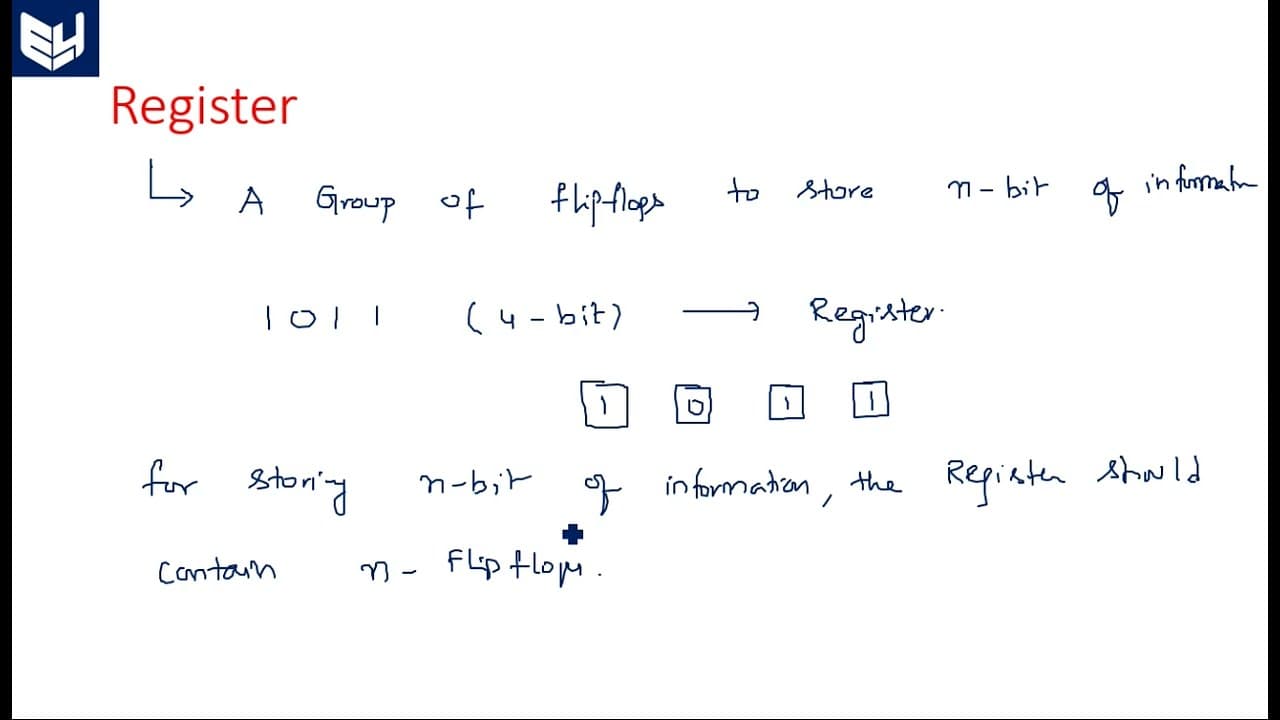
hi everyone in this video I'm going to explain about register concept register is nothing but it is also made up of flip lops in the last few videos I have explained different types of flip lops and what is the purpose of that and we have seen the operation of individual flip lops also now register or registers register is nothing but a group of fl... Read More
Key Insights
- 🛟 Registers are essential in digital systems, serving as temporary storage units for binary data.
- 🥹 Each flip-flop in a register is responsible for holding a single bit of information, allowing flexible data storage capacities.
- 💐 The ability to shift data within registers is pivotal for various digital operations, influencing data flow management.
- 🎨 Types of shift registers cater to specific data processing needs, enhancing versatility in digital circuit designs.
- 🈸 Shifting operations can be applied in diverse applications, providing the foundation for serial to parallel conversion.
- 🐬 The synchronous operation of D flip-flops in registers allows for coordinated data movement, increasing efficiency in processing tasks.
- 🎨 Understanding registers and their functionalities is crucial for designing and implementing effective digital circuits in technology.
Install to Summarize YouTube Videos and Get Transcripts
Explore YouTube Video Summarizer or Get YouTube Transcript Extractor
Questions & Answers
Q: What is a register in the context of digital circuits?
A register is a group of flip-flops used to store n bits of information. Each flip-flop can store one bit, so for an n-bit register, n flip-flops are required. Registers enable the temporary storage of data in digital circuits, crucial for data processing and manipulation.
Q: What are the primary functions of a shift register?
A shift register stores data and allows for the shifting of bits either left or right. This operation aids in various tasks, such as converting serial data to parallel data and vice versa. Shifting actions are vital in applications like data transmission and storage within digital circuits.
Q: Can you explain the difference between serial in parallel out and parallel in serial out shift registers?
A serial in parallel out shift register accepts data bits in a serial manner and converts them into parallel outputs. In contrast, a parallel in serial out shift register accepts multiple data bits simultaneously and releases them one at a time in a serial format. This distinction allows for diverse data handling applications.
Q: Why are D flip-flops commonly used in registers?
D flip-flops are used in registers because they store data reliably without altering it as it shifts. Each D flip-flop captures the input data at clock pulse intervals, ensuring that the original data remains consistent throughout the shifting and storage processes, which is critical for accurate data management.
Summary & Key Takeaways
-
A register is a collection of flip-flops, where each flip-flop stores one bit of data, allowing n bits to be stored collectively. This means a 4-bit register requires four flip-flops.
-
Registers can facilitate data storage and movement, allowing bits to shift left or right, making them essential for operations like serial to parallel conversion and vice versa.
-
There are four primary types of shift registers categorized by input and output configurations: serial in serial out, serial in parallel out, parallel in serial out, and parallel in parallel out, which are used in various digital circuit applications.
Read in Other Languages (beta)
Share This Summary 📚
Summarize YouTube Videos and Get Video Transcripts with 1-Click
Try YouTube Summary with ChatGPT & Claude or YouTube Transcript Generator