Unit 11: LNG Case 1, Video 2: Introduction
TL;DR
A parametric analysis of a flexible LNG plant design shows that it can provide economic benefits through discount rate effects, learning effects, and modular design, which work against the economies of scale traditionally favored in such projects.
Transcript
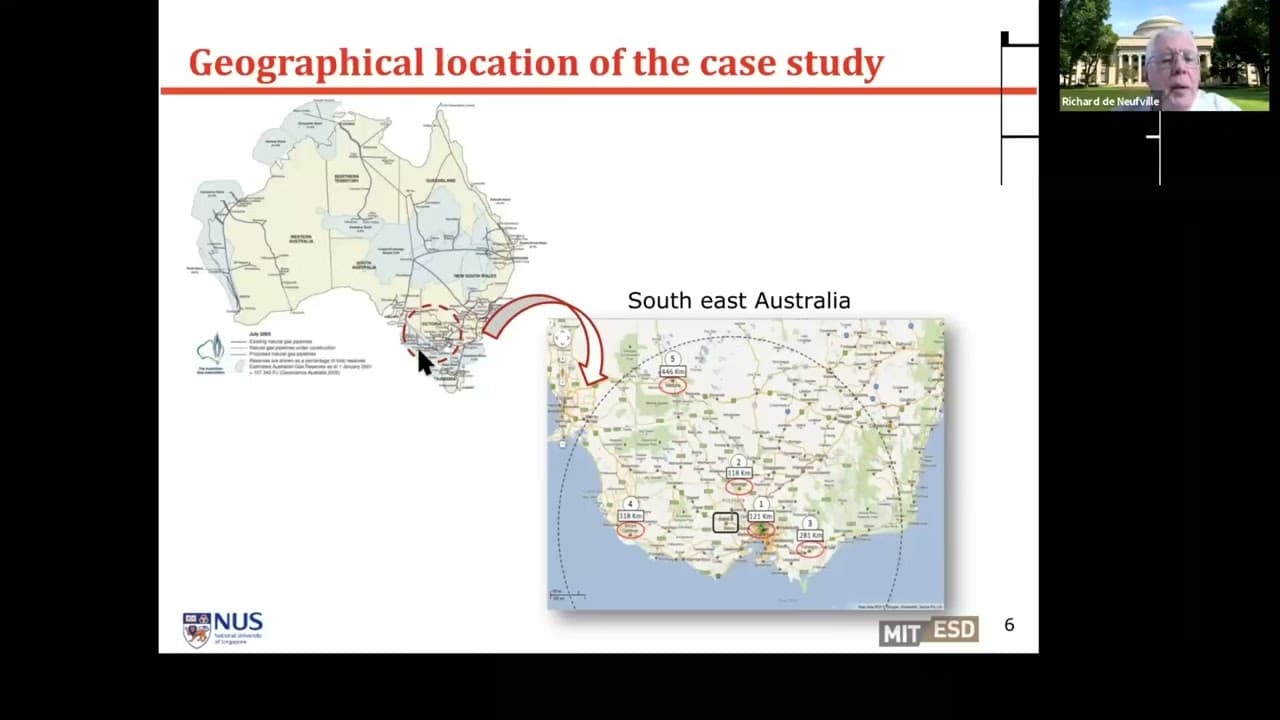
[SQUEAKING] [RUSTLING] [CLICKING] RICHARD DE NUEFVILLE: Talks about a perspective LNG plant that I worked on with these colleagues, Cardin, Bourani, his thesis student-- Cardin and his thesis student, Bourani, and others with the Keppel Offshore and Marine Corporation, which is a big shipbuilding platformbuilding, metal bending government company i... Read More
Key Insights
- 👻 A parametric analysis allows for exploring a range of factors and conditions to identify improved design approaches.
- ☠️ The economic benefits of a flexible LNG plant design are driven by discount rate effects and learning effects.
- 🎨 Modular design and decentralized production units can provide additional economic advantages.
- ✋ Relying solely on economies of scale may not be the most economic approach due to higher costs and limitations in uncertain conditions.
- 🎨 The value of an LNG project may decrease under uncertainty, and the design may require adjustment.
- 🇨🇷 Flexibility in size and timing of capacity additions can result in a more cost-effective approach to meet evolving demand.
- 🌱 Locational choices can impact the overall economics of an LNG plant by reducing transportation costs.
Install to Summarize YouTube Videos and Get Transcripts
Explore YouTube Video Summarizer or Get YouTube Transcript Extractor
Questions & Answers
Q: What is the purpose of a parametric analysis in the context of LNG plant design?
A parametric analysis allows for the exploration of various factors and conditions to determine the best design approach, considering factors such as economies of scale, uncertainty, learning effects, and discount rates.
Q: How does a flexible LNG plant design provide economic benefits?
A flexible design allows for adjustments in size and timing based on demand, leading to cost savings through lower present value costs and improved design through learning effects. Modular design also contributes to economic benefits by avoiding the need to build for future capacity upfront.
Q: What are the potential drawbacks of relying solely on economies of scale in LNG plant design?
Building for all future capacity right at the beginning may not be economically efficient. It can result in higher costs and may not account for uncertainties or learning effects. Discount rates and learning effects can favor smaller, modular designs.
Q: What are the primary uses of LNG in Australia?
In Australia, LNG is primarily viewed as a transportation fuel and cleaner alternative to diesel. It is also used for home heating and power plants in Europe but less relevant in areas like South Australia where heat demand is lower.
Summary & Key Takeaways
-
The content discusses a parametric analysis of a proposed LNG plant design, focusing on exploring different factors and conditions to determine potential improvements.
-
The analysis considers the impact of economies of scale, uncertainty, learning effects, and discount rates on the economic benefits of a flexible design.
-
The content also explores alternative designs, including modular plants and decentralized production units.
Read in Other Languages (beta)
Share This Summary 📚
Summarize YouTube Videos and Get Video Transcripts with 1-Click
Try YouTube Summary with ChatGPT & Claude or YouTube Transcript Generator
Explore More Summaries from MIT OpenCourseWare 📚



Summarize YouTube Videos and Get Video Transcripts with 1-Click
Try YouTube Summary with ChatGPT & Claude or YouTube Transcript Generator