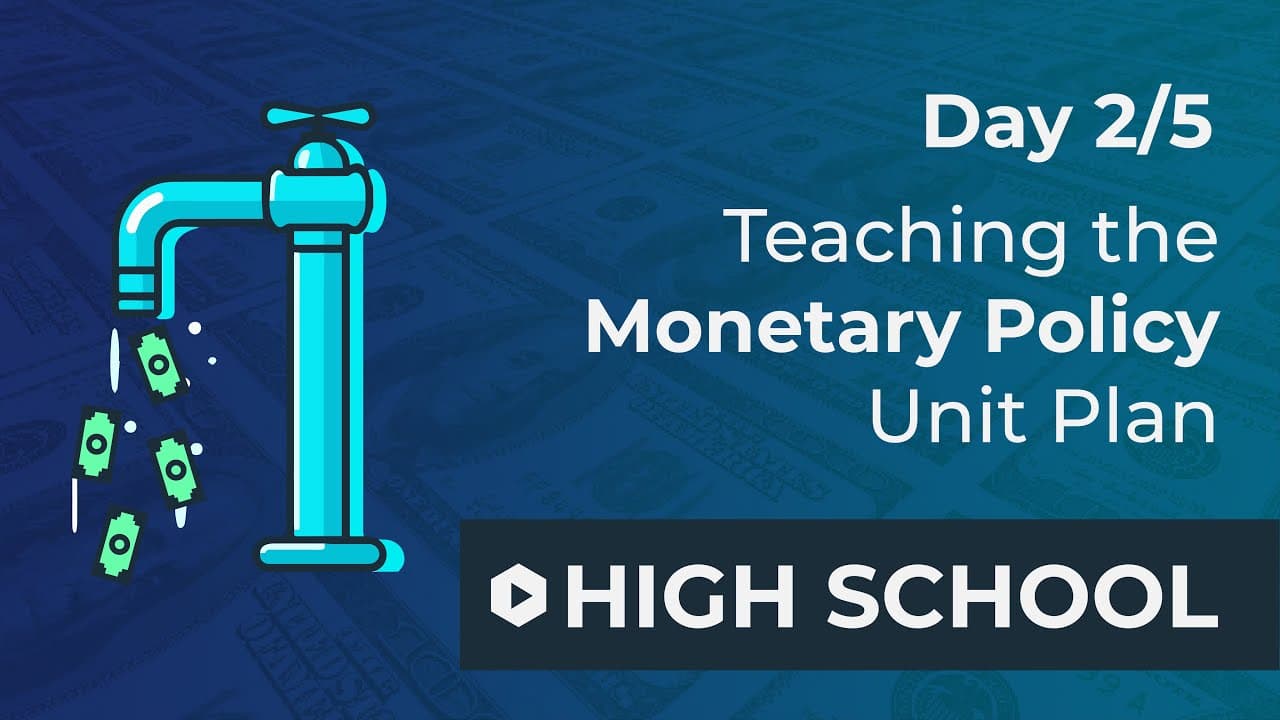
Day 2: How Does the Federal Reserve Prevent Bank Runs? | Monetary Policy Unit Plan Walkthrough
TL;DR
The Federal Reserve helps prevent bank runs by lending money to banks and buying their assets during a crisis, while the government can also guarantee deposits through FDIC insurance of up to $250,000. These measures give banks cash to meet withdrawals, but they can create moral hazard by encouraging greater risk-taking. Read on for the lesson’s three-part framework, historical examples, and teaching sequence.
Transcript
hi I'm Matt Hill I'm the curriculum designer here at mru here is day two of the monetary policy unit plan super fun day in my opinion really happy uh with this one all right so uh to open for the bell ringer we want to recall the previous day have the students sort of try to remember what they learned in the previous day um talking about what is a ... Read More
Key Insights
- The Federal Reserve is the central bank of the United States and acts as a lender of last resort.
- Bank runs occur when many depositors withdraw their money simultaneously, risking bank failure.
- To prevent bank runs, the government can guarantee deposits, lend money to banks, or buy bank assets.
- The Federal Deposit Insurance Corporation (FDIC) insures deposits up to $250,000 to maintain stability.
- Open market operations involve the Fed buying or selling assets to influence the money supply.
- Quantitative easing is a form of open market operation used during financial crises to reassure markets.
- Moral hazard arises when banks take on more risk, knowing the Fed will bail them out if needed.
- Regulations aim to mitigate moral hazard by restricting the level of risk banks can take.
Install to Summarize YouTube Videos and Get Transcripts
Explore YouTube Video Summarizer or Get YouTube Transcript Extractor
Questions & Answers
Q: How does the Federal Reserve prevent bank runs?
The Federal Reserve can lend money to banks during a crisis or buy their long-term assets, giving them cash to meet depositor withdrawals. Deposit guarantees provide another layer of protection by reassuring customers that their money is insured even if a bank fails.
Q: What is a bank run, and why can it cause a bank to fail?
A bank run occurs when many depositors ask for their money back at the same time. Because banks lend out deposited money and may hold long-term assets that cannot be sold immediately, they may lack enough cash to satisfy every withdrawal.
Q: What three government responses to a bank run does the lesson introduce?
The lesson organizes possible responses into three categories: guaranteeing deposits, lending money to banks, and buying bank assets. The latter two approaches provide banks with cash that they can return to depositors.
Q: What role does the FDIC play in preventing bank runs?
The FDIC insures bank deposits up to $250,000. This guarantee reassures depositors that insured funds will be returned even if their bank fails, reducing the incentive to rush to withdraw money.
Q: Why is the Federal Reserve called the lender of last resort?
The Federal Reserve can step in and lend to banks during a crisis when they need cash. The lesson presents this emergency role as one of the original purposes of the United States central bank.
Q: How does J.P. Morgan’s role in the Panics of 1893 and 1907 connect to the creation of the Fed?
J.P. Morgan helped rescue the economy twice, including arranging for gold reserves to remain in the United States during the Panic of 1893. The lesson then uses an NPR Planet Money video about his response to the Panic of 1907 to show why relying on one person was inadequate and why a central bank was needed.
Q: What is moral hazard in the Federal Reserve’s bank safety net?
Moral hazard arises when banks take greater risks because they expect support from the Federal Reserve if they get into trouble. Regulations attempt to limit this behavior by restricting how much risk banks can take, although the system is not foolproof.
Q: How is Day 2 of the Monetary Policy Unit Plan structured?
Matt Hill begins with a bell ringer that asks students to recall how bank runs occur and how banks use deposits. Students then propose ways the government could stop a run, connect their ideas to the FDIC and Federal Reserve, and examine J.P. Morgan and the birth of the Fed before discussing moral hazard and monetary policy.
Summary & Key Takeaways
-
The Federal Reserve prevents bank runs by acting as a lender of last resort, providing liquidity to banks in times of crisis. This involves guaranteeing deposits, lending money, and buying assets to ensure financial stability. However, this safety net can create moral hazard, where banks may take on more risk, knowing they have a safety net.
-
Open market operations and quantitative easing are tools used by the Fed to manage the money supply and maintain economic stability. These actions reassure markets during crises, such as the financial crisis and the COVID-19 pandemic, by buying assets from banks and providing liquidity.
-
Moral hazard is a concern when the Fed acts as a lender of last resort, as it may encourage banks to take on excessive risk. The government attempts to mitigate this by enforcing regulations that limit the risks banks can take, though this system is not foolproof, as evidenced by bank failures.
Read in Other Languages (beta)
Share This Summary 📚
Summarize YouTube Videos and Get Video Transcripts with 1-Click
Try YouTube Summary with ChatGPT & Claude or YouTube Transcript Generator
Explore More Summaries from Marginal Revolution University 📚
Summarize YouTube Videos and Get Video Transcripts with 1-Click
Try YouTube Summary with ChatGPT & Claude or YouTube Transcript Generator