How Does Marketing Increase Perceived Value?
TL;DR
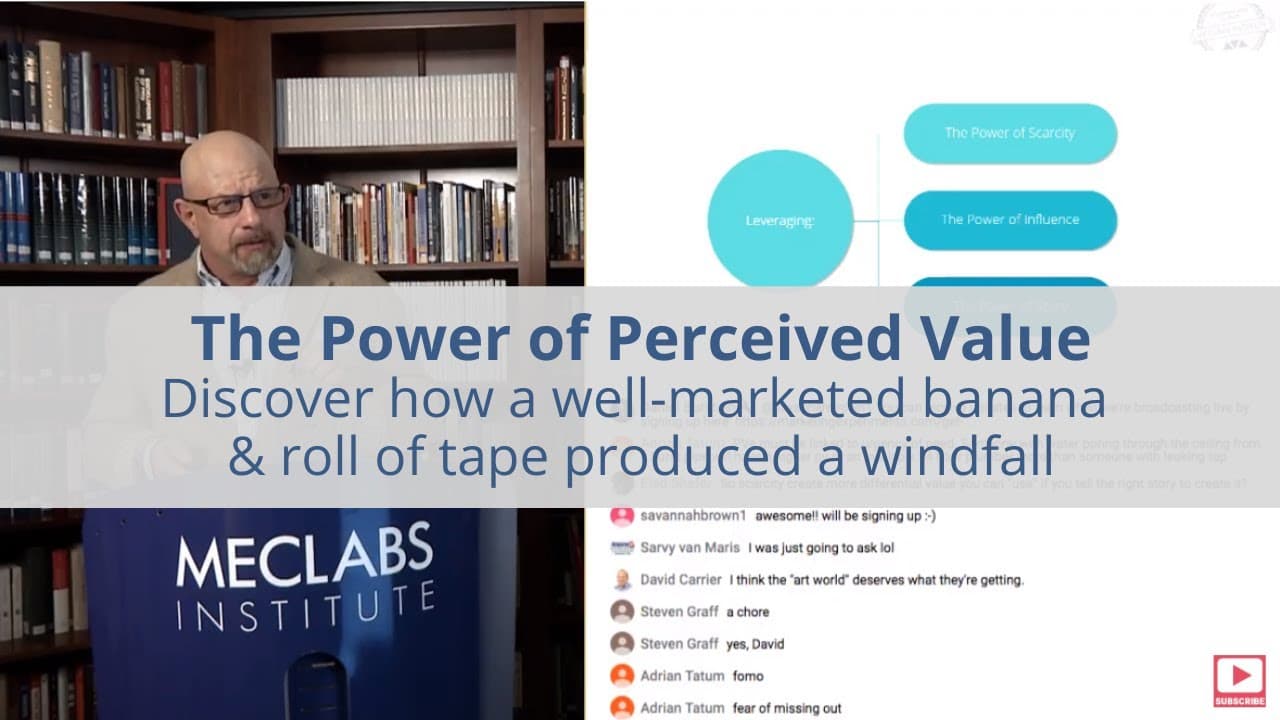
Customers buy when an offer’s perceived value exceeds its perceived cost, including price, energy, and risk. Marketers can increase that difference by presenting genuine scarcity within the right context, building a compelling story, and supplying credible influence such as social proof or authority. The banana artwork illustrates how these factors can transform inexpensive materials into something the market values at $120,000.
Transcript
thank you for joining us I am holding in my hand a roll of duct tape and a banana let me ask you a question what do you think this banana is worth and as you think about that let's independently value this roll of duct tape what do you believe this roll of duct tape is worth in fact let's just take a let's just take a small piece of it let's call i... Read More
Key Insights
- Actual value and perceived value are different measures because customers respond to what they believe an offer is worth, not simply its material cost or the seller’s internal assessment. Marketing communication can therefore raise or reduce an offer’s apparent worth without changing its physical components.
- The banana and duct tape had an estimated material value of $0.77, based on a $0.75 banana and approximately $0.02 of tape. Their presentation as museum artwork produced a perceived value of $120,000, illustrating the scale a value differential can reach.
- Scarcity is a psychological driver of perceived value when an item appears limited within a meaningful context. The same banana and tape would not command comparable attention in a store, but scarcity combined with an art museum setting changed how observers evaluated them.
- Story is a source of perceived value because buyers interpret an offer through its surrounding narrative. The artist’s emergence from retirement, his intended artistic effect, the public reaction, and the work’s place in the art world contributed meaning beyond the materials themselves.
- Influence is created through signals such as social proof, celebrity, and authority. The worldwide attention, intense public discussion, and crowds visiting the artwork showed that other people considered it significant, reinforcing its perceived importance and helping justify a higher valuation.
- Perceived value differential is the gap between a customer’s perceived value and perceived cost. It gives marketers a practical framework for evaluating an offer because a customer’s decision depends on the relative strength of those two perceptions, not on value considered in isolation.
- Perceived cost includes more than the listed price because customers may also consider energy, risk, and other negative factors. When those combined costs appear greater than the value received, the resulting differential is negative and the customer is unlikely to buy.
- Perceived value can become actual market value when buyers repeatedly demonstrate willingness to pay. The discussion compares this process with an appraisal based on comparable purchases, where earlier market transactions help estimate what another buyer may pay for a similar offering.
Install to Summarize YouTube Videos and Get Transcripts
Explore YouTube Video Summarizer or Get YouTube Transcript Extractor
Questions & Answers
Q: What is the difference between actual and perceived value?
Actual value refers to an offer’s underlying or material worth, while perceived value is what a potential customer believes the offer is worth. The banana and tape were estimated to contain only $0.77 in materials, yet their museum presentation generated a $120,000 valuation. For marketers, the customer’s perception matters most because purchase decisions follow perceived value, not the seller’s private assessment.
Q: What is perceived value differential in marketing?
Perceived value differential, abbreviated as PVD in the presentation, is the difference between the value a customer perceives and the costs the customer perceives. It functions like a cognitive calculation during a purchase decision. If perceived costs exceed perceived value, the result is negative and the customer does not buy. Marketers can improve response by increasing perceived value or reducing perceived costs.
Q: How do customers calculate whether an offer is worthwhile?
Customers mentally subtract perceived costs from perceived value when considering a purchase. Perceived cost is broader than the price because it can include energy, risk, and other negative factors. When the remaining difference is positive, the offer appears worthwhile. When the difference is negative because the costs seem greater than the benefits, customers are unlikely to complete the purchase.
Q: How does scarcity increase perceived value?
Scarcity increases perceived value by making an offering appear limited and difficult to obtain, but its effect depends on context. A banana and duct tape displayed among ordinary store inventory would not appear especially valuable. Presented as a limited artwork inside a museum, the same materials acquire different significance. The lesson is that scarcity works in conjunction with the setting in which customers encounter the offer.
Q: Why does storytelling affect an offer’s perceived value?
Storytelling affects perceived value by giving customers a meaningful framework for interpreting an offer. The artwork was surrounded by a narrative about a famous artist coming out of retirement, attempting to create an artistic effect, provoking a worldwide response, and attracting the Bancroft family’s interest. These elements gave the banana and tape significance that their physical materials could not provide alone.
Q: How does social proof influence perceived value?
Social proof influences perceived value by showing that other people consider an offer important. The artwork generated discussion throughout the art world and attracted crowds large enough that it was withdrawn from view because of concern about damage. That visible attention acted as evidence of significance. Influence can also arise through celebrity and authority, according to the factors identified in the description.
Q: Can perceived value become actual market value?
Perceived value can become actual market value when a buyer pays the perceived price and comparable transactions support that valuation. The artwork’s $120,000 purchase established observable evidence of what the market would pay. The presentation compares this with real estate appraisal, where sales of similar properties help an appraiser estimate the likely market price of another property or facility.
Q: How can marketers improve the perceived value of an offer?
Marketers can improve perceived value by communicating genuine scarcity in an appropriate context, surrounding the offer with a meaningful story, and supplying credible influence through signals such as social proof, celebrity, or authority. They should also account for perceived costs beyond price, including energy and risk. The goal is to make the customer’s perceived value exceed the complete perceived cost of accepting the offer.
Summary & Key Takeaways
-
A banana priced at about $0.75 and less than 12 inches of duct tape valued at roughly $0.02 have a combined material value of approximately $0.77. When presented as artwork in a museum, however, the combination sold for $120,000, demonstrating the enormous possible gap between material cost and market perception.
-
The artwork gained perceived value through three psychological drivers: scarcity, story, and influence. Its museum context made it scarce and meaningful, the artist’s return from retirement supplied a narrative, and the worldwide attention and large crowds created social proof that encouraged people to treat the work as important and valuable.
-
Perceived value differential describes the difference between what customers believe an offer is worth and the costs they associate with obtaining it. Those costs can include price, energy, and risk. An offer becomes attractive when perceived value exceeds perceived cost, so marketers must communicate value from the customer’s perspective rather than relying on internal convictions.
Read in Other Languages (beta)
Share This Summary 📚
Summarize YouTube Videos and Get Video Transcripts with 1-Click
Try YouTube Summary with ChatGPT & Claude or YouTube Transcript Generator
Explore More Summaries from Flint McGlaughlin 📚


Summarize YouTube Videos and Get Video Transcripts with 1-Click
Try YouTube Summary with ChatGPT & Claude or YouTube Transcript Generator