Class 12: Tensegrities
TL;DR
Tensegrities are rigid structures that rely on the balance between struts and cables, and their equilibrium stresses can be determined through linear programming.
Transcript
PROFESSOR: Alright, lecture 12 is about tensegrities, like this one which you saw. And when they're rigid-- infinitesimal rigidity, and carpenter's rule theorem, all in one quick lecture. So, just a couple questions about tensegrities. Well first is about infinitesimal rigidity in general. This is sort of extra, bonus. I talked about one reason why... Read More
Key Insights
- ⚖️ Tensegrities rely on the balance between tension and compression to maintain stability.
- 🚠 The dot product condition is one way to determine if a tensegrity is rigid, ensuring that the lengths of struts and cables are preserved to the first order.
- 🦔 Infinitesimal rigidity in tensegrities can be understood as the relative motion of vertices being perpendicular to the connecting edges.
- 🤢 Springs are often used to represent bars in tensegrity structures due to their natural resting length and ability to restore their original length when stretched or compressed.
- ❓ Simulating the equilibrium stresses in tensegrities can provide insights into their behavior and stability.
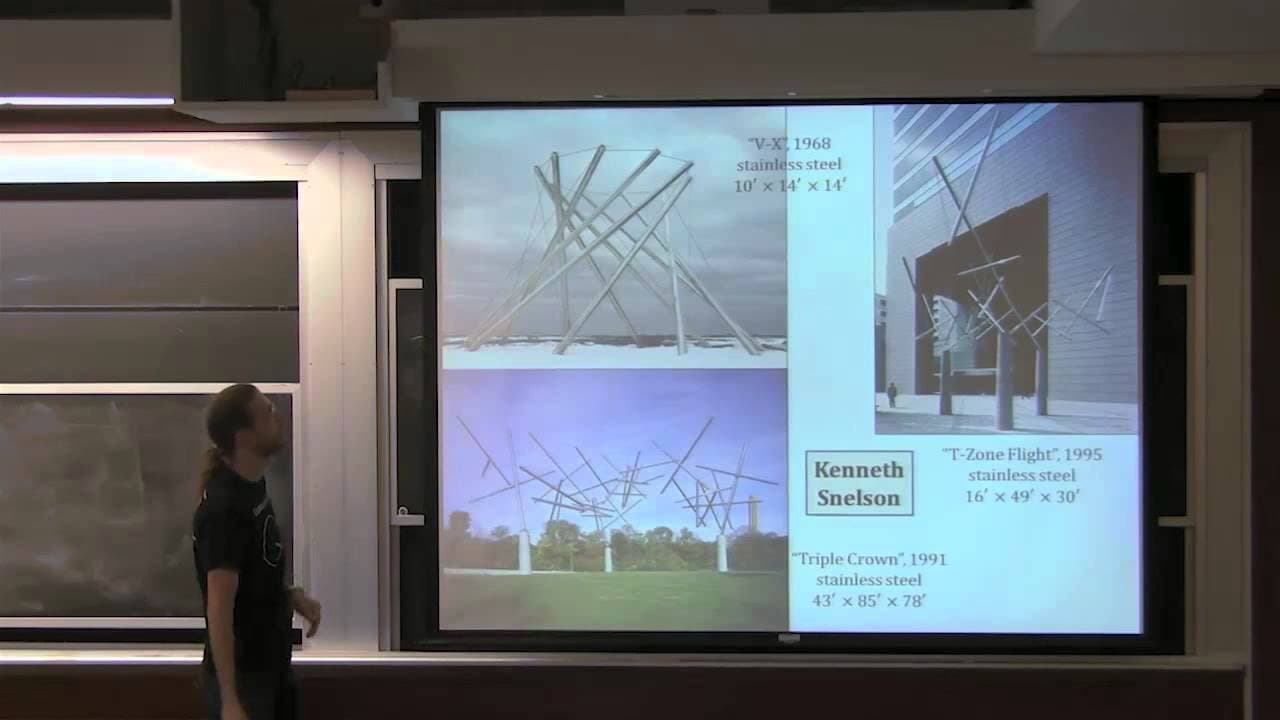
- 💦 Kenneth Snelson is a renowned artist known for his work with tensegrity sculptures.
- 🏗️ There are various construction methods and resources available for building tensegrities, including using household objects like straws or rubber bands.
Install to Summarize YouTube Videos and Get Transcripts
Explore YouTube Video Summarizer or Get YouTube Transcript Extractor
Questions & Answers
Q: How can infinitesimal rigidity in tensegrities be explained intuitively?
Infinitesimal rigidity in tensegrities can be understood as the relative motion of one vertex with respect to another, which should be perpendicular to the edge connecting them. This perpendicular motion preserves the length of the edge and ensures stability.
Q: Why are springs often used to represent bars in tensegrity structures?
Springs are commonly used to represent bars in tensegrity structures because they have a natural resting length and can restore their original length when stretched or compressed. This allows for intuitive understanding and easy visualization of the forces within the structure.
Q: Can equilibrium stresses in tensegrities be observed through simulation?
While not explicitly shown in the lecture, it is possible to simulate and observe the wobbling or fluctuations of equilibrium stresses in tensegrities by applying external forces and allowing the structure to restore its constraints. This can be achieved using computational tools, such as the Freeform Tensegrity software mentioned in the lecture.
Q: How can one determine if a tensegrity structure is rigid?
The rigidity of a tensegrity structure can be determined by solving a linear programming problem. If the problem is unbounded, meaning there is a non-zero equilibrium stress, then the structure is rigid. Conversely, if the problem has only the trivial solution (0,0,0), the structure is not rigid.
Summary & Key Takeaways
-
Tensegrities are structures composed of struts and cables that rely on the balance between tension and compression for stability.
-
Infinitesimal rigidity is a property of tensegrities that ensures their stability under small deformations.
-
The dot product condition is one way to determine if a tensegrity is rigid, with the goal of preserving the lengths of the struts and cables to the first order.
Read in Other Languages (beta)
Share This Summary 📚
Summarize YouTube Videos and Get Video Transcripts with 1-Click
Try YouTube Summary with ChatGPT & Claude or YouTube Transcript Generator
Explore More Summaries from MIT OpenCourseWare 📚


Summarize YouTube Videos and Get Video Transcripts with 1-Click
Try YouTube Summary with ChatGPT & Claude or YouTube Transcript Generator