8.3.11 Radiation Therapy - Video 6: The Analytics Edge
TL;DR
Optimization models improve efficiency and effectiveness of radiation therapy, allowing for personalized treatments and better patient outcomes.
Transcript
Radiation therapy is one of the most well used applications of optimization in health care. In practice, radiation machines are connected to treatment planning software that implements and solves optimization models. Both linear optimization models, like we saw here, and other types of optimization models. Some examples of radiation machines that u... Read More
Key Insights
- 😒 Radiation therapy extensively uses optimization models to improve efficiency and effectiveness.
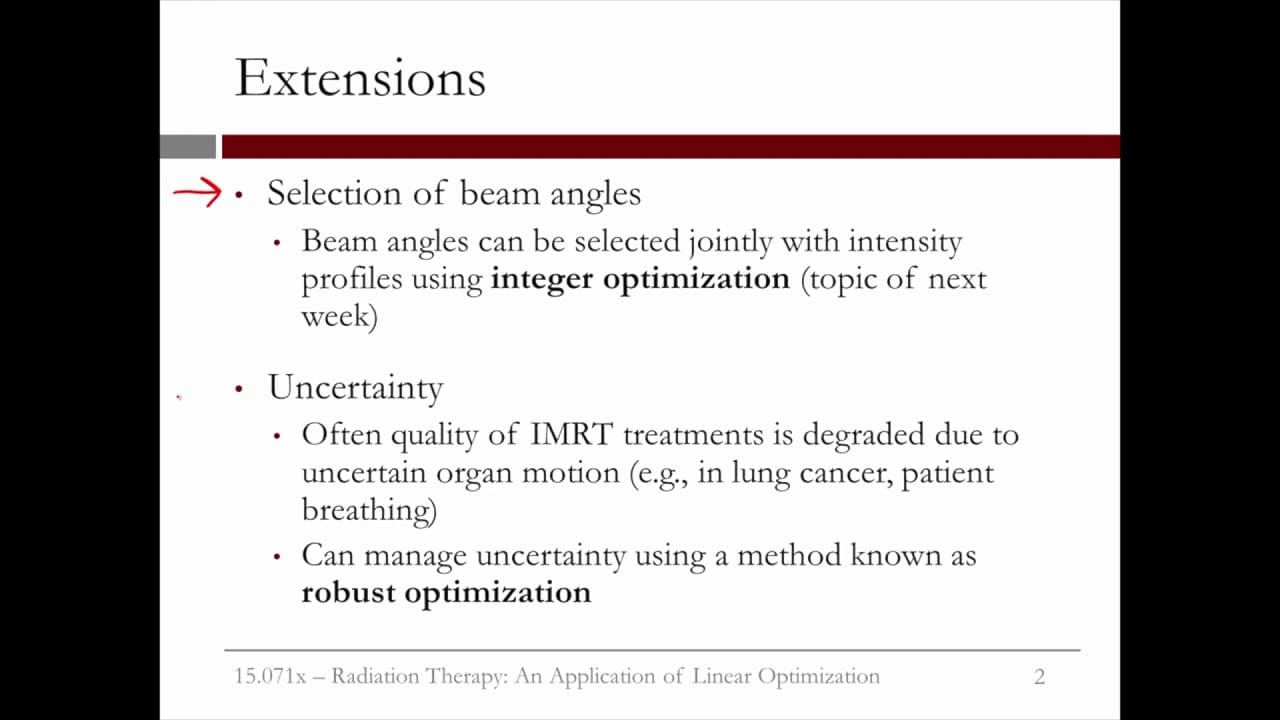
- 😁 Optimization allows for personalized treatments by selecting beam angles and intensity profiles.
- ❓ Uncertainties in radiation therapy can be managed using robust optimization methods.
- ❓ Linear optimization significantly improves the efficiency of radiation therapy.
- ❓ Optimization benefits patients by improving treatment quality and reducing side effects.
- 🤕 Optimized IMRT treatments have specific benefits for head and neck, prostate, and lung cancers.
- ❓ Treatment planning software, such as Pinnacle, RayStation, and Eclipse, implement and solve optimization models.
Install to Summarize YouTube Videos and Get Transcripts
Explore YouTube Video Summarizer or Get YouTube Transcript Extractor
Questions & Answers
Q: How are radiation machines connected to optimization software?
Radiation machines are connected to treatment planning software that implements and solves optimization models, such as linear optimization, to improve the planning and delivery of radiation therapy.
Q: What are some examples of radiation machines that use optimization software?
Some examples of radiation machines that use optimization software are Pinnacle by Philips, RayStation by RaySearch Labs, and Eclipse by Varian. These software systems help in designing optimized IMRT treatment plans.
Q: How does optimization allow for personalized treatments in radiation therapy?
Optimization allows for personalized treatments by selecting beam angles and intensity profiles using integer optimization. This enables the treatment to be tailored to the specific tumor and patient, improving the effectiveness of radiation therapy.
Q: How does optimization account for uncertainty in radiation therapy?
Optimization in radiation therapy can account for uncertainty, such as organ motion, using a method known as robust optimization. This helps manage the uncertainty and ensure that the treatment plan is robust and effective even in the presence of uncertainties.
Q: What are some benefits of optimized IMRT treatments?
Optimized IMRT treatments offer several benefits, such as sparing saliva glands in head and neck cancers, reducing toxicities in prostate cancer, and reducing the risk of radiation-induced pneumonitis in lung cancer. These improvements contribute to better patient outcomes and quality of life.
Summary & Key Takeaways
-
Radiation therapy uses optimization models, like linear optimization, connected to treatment planning software to improve the efficiency and effectiveness of treatments.
-
Optimization allows for personalized treatments by selecting beam angles and accounting for uncertainty, improving the quality of life for patients.
-
Optimization in radiation therapy has benefits such as sparing saliva glands in head and neck cancers, reducing toxicities in prostate cancer, and reducing the risk of radiation-induced pneumonitis in lung cancer.
Read in Other Languages (beta)
Share This Summary 📚
Summarize YouTube Videos and Get Video Transcripts with 1-Click
Try YouTube Summary with ChatGPT & Claude or YouTube Transcript Generator
Explore More Summaries from MIT OpenCourseWare 📚



Summarize YouTube Videos and Get Video Transcripts with 1-Click
Try YouTube Summary with ChatGPT & Claude or YouTube Transcript Generator