19.2 Rocket Problem 2 - Momentum Diagrams
TL;DR
The content discusses how to analyze the motion of a rocket by applying the momentum principle and considering changes in mass and velocity.
Transcript
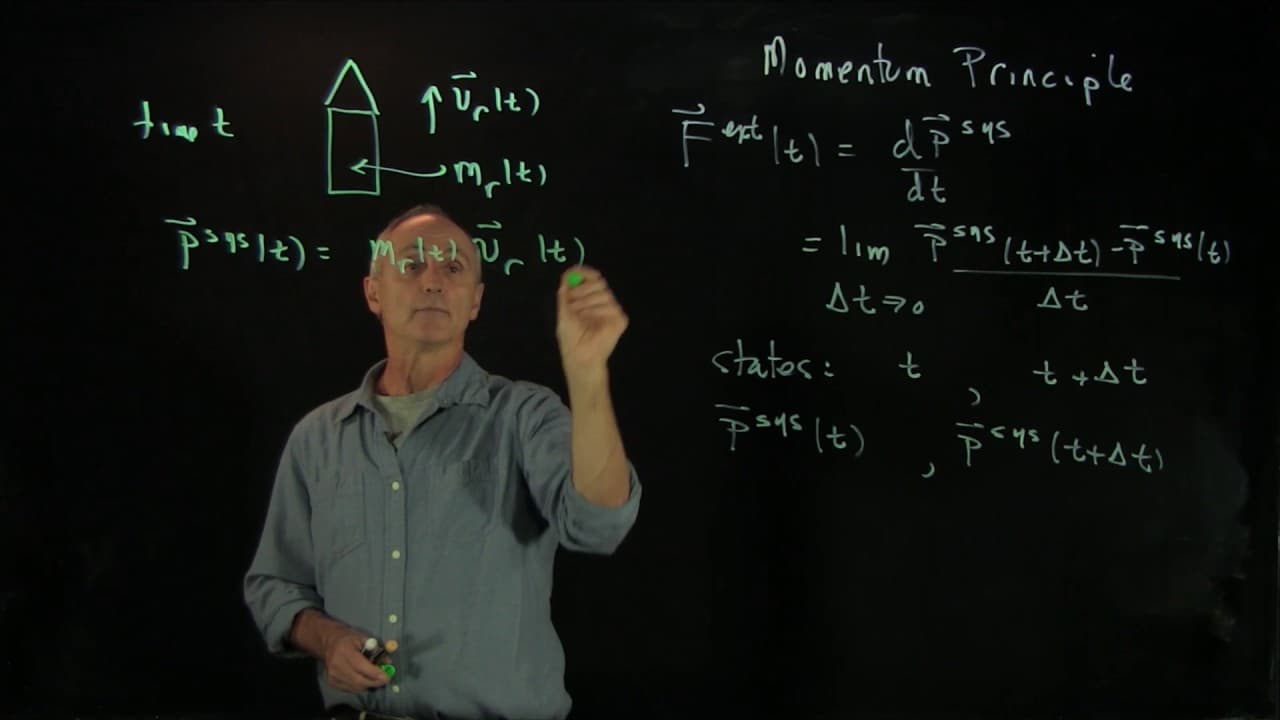
We would now like to apply the momentum principle to analyze the motion of the rocket. So what is our momentum principle? We know that the external force at time t is equal to the rate of change of the momentum of the system over t. Now, recall we're going to actually use the formal definition of a derivative to write this as a limit as delta t goe... Read More
Key Insights
- 💱 The momentum principle is a fundamental concept in physics that relates external forces to changes in the momentum of a system.
- 💆 Analyzing the motion of a rocket involves separate analyses of the momentum at different states, considering changes in mass and velocity.
- 💆 Changes in mass, specifically fuel ejection, affect the rocket's momentum and must be taken into account.
- 🛝 Velocity plays a crucial role in the momentum analysis, including the rocket's velocity at different states and the velocity of the ejected fuel relative to the ground frame.
- 😑 Mass conservation equations and relative velocity conditions can help simplify the expressions involved in the momentum analysis.
- 🧑🏭 The momentum analysis provides valuable insights into the forces acting upon the rocket and its overall motion.
- 👻 Considering changes in mass and velocity allows for a more accurate analysis of the rocket's motion.
Install to Summarize YouTube Videos and Get Transcripts
Explore YouTube Video Summarizer or Get YouTube Transcript Extractor
Questions & Answers
Q: What is the momentum principle and how is it used to analyze rocket motion?
The momentum principle states that the external force at a given time is equal to the rate of change of the system's momentum. To analyze rocket motion, we separate the analysis into two states (time t and time t + delta t) and calculate the momentum at each state.
Q: How is the rocket's mass and velocity taken into account in the momentum analysis?
The rocket's mass and velocity play a crucial role in the momentum analysis. The momentum at time t is determined by multiplying the mass of the rocket at time t by its velocity. At time t + delta t, the analysis includes changes in mass (due to fuel ejection) and utilizes the velocity of the rocket and the ejected fuel relative to the ground frame.
Q: What is the significance of considering changes in mass when analyzing the rocket's motion?
Changes in mass, specifically the ejection of fuel, have an impact on the rocket's momentum. By accounting for changes in mass, we can accurately calculate the system's momentum at different states, which provides insights into the rocket's motion and the forces acting upon it.
Q: How do changes in velocity and relative velocity affect the momentum analysis of the rocket?
Changes in velocity, including the rocket's velocity at different states and the velocity of the ejected fuel relative to the ground frame, are important parameters in the momentum analysis. By considering these velocities, we can accurately calculate the momentum at each state and understand the motion of the rocket.
Summary & Key Takeaways
-
The momentum principle states that the external force at a given time is equal to the rate of change of the system's momentum.
-
To analyze the rocket's motion, separate analyses of the system's momentum at two different states (time t and time t + delta t) are conducted.
-
The momentum at time t is determined by multiplying the mass of the rocket at time t by its velocity, while the momentum at time t + delta t takes into account changes in mass and includes the velocity of the ejected fuel.
Read in Other Languages (beta)
Share This Summary 📚
Summarize YouTube Videos and Get Video Transcripts with 1-Click
Try YouTube Summary with ChatGPT & Claude or YouTube Transcript Generator
Explore More Summaries from MIT OpenCourseWare 📚



Summarize YouTube Videos and Get Video Transcripts with 1-Click
Try YouTube Summary with ChatGPT & Claude or YouTube Transcript Generator