What Is a Self-Excited Generator and How Does It Work?
TL;DR
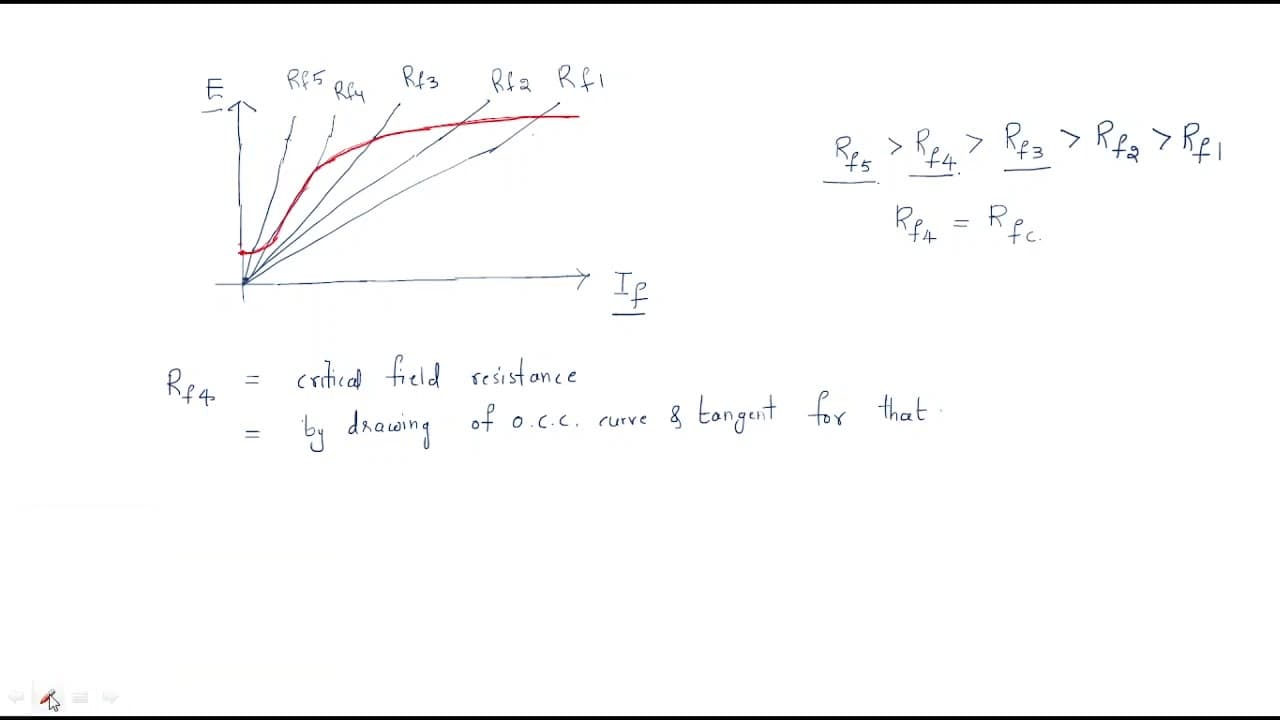
A self-excited generator generates electromotive force (EMF) using residual flux even when the field current is zero. It has a critical field resistance; if resistance exceeds this limit, EMF generation stops. Similarly, a specific critical speed must be maintained below which the generator cannot produce any EMF.
Transcript
hello everyone in this session we will discuss the next topic is so up to now we discussed about the self excited machines in the previous case but in the self excited machines we don't know how the emf will be generated so for the purpose we are discussing about this self excited generator so the title is build up of voltage in self excited genera... Read More
Key Insights
- 🤳 The initial EMF generation in self-excited generators relies on residual flux, a crucial concept for understanding their operation.
- 🏑 The relationship between field current and generated EMF is linear, inversely affected by changes in field resistance.
- 🏑 Critical field resistance is the threshold above which the generator cannot produce EMF, emphasizing the importance of maintaining optimal resistance levels.
- 🐎 Critical speed is defined as the lowest operational speed necessary for meaningful EMF generation, indicating the generator's performance limitations.
- 🏑 Varying field resistance directly impacts the EMF output, which can be graphically represented, underscoring the dynamic behavior of the generator.
- ✊ Self-excited generators exemplify the interplay between electrical principles and mechanical design in generating stable electrical power.
- 🏑 Understanding how to manipulate field current through resistance variations can enhance generator efficacy and reliability.
Install to Summarize YouTube Videos and Get Transcripts
Explore YouTube Video Summarizer or Get YouTube Transcript Extractor
Questions & Answers
Q: What is the role of residual flux in self-excited generators?
Residual flux is crucial as it allows the generator to produce an initial EMF even when the field current is zero. This residual flux is typically 5 to 10 percent of the rated flux and is due to the retentivity property of the materials involved. Without this initial flux, no EMF would be generated, preventing the operation of the self-excited generator.
Q: What happens when the field resistance exceeds the critical field resistance?
When the field resistance exceeds the critical field resistance, the generated EMF drops to zero. This situation arises because high resistance leads to low field current, which is essential for induction of EMF. Understanding this threshold is vital for maintaining effective generator operation.
Q: How does the speed of the self-excited generator affect EMF generation?
The speed of the generator is directly tied to its ability to generate EMF. If the generator operates below a certain critical speed, it will not produce any EMF, reflecting its dependency on speed alongside field current. Therefore, maintaining a proper operational speed is essential for performance.
Q: What is the formula for calculating the generated EMF in a self-excited generator?
The generated EMF in a self-excited generator can be calculated using the formula EMF = (p * φ * n * z) / (60 * a), where p is the number of poles, φ is the flux, n is the speed, z is the number of conductors, and a is the number of parallel paths. This relationship highlights the importance of both flux and speed in EMF generation.
Summary & Key Takeaways
-
This content discusses the principles behind generating electromotive force (EMF) in self-excited generators, focusing on the significance of residual flux when the field current is zero.
-
Critical field resistance is key; if the field resistance exceeds this limit, the EMF generated becomes zero, indicating the importance of balance between field current and resistance.
-
The critical speed also plays a crucial role in EMF generation; below a specific speed, the generator fails to develop any EMF, necessitating optimal operational conditions.
Read in Other Languages (beta)
Share This Summary 📚
Summarize YouTube Videos and Get Video Transcripts with 1-Click
Try YouTube Summary with ChatGPT & Claude or YouTube Transcript Generator