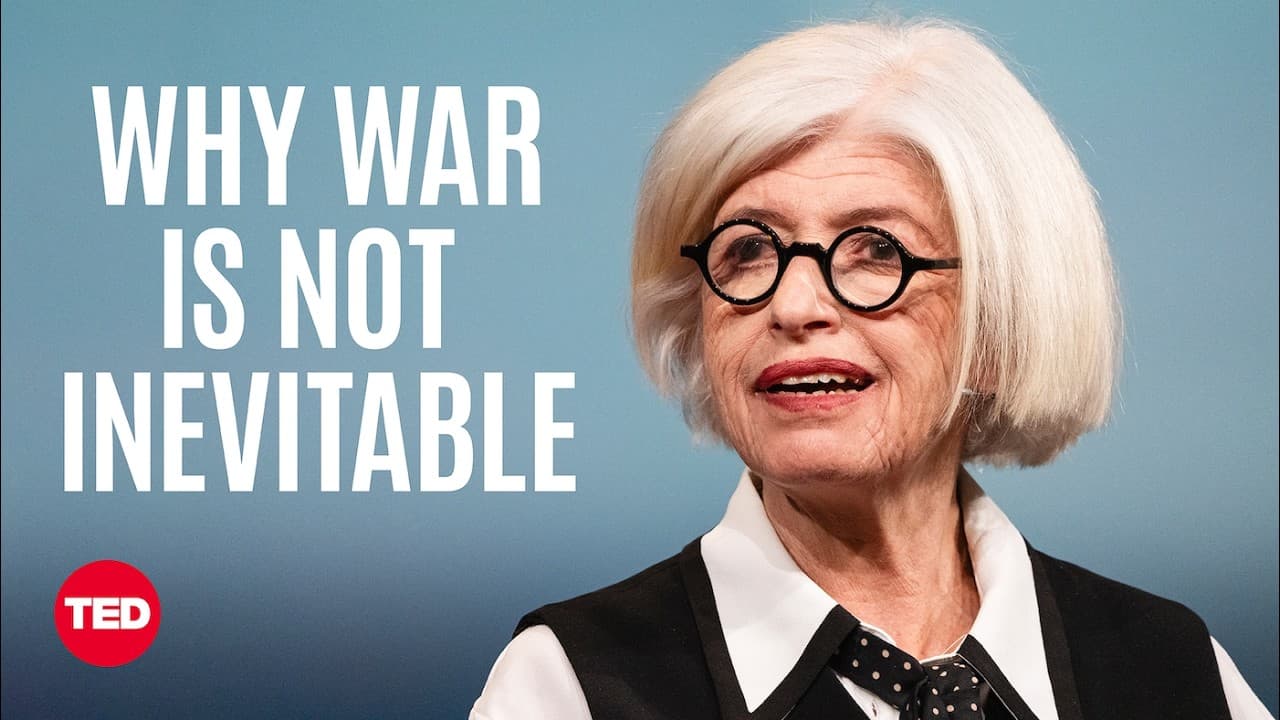
How to Prevent — or Stop — a War | Gabrielle Rifkind | TED
TL;DR
War is a human rights abuse; alternatives to armed conflict exist.
Transcript
I have worked in international conflict resolution for the past two decades. I am not a pacifist, but in the end, war is the greatest human rights abuse and does not make the world safer. We think we go to war for good moral reasons. We're fighting for good to triumph over evil. Instead, we unleash a cascade of chaos and misery. In the 21st century... Read More
Key Insights
- 🫱 War is often framed as a moral imperative, but it generally leads to significant human rights violations and instability.
- 🫚 Many recent conflicts did not address the root causes of tensions, emphasizing a need for a different approach to conflict resolution.
- 🤗 Engaging with adversaries and facilitating open dialogue can lead to more sustainable peace agreements and conflict resolution.
- ❓ The concept of a two-state solution and normalization processes illustrates the complex interplay of regional politics that must be navigated carefully.
- 🫱 A proactive approach to conflict resolution requires early intervention strategies before hostilities escalate to war.
- ❓ Shifting perceptions of enemies and allies can foster a culture of mediation and cooperation rather than militarism.
- 🌍 The empowerment of international organizations like the UN is critical for effective and sustained conflict resolution initiatives.
Install to Summarize YouTube Videos and Get Transcripts
Explore YouTube Video Summarizer or Get YouTube Transcript Extractor
Questions & Answers
Q: What are the main consequences of recent wars led by the United States and its allies?
The speaker outlines devastating outcomes from the wars in Afghanistan, Iraq, Libya, and against the Islamic State. For instance, despite initial military victories, Iraq descended into civil war, while Afghanistan saw the Taliban regain power post-U.S. withdrawal. In Libya, chaos subsequently spread throughout the Sahel. These situations illustrate how military interventions can fail to bring about lasting peace or security.
Q: What role does the speaker believe communication plays in conflict resolution?
The speaker emphasizes that communication is crucial, especially with those deemed adversaries. Historical examples, like the engagement with the IRA and FARC, show that talking to opponents can lead to peace. Ignoring dialogue with key figures, such as President Assad or potential mediators like Marwan Barghouti, can result in prolonged suffering and heightened tensions.
Q: What strategies are recommended to prevent future wars or manage existing conflicts?
To prevent conflict, the speaker suggests addressing the security concerns of all involved parties, not solely one’s own interests. This includes establishing back channels for diplomacy, engaging with adversaries early on, and creating a dedicated UN framework for ongoing mediation efforts. These strategies aim to foster understanding and cooperation.
Q: How does the speaker propose empowering the UN in conflict prevention?
The speaker suggests enhancing the UN’s role in early mediation by appointing war prevention teams in at-risk regions. This would involve statutory measures to engage warring parties when tensions are high and to maintain ongoing dialogues post-conflict. By institutionalizing these efforts, the UN could help resolve conflicts before they escalate into war.
Summary & Key Takeaways
-
The speaker argues that war, despite being framed as a necessity for good over evil, often results in chaos and human suffering, illustrating the failures of recent conflicts like Afghanistan, Iraq, and Libya.
-
Emphasizing the need for proactive conflict resolution, the speaker advocates for engaging with all parties, including adversaries, to address underlying grievances and security concerns that lead to war.
-
Proposing the strengthening of the UN and early mediation processes, the speaker calls for a shift in approach from military intervention to diplomatic engagement, highlighting the importance of understanding diverse perspectives to prevent future conflicts.
Read in Other Languages (beta)
Share This Summary 📚
Summarize YouTube Videos and Get Video Transcripts with 1-Click
Try YouTube Summary with ChatGPT & Claude or YouTube Transcript Generator
Explore More Summaries from TED 📚

Summarize YouTube Videos and Get Video Transcripts with 1-Click
Try YouTube Summary with ChatGPT & Claude or YouTube Transcript Generator